267
7
Syllogisms in Ordinary
Language
7.1 Syllogistic Arguments
7.2 Reducing the Number of Terms to Three
7.3 Translating Categorical Propositions into Standard Form
7.4 Uniform Translation
7.5 Enthymemes
7.6 Sorites
7.7 Disjunctive and Hypothetical Syllogisms
7.8 The Dilemma
7.1 Syllogistic Arguments
In ordinary discourse the arguments we encounter rarely appear as neatly
packaged, standard-form categorical syllogisms. So the syllogistic arguments
that arise in everyday speech cannot always be readily tested. They can be
tested, however, if we put them into standard form—and we can generally do
that by reformulating their constituent propositions. The term syllogistic ar-
gument refers to any argument that either is a standard-form categorical syl-
logism or that can be reformulated as a standard-form categorical syllogism
without any loss or change of meaning.
We want to test the validity of syllogistic arguments. If they are fallacious
or misleading, that will be most easily detected, as Immanuel Kant pointed
out, when they are set out in correct syllogistic form. The process of reformu-
lation is therefore important because the effective tests discussed in Chapter 6—
Venn diagrams and the rules for categorical syllogisms—cannot be applied
directly until the syllogism is in standard form. Putting it into standard form is
called reduction (or translation) to standard form. When we reformulate (or
reduce) a loosely put argument that appears in ordinary language into a clas-
sical syllogism, the resulting argument is called a standard-form translation
of the original argument. Effecting this reformulation can present some
difficulties.
M07_COPI1396_13_SE_C07.QXD 10/16/07 9:18 PM Page 267
We already know the tests for validity (Venn diagrams and the rules for
syllogisms). What we need, to evaluate syllogistic arguments using these tests,
are techniques for translating syllogistic arguments from their loose forms into
standard form. With these techniques in hand, we can first translate the argu-
ment into standard form, and then test that argument using the Venn diagram
method or the syllogistic rules.
To describe the various techniques for reduction to standard form, we
begin by noting the kinds of problems that create the need for them—that is,
by noting different ways in which a syllogistic argument in ordinary language
may deviate from a standard-form categorical argument. Understanding those
deviations, we can proceed to counteract them.
First deviation. The premises and conclusion of an argument in ordinary
language may appear in an order that is not the order of the standard-form syl-
logism. This difficulty is easily remedied by reordering the premises: The
major premise is put first, the minor premise second, and the conclusion third.
(Recall that the major premise is the premise that contains the term that is the
predicate term of the conclusion, whereas the minor premise contains the term
that is the subject term of the conclusion.)
Second deviation. A standard-form categorical syllogism always has exactly
three terms. The premises of an argument in ordinary language may appear to
involve more than three terms—but that appearance may be deceptive. If the
number of terms can be reduced to three without loss of meaning, the reduc-
tion to standard form may be successful.
Third deviation. The component propositions of the syllogistic argument in ordi-
nary language may not all be standard-form propositions. This deviation is very com-
mon, but if the components can be converted into standard-form propositions
without loss of meaning, the reduction to standard form may be successful.
To cope with the second and third of these deviant patterns, there are
known techniques, which we now explain.
7.2 Reducing the Number of Terms to Three
A valid syllogism must have exactly three terms. If more than three terms
seem to be involved in an argument of apparently syllogistic form, it may be
possible to translate the argument into a standard-form categorical syllogism
that is equivalent to it but that contains only three terms and is perfectly valid.
How can that be done?
One way is by eliminating synonyms. A synonym of one of the terms in the
syllogism is not really a fourth term, but only another way of referring to one
of the three classes involved. So we begin by eliminating synonyms, if any
268 CHAPTER 7 Syllogisms in Ordinary Language
M07_COPI1396_13_SE_C07.QXD 10/16/07 9:18 PM Page 268
7.2 Reducing the Number of Terms to Three 269
appear. For example, the following syllogistic argument appears to contain six
terms:
No wealthy persons are vagrants.
All lawyers are rich people.
Therefore no attorneys are tramps.
However, “wealthy” and “rich” are synonyms, as are “lawyer” and “attor-
ney,” and also “vagrant” and “tramp.” If the synonyms are eliminated, the ar-
gument becomes
No wealthy persons are vagrants.
All lawyers are wealthy persons.
Therefore no lawyers are vagrants.
This argument in standard form, EAE–1 (Celarent), is plainly valid.
A second way to reduce the number of terms to three is by eliminating class
complements, a concept explained in Section 5.6. We illustrate this using the fol-
lowing syllogistic argument, whose propositions are standard-form categori-
cal propositions:
All mammals are warm-blooded animals.
No lizards are warm-blooded animals.
Therefore all lizards are nonmammals.
On the surface, this argument appears to be invalid, because it seems to have
four terms—and it also draws an affirmative conclusion from a negative
premise, which breaks one of the rules of the syllogism.
This argument, however, is in fact perfectly valid when it is translated into
standard form. We can reduce the number of terms to three, because two of
the terms in it (“mammals” and “nonmammals”) are complements of one an-
other. So, by obverting the conclusion (to obvert a proposition, we change its
quality and replace the predicate term by its complement), we get “No lizards
are mammals.” Using this valid immediate inference, we derive the following
standard-form translation of the original argument:
All mammals are warm-blooded animals.
No lizards are warm-blooded animals.
Therefore no lizards are mammals.
which is logically equivalent to the original because it has identically the same
premises and a logically equivalent conclusion. This standard-form transla-
tion conforms to all the syllogistic rules and thus is known to be valid. Its form
is AEE–2 (Camestres).
M07_COPI1396_13_SE_C07.QXD 10/16/07 9:18 PM Page 269
There may be more than one translation of a syllogistic argument into
standard form, but if any one of those translations yields a valid syllogism, all
the others must be valid as well. Thus, for example, the preceding illustrative
argument can also be reduced to standard form in a different (but logically
equivalent) way. This time we leave the conclusion unchanged and work with
the premises. We take the contrapositive of the first premise, and we obvert
the second premise. We then get:
All non(warm-blooded animals) are nonmammals.
All lizards are non(warm-blooded animals).
Therefore all lizards are nonmammals.
This is also a valid translation; its form is AAA–1 (Barbara), and it conforms to
all the rules of the syllogism.
Any syllogistic argument that appears to contain four terms can be re-
duced to standard form (that is, can be translated into a logically equivalent
standard-form categorical syllogism) if one of its terms is the complement of
one of the other three. Likewise, reduction from an argument with five terms
is possible if two of its terms are complements of other terms in the argument;
and even arguments with as many as six terms may be reduced to standard
form if three of those terms are complements of other terms in the argument.
The key to such reductions is to use the valid immediate inferences discussed
in Chapter 5: conversion, obversion, and contraposition.
More than one immediate inference may be needed to reduce the argu-
ment to standard form. Consider this example:
No nonresidents are citizens.
All noncitizens are nonvoters.
Therefore all voters are residents.
The argument has six terms, but it is in fact valid, and that can be shown by re-
ducing it to standard form, which can be done in more than one way. Perhaps
the most natural reduction is to convert and then obvert the first premise. This
yields “All citizens are residents.” Then take the contrapositive of the second
premise, which yields “All voters are citizens.” The argument is then in stan-
dard form:
All citizens are residents.
All voters are citizens.
Therefore all voters are residents.
The middle term (“citizens”) is the subject term of the major premise and the
predicate term of the minor premise, so the syllogism is in the first figure. Its
270 CHAPTER 7 Syllogisms in Ordinary Language
M07_COPI1396_13_SE_C07.QXD 10/16/07 9:18 PM Page 270
7.2 Reducing the Number of Terms to Three 271
three propositions are universal affirmatives. This is a syllogism in Barbara,
AAA–1, and it is plainly valid.
EXERCISES
Translate the following syllogistic arguments into standard form, and test
their validity by using either Venn diagrams or the syllogistic rules set forth
in Chapter 6.
EXAMPLE
1. Some preachers are persons of unfailing vigor. No preachers are non-
intellectuals. Therefore some intellectuals are persons of unfailing
vigor.
SOLUTION
This argument may be translated into: Some preachers are persons of
unfailing vigor. (Some Pis V.) All preachers are intellectuals. (By
obversion: All Pis I.) Therefore some intellectuals are persons of
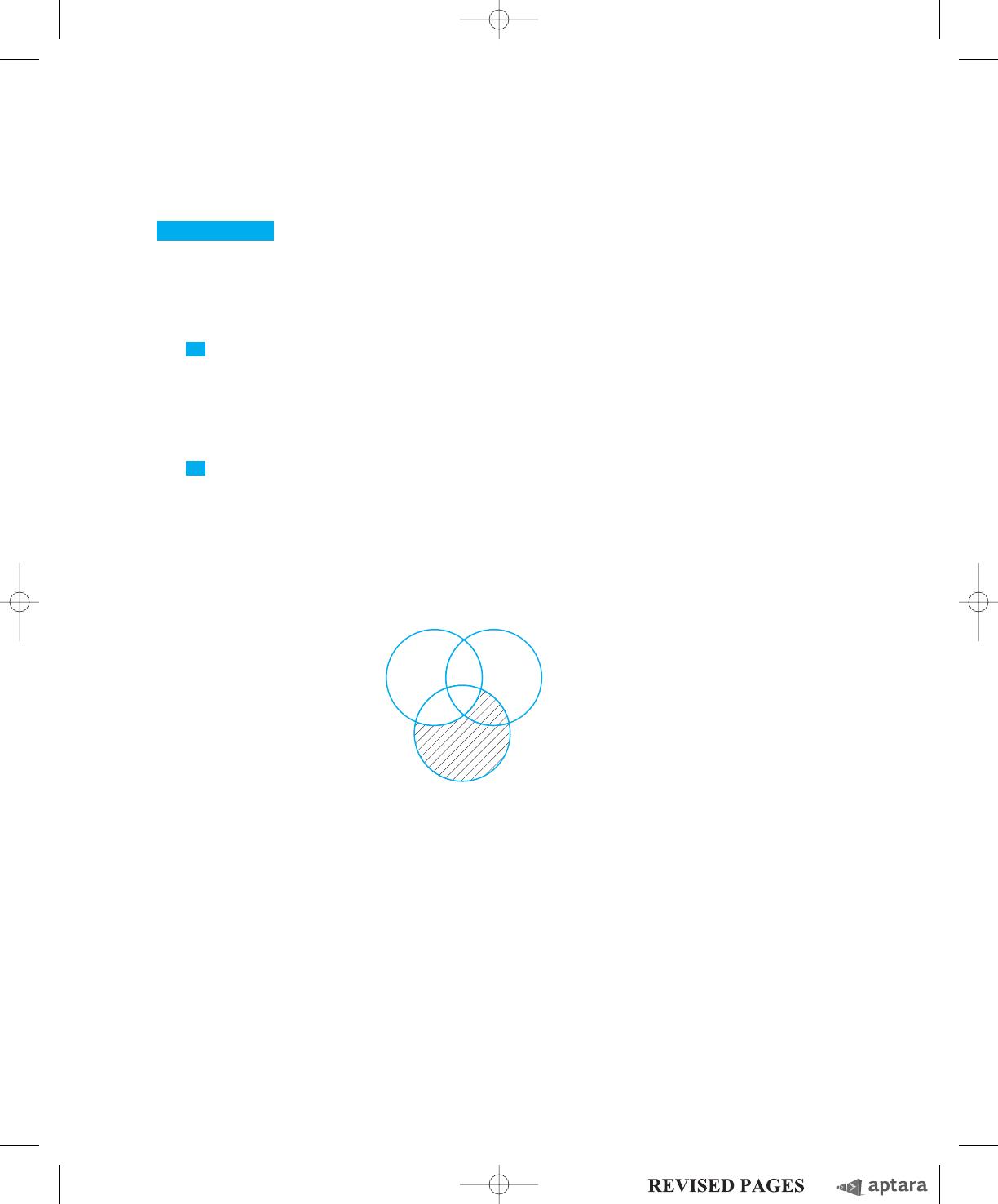
unfailing vigor. (Some Iis V.) Shown on a Venn diagram, this
syllogism is seen to be valid:
2. Some metals are rare and costly substances, but no welder’s materials
are nonmetals; hence some welder’s materials are rare and costly
substances.
3. Some Asian nations were nonbelligerents, because all belligerents
were allies either of Germany or Britain, and some Asian nations were
not allies of either Germany or Britain.
4. Some nondrinkers are athletes, because no drinkers are persons in per-
fect physical condition, and some people in perfect physical condition
are not nonathletes.
*5. All things inflammable are unsafe things, so all things that are safe are
nonexplosives, because all explosives are flammable things.
P
VI
x
M07_COPI1396_13_SE_C07.QXD 10/16/07 9:18 PM Page 271
6. All worldly goods are changeable things, for no worldly goods are
things immaterial, and no material things are unchangeable things.
7. All those who are neither members nor guests of members are those
who are excluded; therefore no nonconformists are either members or
guests of members, for all those who are included are conformists.
8. All mortals are imperfect beings, and no humans are immortals,
whence it follows that all perfect beings are nonhumans.
9. All things present are nonirritants; therefore no irritants are invisible
objects, because all visible objects are absent things.
*10. All useful things are objects no more than six feet long, because all dif-
ficult things to store are useless things, and no objects over six feet
long are easy things to store.
7.3 Translating Categorical Propositions
into Standard Form
We noted in Section 7.1 that syllogistic arguments in ordinary language may
deviate from standard-form categorical syllogisms not only because they may
appear to contain more than three terms (as discussed in Section 7.2), but also
because the component propositions of the syllogism in ordinary language may
not all be standard-form propositions. A, E, I, and Opropositions are clearly
somewhat stilted, and many syllogistic arguments in everyday life contain non-
standard-form propositions. To reduce these arguments to standard form re-
quires that their constituent propositions be translated into standard form.
It would be very convenient if there were some neat list of rules that we
could use to effect such translations. Unfortunately, ordinary language is too
rich and too multiform to permit the compilation of such a set of rules.
Different sorts of transformation are called for in different settings, and to
know what is called for we must, in every case, understand fully the given non-
standard-form proposition that needs to be reformulated. If we understand the
proposition, we can reformulate it without losing or changing its meaning.
Although no complete set of rules can be given, we can describe a num-
ber of well-tested methods for translating nonstandard propositions of differ-
ent sorts. These methods—we will present nine of them in this section—must
be regarded as guides rather than rules; they are techniques with which
nonstandard-form propositions of certain describable kinds can be reformulated
into standard-form propositions that may serve as constituents of syllogistic
arguments.
272 CHAPTER 7 Syllogisms in Ordinary Language
M07_COPI1396_13_SE_C07.QXD 10/16/07 9:18 PM Page 272
7.3 Translating Categorical Propositions into Standard Form 273
I. Singular Propositions. Some propositions affirm or deny that a specific
individual or object belongs to a given class—for example, “Socrates is a
philosopher,” and “This table is not an antique.” These are called
singular propositions. Such propositions do not affirm or deny the in-
clusion of one class in another (as standard-form propositions do), but
we can nevertheless interpret a singular proposition as a proposition deal-
ing with classes and their interrelations. We do this in the following way.
To every individual object there corresponds a unique unit class
(one-membered class) whose only member is that object itself. Then, to
assert that an object sbelongs to a class Pis logically equivalent to as-
serting that the unit class Scontaining just that object sis wholly included
in the class P. And to assert that an object sdoes not belong to a class Pis
logically equivalent to asserting that the unit class Scontaining just that
object sis wholly excluded from the class P.
It is customary to make this interpretation automatically, without
any notational adjustment. Thus it is customary to take any affirma-
tive singular proposition of the form “sis P” as if it were already ex-
pressed as the logically equivalent Aproposition, “All Sis P,” and we
similarly understand any negative singular proposition “sis not P” as
M07_COPI1396_13_SE_C07.QXD 10/16/07 9:18 PM Page 273