1
PERSONAL HEALTH
PHS 1514 Fall 2017
Virginia Polytechnic Institute and State University
College of Population Health Sciences
SYLLABUS AND COURSE INSTRUCTIONS
INSTRUCTOR: Amy H. Smith, PhD, CHES (Professor Smith)
Contact: asmith@vt.edu. All communication with Professor Smith is by email.
TEXTBOOK
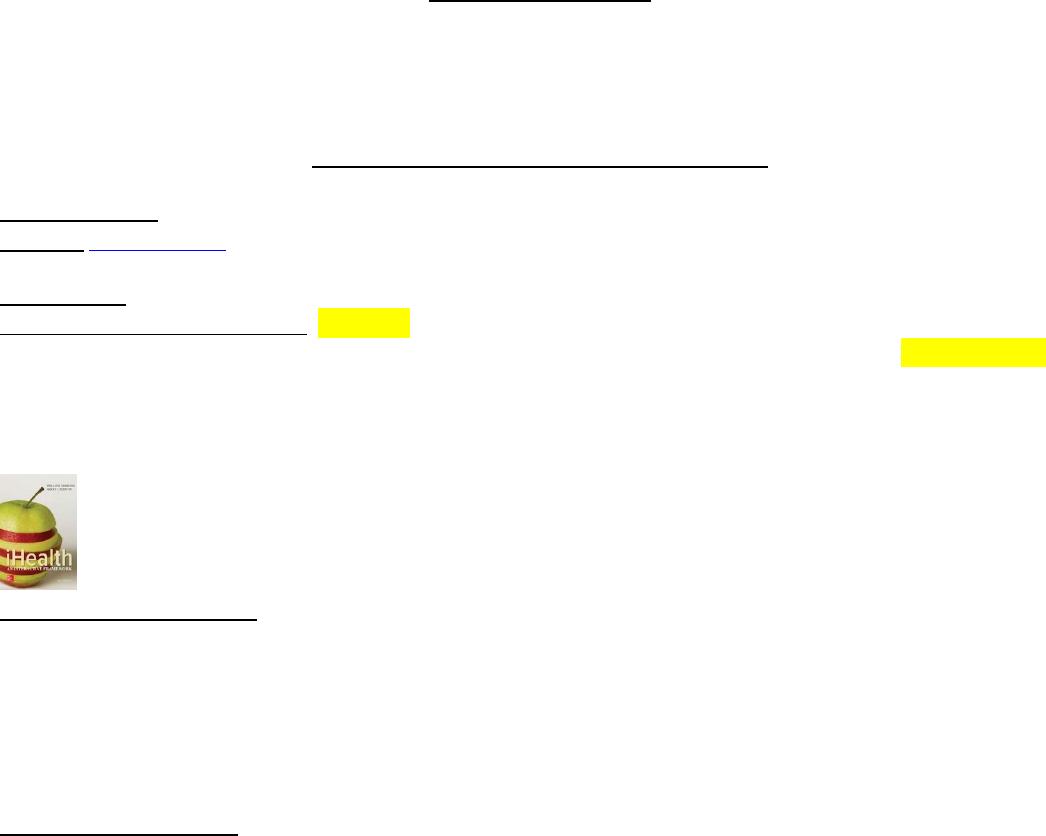
iHealth: An Interactive Framework, 3rd edition, Sparling & Redican. McGraw Hill. A hard copy with a Connect access
code may be purchased from the VT bookstore. The ISBN for the hard copy discounted for VT is 9781259932410.
This access code will also give you access to the Smart Book. OR, you may use the SmartBook only version when you
register with Connect on-line (No hard copy). This is a bundle for Virginia Tech and should not be purchased by a third
party seller such as Amazon. Used books will not have the proper access code. Additional Instructions for registration
with Connect are below.
COURSE DESCRIPTION
This on-line course is designed to provide students with health information based on scientific principles that will enable
him/her to make sound decisions regarding his/her health throughout life. The major emphasis is wellness and the
importance of individual responsibility for health related matters through health promotion efforts. Selected major
content topics include: mental health, drug abuse, consumer health, communicable diseases, chronic diseases, nutrition,
human sexuality, environmental health, aging, death and dying. Each content area listed above will be examined in an
overview manner.
COURSE OBJECTIVES
After completion of the course the student should be able to:
1. Develop a mechanism for making sound decisions about health-related matters.
2. Analyze individual health behaviors (lifestyles) and make efforts to correct negative ones.
3. Apply health promotion concepts to his/her lifestyle including nutrition, exercise and substance use/abuse.
4. Identify appropriate ways to use the healthcare delivery system including Western and Complementary
Medicine.
5. Discuss why the individual must take responsibility for his/her health.
6. Identify the criteria for sound mental health including ways to reduce and manage stress.
7. Discuss what is meant by wellness, holistic health, primary/secondary/tertiary prevention, and prospective
medicine.
8. Describe the differences (physical, mental, and social effects) between the major drug categories.
9. Describe the physiology of Alcohol and other drugs, and discuss issues involving Alcohol including binge drinking,
DUIs and Fake IDs.
10. Describe the infectious disease process for bacterial, viral, and fungal infections and sexually transmitted
diseases (STD).
11. Discuss the pathogenesis of such diseases as AIDS, Toxic Shock Syndrome, NSU, and Herpes infections.
12. Discuss the etiology and epidemiology of heart disease, stroke, diabetes and cancer.
13. Identify and discuss key environmental health problems and issues.
14. Discuss the physiology of human reproduction and contraception as well as respectful sexual behavior and
healthy relationships.
HONOR SYSTEM POLICIES
All students are bound to the VPI & SU Honor System which is outlined in the current University Policies for Student
Life manual.
SSD Accommodations
Any student who feels that he or she may need an accommodation because of a disability (learning disability, attention
deficit disorder, psychological, physical, etc.), please contact me via email as soon as possible along with a copy of your
SSD letter. Please notify the professor of any SSD accommodations in the first week of the term.
STUDENT RESPONSIBILITY
This is an on-line class that requires students to:
1. Work independently and be self-motivated.
2. Take timed quizzes and tests which require reading and understanding all material in the text book.
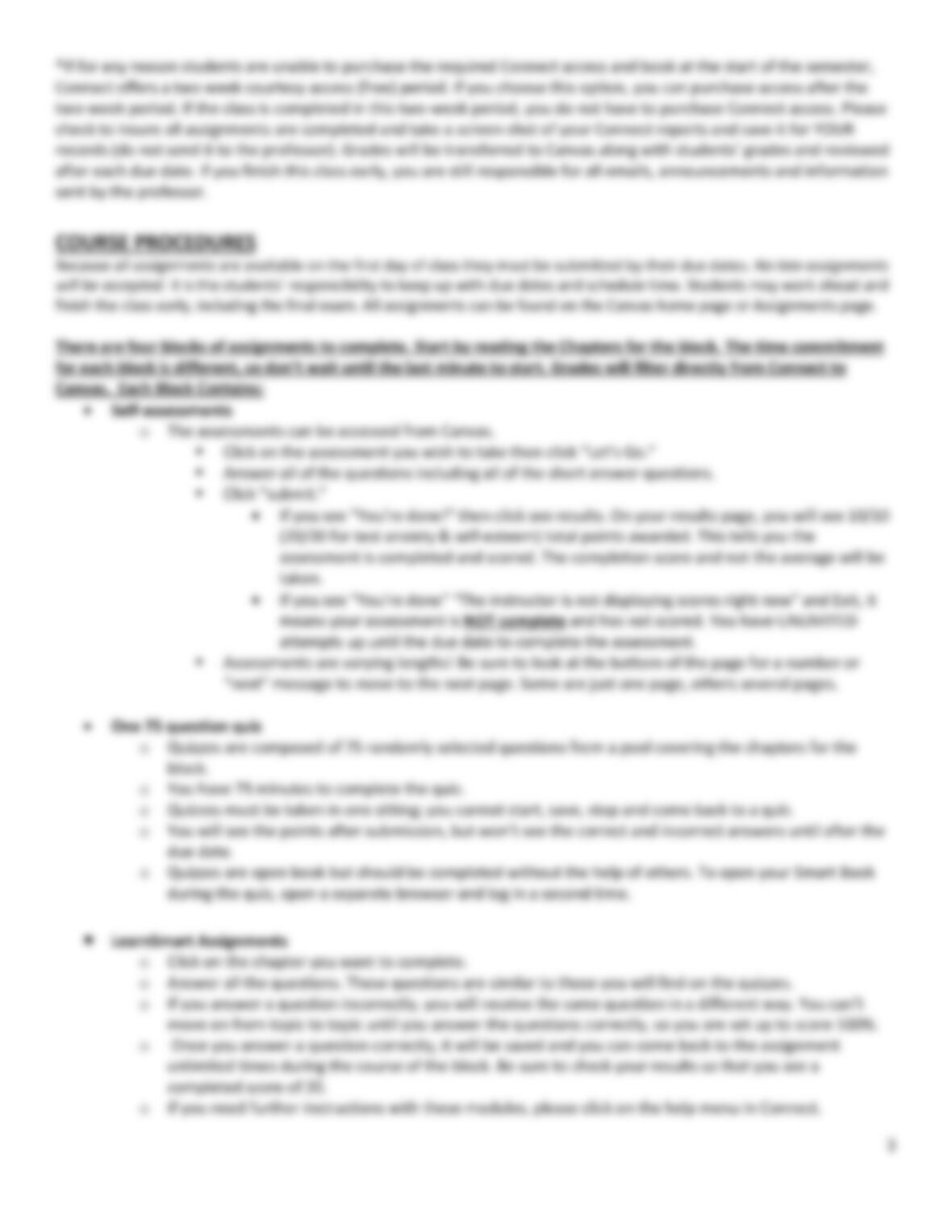
3. Meet all deadlines for assignments. No late assignments are accepted. *
4. Check VT email daily for important class announcements and reminders.
5. Have access to a working, reliable computer that meets the requirements of Connect, and a reliable internet
connection. (If in question, call Text support). Google Chrome or Firefox are preferred browsers.
6. Call the technical support number for Connect when experiencing technical difficulties: 1-800-331-5094.
* Students traveling in a different time zone or out of the country should be mindful of the due dates and