Keep this syllabus for reference throughout the semester.
801 North Capitol Street, NE ⚫ Washington, DC 20002 ⚫ (202) 274-5800
FINITE MATHEMATICS (MATH 116C)
Semester and Year: Spring 2020 Class Location: 610
Course Title: Finite Mathematics Course Number and Section: Math 116c
CRN: 20424 Credit Hours: 3
Prerequisite(s): Intermediate Algebra
Meeting Time: Mon. & Wed. 2:00 – 3:20 p.m.
Instructor: Nicholas Brown Faculty Office: 614
Office Phone: 202-274-5928 Email Address:nicholas.brown@udc.edu
Office Hours:
Mon. 1:00 – 2:00 p.m., 3:30 – 4:00 p.m.
Tues. 3:30 – 4:00 p.m., 5:30 – 6:30 p.m.
Wed. 1:00 – 2:00 p.m., 3:30 – 4:00 p.m.
Thurs. 3:30 – 4:00 p.m.
**If you send an email and do not get a response within 24 hours, please resend. Please include your
name and course info in the email subject line.
COURSE DESCRIPTON
This course with pre-calculus topics in the general categories of finite mathematics, beginning
with a review of basic algebra and linear equations, and proceeding through functions, in particular
logarithmic and exponential functions, in order to prepare the student for calculus. In concludes with a
study of systems of linear equations , matrices and linear programming. Throughout the course,
special attention is paid to practical business applications.
Prerequisites: Successful completion of Intermediate Algebra (Math 105).
COURSE RATIONALE
This course will satisfy the math requirement Business majors for the AS degrees.
COURSE GOALS
This course will help students develop math skills needed to solve everyday business problems, manage
Business activities, or start a small business. In addition, the course lays a foundation in understanding
The basic principles of mathematics as used in business decision making, a foundation upon which the
interested student may base further study.
LEARNING OBJECTIVES
The purpose of this course is to provide the serious student of business and economics with a foundation in
calculus, which will serve in the study of business and economics, both of which are heavily dependent
upon mathematical theory and modeling.
The topics of the course will cover:

2
Keep this syllabus for reference throughout the semester.
• Functions, Graphs, Transformations
• Linear Functions, Straight Lines
• Quadratic Functions
• Polynomial, Rational, Exponential, and Logarithmic Functions
• Mathematics of Finance
• Systems of Linear Equations; Matrices
• Linear Inequalities and Linear Programming
COURSE OUTCOMES
This course is intended to satisfy the general studies mathematics requirement for a baccalaureate degree.
It is also designed to serve as a prerequisite for future study in mathematics, such as calculus for business
and nonphysical sciences and mathematics for elementary school teachers, and for future study in other
disciplines. The course is designed to help students develop problem-solving skills.
Successful students will be able to:
• read and understand an applied problem;
• select an appropriate strategy on techniques (graphical, analytic or numerical) relative to the
problem; and
• perform appropriate operations to solve problems.
MEASURABLE STUDENT OBJECTIVES:
Upon completion of the course the student will be able to:
• Define a function, and determine whether a given relation is a function.
• Graph linear functions and quadratic functions in the Cartesian coordinate system.
• Graph transformations of a library of elementary functions.
• Solve a system of linear equations graphically, using Gauss Jordan elimination, and by
Cramer’s rule.
• Perform matrix arithmetic, find the inverse of a given invertible matrix and solve a
system of linear equations using matrices.
• Solve simple linear programming problems (theoretical and applied) using the geometric
approach and the simplex method as applied to maximization problems, minimization
problems, and the dual problem.
• Define and graph polynomial functions using various techniques for graphing functions.
• Define and graph rational, exponential and logarithmic functions.
• Define concepts and solve problems (theoretical and applied) pertaining to functions.
• Solve finance problems involving simple and compound interest; future value and present
value of annuities.
• Graph a system of inequalities.
REQUIRED TEXT
Barnett, R., Ziegler, M., Byleen, K. (2015) College Mathematics for Business, Economics, Life
Sciences and Social Sciences,13th Edition. Upper Saddle River, New Jersey: Pearson, Inc.
MATERIALS
Scientific calculator, ruler, notebook with paper, graph paper, color pencils, pencils
INSTRUCTIONAL STRATEGIES
This course will be conducted via lectures and discussions based on the text and supplemental
materials, and individual assignments. Group discussions and assignments are designed to
enhance collaborative learning and exercise the techniques and considerations presented in the
course. Student comprehension of course content will be assessed through examinations,
individual assignments, homework, quizzes and active participation in class discussions.
Although the course will be a classroom offering, there will be opportunities for the students to
interact with each other and the instructor via discussions or the Chat feature in classroom as
well as online. The students are also free to personally contact the instructor by phone at any
time, by email or by submitting a question to the professor.
Classroom sessions will consist of class lecture, discussion, readings, the assigning of homework
and projects, exams, assignments, and other possible items by students and the instructor.
Specific instructions for each week will be found in the scheduled Weeks Sections. There will
be required readings, homework assignments, quizzes, exams, assignments and discussion
boards.
The Instructor believes in “Learning by Doing,” so there will be assignments that allow the
students to practice and learn by completing projects related to the course material. As
appropriate, the instructor will post hints that should provide help to the students in completing
the assignments. There also will be postings of example problems for the students to download,
examine, and possibly use as templates in completing their assignments.
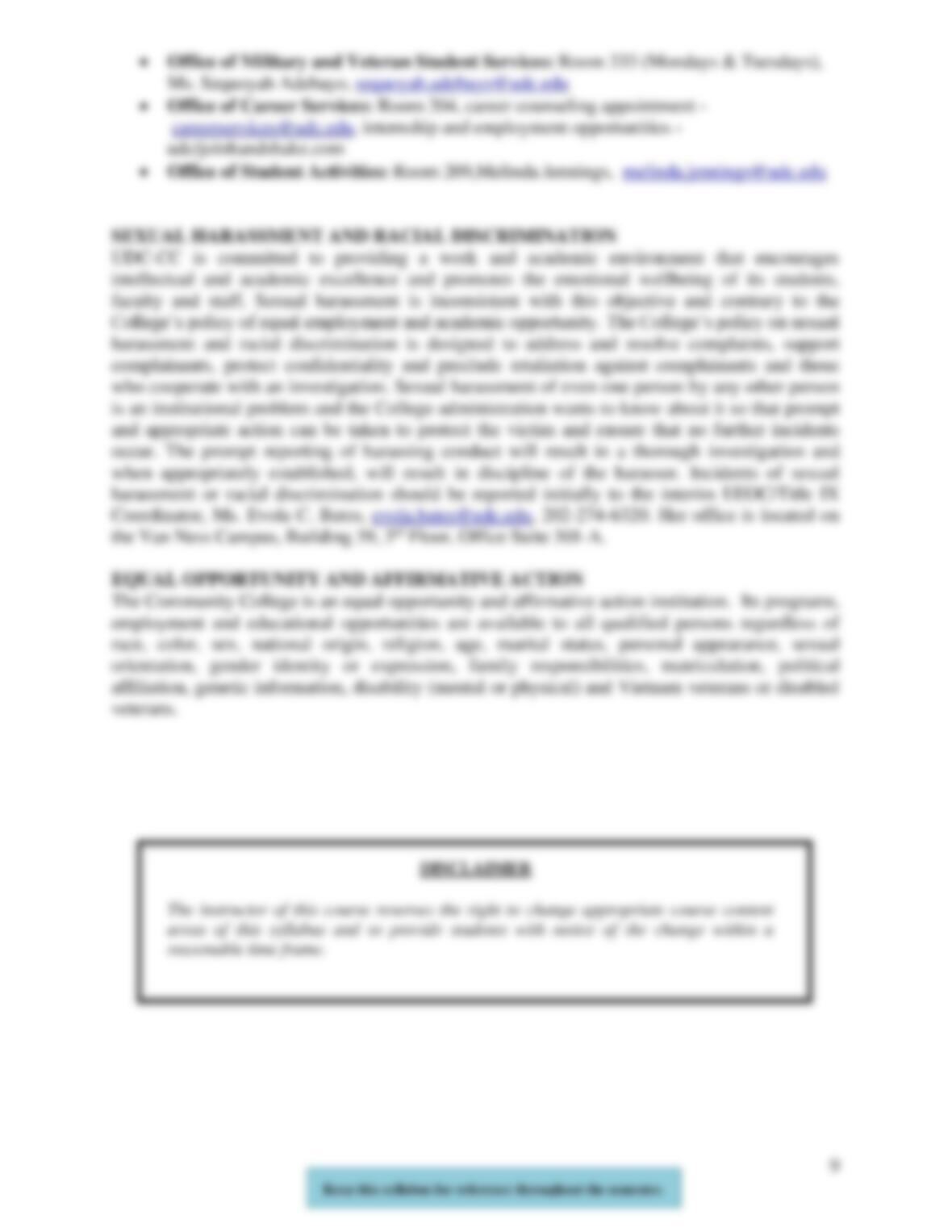
Grading Criteria, Guidelines, Expectations and Weights: The approximate percentage that
each type of evaluation instrument will count toward the final grade is:
Evaluation for final grade Percentages(%)