Ari Warokka, PhD, MSc, MCEUE, MDEM, DEA Page 1
MASTER OF MANAGEMENT PROGRAM
FACULTY OF ECONOMICS
STATE UNIVERSITY OF JAKARTA
_________________________________________________________________________
COURSE CODE: MKK 609/629
COURSE NAME: INTERNATIONAL FINANCIAL MANAGEMENT
PREREQUISITE: MKF 600 (FINANCIAL MANAGEMENT)
___________________________________________________________________________
LECTURER: ARI WAROKKA, PhD, MSc, MCEUE, MDEM, DEA
PHONE: Office: +62 21 478 60 485 Mobile: +62 81 2269 1791
EMAIL: ari.warokka@gmail.com
OFFICE ROOM: MM UNJ, IDB Building I, Lt. 9, Kampus A, UNJ
1.0 SYPNOSIS
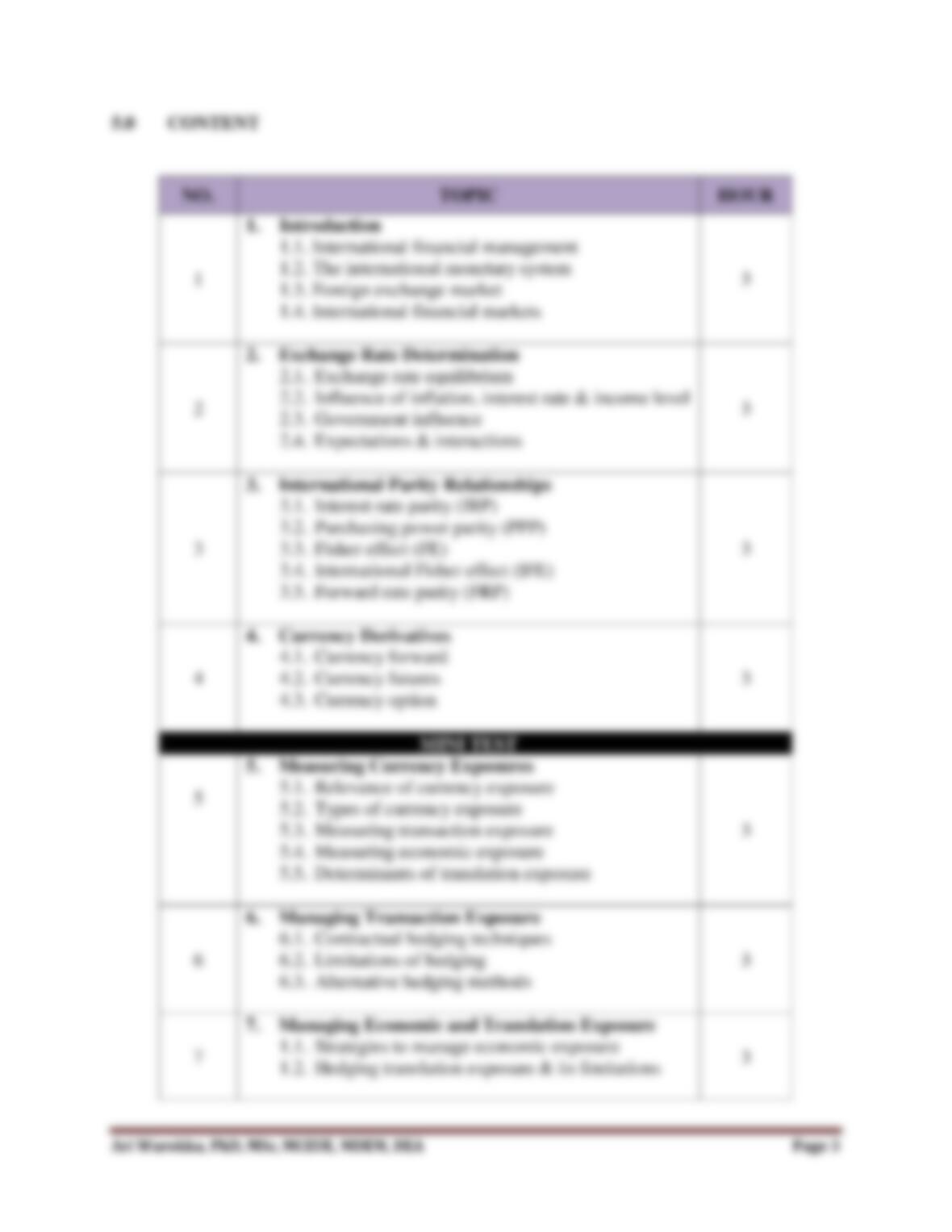
The course provides a brief overview of the international financial management function. Then,
it explores the international financial environment that includes, among others, the international
monetary system, the foreign exchange market, as well as the currency futures and option
markets. The course also discusses the factors that determine exchange rate changes, including
the underpinning theories (international parity relationships). Following these, the course
emphasizes the management of foreign exchange risks. Finally, it focuses on the key components
of multinational corporate finance, more specifically, cost of capital, capital structure, capital
budgeting, and working capital management. The course ends with a discussion on international
trade finance.
2.0 OBJECTIVES
Upon completion of the course, students are expected to
2.1 comprehend the various international financial markets; theories that underpin,
and factors that influence, exchange rates; issues in financing international trade;
as well as the various international financial management tasks.
2.2 appreciate the types of foreign exchange risks faced by a business; and the
techniques and strategies that can be used to manage those risks.
2.3 value the complexities for a multinational company in making decisions related to
the cost of capital and capital structure, capital budgeting, as well as working
capital.
3.0 LEARNING OUTCOMES
Upon completion of the course, students will be able to
3.1 explain international financial management, features of the foreign exchange
market and other international financial markets, characteristics of currency
derivatives, and the types of foreign exchange risks, issues and strategies in
international trade finance.
3.2 illustrate how relevant factors influence exchange rates, and relevant theories help
explain exchange rates.
3.3 analyse problems of locational arbitrage, covered interest arbitrage, speculation
with currency derivatives, hedging or managing foreign exchange risks.