Sustainable purchasing and supply
management: a structured literature review of
definitions and measures at the dyad, chain and
network levels
Joe Miemczyk and Thomas E. Johnsen
Audencia Nantes School of Management – PRES LUNAM, Nantes, France, and
Monica Macquet
ESC Rennes – School of Management, Rennes, France
Abstract
Purpose – This paper provides a structured literature review of sustainability in purchasing and supply management, moving beyond the traditional
environmental and social sustainability. The paper reviews the concept of sustainability at three levels of inter-organizational analysis – i.e. dyad,
supply chain and network. The paper distils the nature and scope of existing research and synthesizes measures used to research sustainability across
organizational boundaries.
Design/methodology/approach – This literature review systematically analyzes existing literature. In particular, the review focuses on definitions
and measures of sustainable purchasing and supply management to obtain an accurate view of current research.
Findings – This paper uncovers two distinct trends in the type of research carried out. First, internal or dyadic issues are in focus and second, a
tendency to deal with environmental, as opposed to social, sustainability. Despite the need to look beyond the dyad given the risks associated with the
extended network, few studies do so in any of the sustainability dimensions.
Research limitations/implications – This review is limited by the method employed focusing on definitions and measures. Although the review
considers supply chain and network research, it does so purely from a purchasing perspective, thus excluding issues such as logistics and transport.
Practical implications – The paper identifies areas open to future research and provides practical insights into how sustainable purchasing and
supply are measured. It also synthesizes existing measures of sustainability at different levels and organizes these into a taxonomy.
Originality/value – The paper examines studies across multiple levels of analysis and integrates multiple fields of knowledge to show how research
on sustainability in purchasing and supply is structured.
Keywords Sustainability, Ethical, Environmental, Purchasing, Sourcing, Supply chain, Network, Stakeholders, Supply chain management, Research
Paper type Research paper
1. Introduction
A company is no more sustainable than the suppliers from
which it sources (Krause et al., 2009). This puts purchasing
and supply management in a central position on the road to
achieving sustainability. However, fully understanding a
company’s sustainability profile requires a view of not only
the company’s direct suppliers but also its extended supply
chain or even the wider network in which it operates. A
growing amount of research on sustainability concerns
purchasing and supply management, such as ethical
sourcing (Preuss, 2009; Roberts, 2003), corporate social
responsibility in the supply chain (Faisal, 2010; Maloni and
Brown, 2006), socially responsible buying (Maignan et al.,
2002; Park and Stoel, 2005) and green supply chains
(Kainuma and Tawara, 2006; Mollenkopf et al., 2010).
While significant progress has been made in these areas, it is
important to make further advances and consolidate systemic
issues that exist at the interface of sustainability and
purchasing and supply (Linton et al., 2007).
One difficulty with studying sustainability in this field is the
problem of levels of analysis. Authors often describe their
research as addressing supply chains when, in fact, the level of
analysis is restricted, for example, to an internal or dyadic
buyer or supplier perspective. In adopting a purchasing and
supply management perspective, this paper seeks to identify
those sustainability issues that have been researched that
primarily concern purchasing and supply management and,
simultaneously, the different levels of analysis. A second
significant concern in studying sustainability in purchasing
The current issue and full text archive of this journal is available at
www.emeraldinsight.com/1359-8546.htm
Supply Chain Management: An International Journal
17/5 (2012) 478–496
qEmerald Group Publishing Limited [ISSN 1359-8546]
[DOI 10.1108/13598541211258564]
Received 21 April 2011
Revised 11 August 2011
16 December 2011
10 February 2012
Accepted 12 February 2012
This project was partially funded by the French agency ADEME under
PREDIT 4 GO4 (AAP No. 1) – Projet FUSION CO2.
478

and supply is the topic focus. Previous reviews have identified
a typical division in research in this area between
environmental and social issues (Seuring and Muller, 2008;
Srivastava, 2007). However, a general view of sustainability
research in this area reveals that many studies have adopted
an environmental, or green, perspective. These studies
concentrate on issues of buying green inputs, or managing
waste and pollution (Holt and Ghobadian, 2009; Hong et al.,
2009; Zhu and Sarkis, 2007; Zhu et al., 2005a). Relatively few
studies have explicitly adopted a social sustainability
viewpoint (Besser et al., 2006; Handfield and Baumer,
2006; Worthington et al., 2008).
This paper provides a comprehensive, critical review of
sustainable purchasing and supply research to date. While
there have been a number of reviews in this area, our focus is
on how sustainability is operationalized from a research
perspective. Therefore, the analysis is directed towards how
sustainable purchasing and supply are defined and how
sustainability is measured in this field. First, definitions of
sustainability at the dyad, chain and network levels of analysis
are offered. This includes an analysis of the social and
environmental aspects of sustainability that can be identified
at the different levels. Second, a synthesis of the principal
measures used to gauge the degree of sustainability at these
different levels of analysis is provided. These measures
include those used in empirical and conceptual frameworks as
well as those typically used in practitioner models. In sum, we
ask: what are the definitions and measures used to describe
sustainability at different levels of inter-organizational analysis
in the area of purchasing and supply management?
When examining the supply chain and network literature,
our interest is in purchasing (in its broad sense) rather than
logistics or other supply chain management practices. Hence,
the scope of this study is limited to the activities associated
with purchasing (or procurement or sourcing), such as the
purchasing process, supplier selection and supplier
development. The study does not include activities related
to transportation (such as vehicle routing), management of
inventory (except where suppliers are concerned), reverse
logistics or closed-loop systems for waste recovery unless
there is a link to purchasing and supply activities.
The paper is organized as follows. The first section explains
the logic of considering three levels of analysis in sustainable
purchasing and supply management. The second section
outlines the methodology employed in the literature review.
The third, fourth and fifth sections report the findings from
the literature review, with each section focusing on one level
of analysis. The final section presents the conclusions from
the literature review and outlines implications and limitations.
1.1 Three levels of analysis in sustainable purchasing
and supply management
Drawing on existing classifications of levels of analysis in the
management of supply chains (Croom et al., 2000; Harland,
1996; Mo¨ller et al., 2005; Ritter and Gemu
¨nden, 2003), we
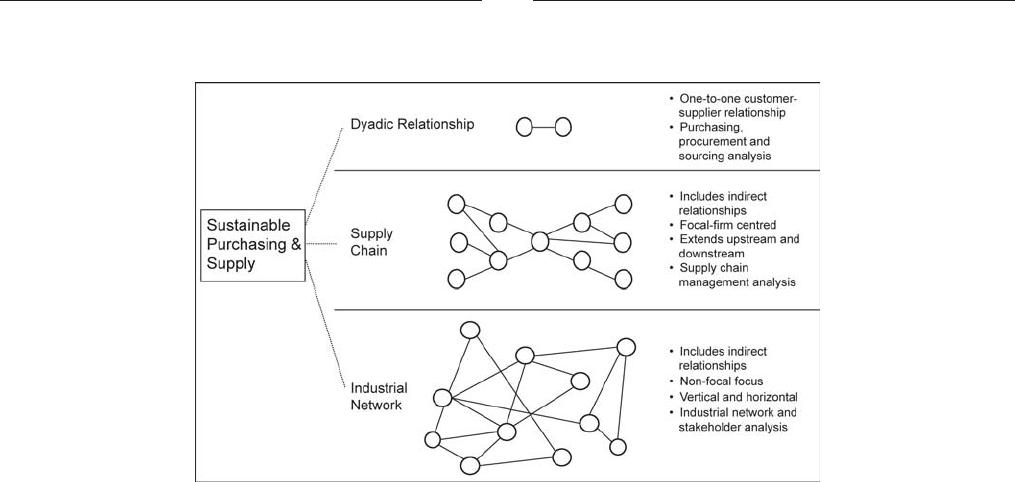
distinguish between three levels of sustainability analysis
pertinent to purchasing and supply management: dyadic
relationships, supply chains and industrial networks
(Figure 1). Although various levels of inter-organizational
analysis have been suggested, this simple classification makes
it possible to clearly differentiate among the levels.
Dyads refer to relationships between two actors. In the
purchasing and supply context, we focus on the company-
direct supplier dyad. As companies seek to implement
sustainability in their supply chains, their first natural step is
to focus on direct supplier relationships. Purchasing and
supply activities within dyads involve both discrete one-off
exchanges (transactions) and long-term, relationship-
development issues, such as the adaptation of business
processes to suit other parties and the institutionalization of
business practices (Ha
˚kansson, 1982). Purchasing,
procurement and sourcing decisions typically concern
internal buying processes that relate primarily to direct
suppliers, i.e. dyadic relationships, including specification,
supplier selection, contracting, ordering, expediting and
evaluation (see, for example, Van Weele, 2010).
Definitions of purchasing, procurement and sourcing vary
in scope and the extent to which these functions extend to
indirect suppliers is not always clear. Procurement and
sourcing are often defined as more inclusive, or strategic, than
purchasing – for example, procurement may be defined as
including the make-or-buy decision (Murray, 2009, p. 199) –
but this is not always the case. Furthermore, the use of the
terms is often industry specific, e.g. the public sector often
uses the term “procurement” instead of “purchasing” (see
Ramsay and Croom, 2008; Rozemeijer, 2008; for a debate on
this issue). Furthermore, the role of purchasing in relation to
supply chain management varies; “unionists” view purchasing
as part of supply chain management, while others believe that
supply chain management has replaced purchasing (Larson
and Halldorsson, 2002). For practical reasons, we group
purchasing, procurement and sourcing together.
Sustainability problems are likely to stem from indirect
supplier relationships that are part of the extended supply
chain. Supply chain management focuses on multiple
customer-supplier dyads, with the supply chain ultimately
spanning from original raw material extractors to final end
customers (Harland, 1996). Supply chains tend to be
depicted around a focal firm and its upstream and
downstream relationships (Christopher, 1998; Lambert et al.,
1998), although there has been some debate as to whether
supply chains are simple linear structures – chains – or more
like “supply chain networks” (or “supply networks”) that
include inter-connected supply chains (see, e.g. Lamming
et al., 2000; Lockamy, 2008). The consensus seems to be that
supply chains should be understood as the latter.
Thus, some authors have argued that sustainability needs to
be understood from an even higher level of analysis; this level
is typically referred to as network or stakeholder analysis. In
this regard we draw from the theoretical perspective of the
Industrial Marketing and Purchasing (IMP) group
(Ha
˚kansson, 1982), which has developed concepts and
constructs for the study of industrial networks over the last
30 years. It seems pertinent to study sustainability at a
network level – as Roome (2001, p. 70) aptly states, “we
increasingly see ourselves as part of a network society living in
a network age”, “concerns about complex environmental and
social consequences of industrial activity have provoked the
need for more frequent and meaningful engagement between
companies and stakeholders”, “networks have an identified
role in innovation for environmental management and
sustainable development” and “knowledge suggests that
ecosystems are based on organisms connected through
complex networks of energy and material flows”. It is
therefore important to identify the extent to which literature
on sustainability has embraced this level of analysis.
Sustainable purchasing and supply management
Joe Miemczyk, Thomas E. Johnsen and Monica Macquet
Supply Chain Management: An International Journal
Volume 17 · Number 5 · 2012 · 478–496
479
In the sustainability literature, an increasing number of
studies analyze and discuss sustainability from a purchasing
and supply chain management perspective. However, the
issue of the level of analysis seems to be all too often ignored
or taken for granted. Studies that claim to adopt a supply
chain focus on sustainability may do so purely from a dyadic
perspective. The first main objective of this study, therefore, is
to: analyze existing research on sustainable purchasing and
supply management at the dyad, chain and network levels,
with a focus on the definitions that are used.
The second main objective of this study is to understand
how sustainable purchasing and supply are operationalized
from a research perspective. Although sustainability is still
rather immature in its development as a research field in
purchasing and supply, a number of empirical works have
attempted to show the state of implementation in
organizations. A review of the current research provides an
opportunity to discuss gaps and opportunities for further
research. An examination of the measures used (the actual
questions asked of organizations by researchers) can give a
good indication of the subject matters covered. However,
there appears to be little standardization in these questions
and subjects, making comparison problematic and creating an
opportunity for consolidation and categorization. It is also
important to know how sustainability is integrated into
purchasing and supply activities. Therefore, we aim to
delineate those types of measures that are used in different
purchasing and supply processes (such as supplier selection or
development). From this, our second objective is to: identify
and categorize the measures used in existing studies of the
main purchasing processes.
Given our first objective of understanding the levels of
analysis of sustainable purchasing and supply research, and
our second objective of identifying and categorizing measures,
there is a need to establish a framework that can provide a
systematic overview of measures used across the various levels
of analysis. Hence, our last objective is to: develop a
taxonomy of measures used in sustainable purchasing and
supply at the dyad, chain and network levels of analysis.
2. Method
This paper seeks to provide a rigorous, critical analysis of the
state-of-the-art research into sustainable purchasing and
supply management. One difficulty in defining sustainability
at different levels is that authors often describe their research
as addressing supply chains when, in fact, the level of analysis
is restricted, for example, to a dyadic buyer or supplier
perspective. Therefore, we do not limit this review to
empirical works (as such research is limited across all levels
of analysis) but include conceptual papers as well. At the same
time, this review does not consider analytical modeling
approaches; although there are significant research studies in
this area, we do not consider how sustainability in purchasing
and supply is conceptualized mathematically. Furthermore,
we search for both explicit and implicit measures used to
detect differences in elements of sustainability at the different
levels of analysis.
The paper attempts to synthesize a rapidly growing field of
knowledge. To do so, we have adopted a structured approach
to the literature search and analysis, heeding the call for
systematic reviews in the field of management “to provide
collective insights through theoretical synthesis into fields and
sub-fields” (Tranfield et al., 2003, p. 220). As described by
Tranfield et al. (ibid), the key steps in a systematic review
include the planning phase, the actually undertaking of the
review, and reporting and dissemination, steps which are
described later. One of the difficulties in carrying out a review
of management literature is the range of research approaches
encountered. While quantitative studies have clearly defined
variables and concepts, and normally detail the measures used,
we did not aim to exclude all non-quantitative research. As
such, all types of papers – conceptual, qualitative, empirical
and quantitative studies – are included in the review. This
created some difficulties in extracting definitions and measures
from the review articles but widened the review’s scope.
Instead of judging the quality of non-quantitative studies, as
suggested by Popay et al. (1998), we adopted a specific aim: to
search for and report on the definitions and measures (or at
least, for example, the questions used to survey case study
respondents) used in the studies identified.
Figure 1 Three levels of sustainable purchasing and supply analysis
Sustainable purchasing and supply management
Joe Miemczyk, Thomas E. Johnsen and Monica Macquet
Supply Chain Management: An International Journal
Volume 17 · Number 5 · 2012 · 478–496
480

In the initial search for relevant papers, we used the well-
established databases Emerald and EBSCO. For this part of
the study, journal article titles were searched. The search
terms listed in Table I were used in combination (e.g. “green”
and “supply”). They were used in both in keyword and
abstract searches, which was less efficient than just focusing
on the keywords but ensured that we captured as many
relevant papers as possible. We did not include the term
“chain”, as we assumed this would be included in “supply”.
The following list shows the journals in which we identified
relevant research papers. We should stress that we did not
purely search in the listed journals; these journals were simply
those with papers found during the search and selection
process:
.Academy of Management Perspectives.
.Asian Business & Management.
.Benchmarking: An International Journal.
.Business Strategy & the Environment.
.Corporate Environmental Strategy.
.Corporate Social Responsibility & Environmental Management.
.European Journal of Innovation Management.
.Entrepreneurship & Regional Development.
.International Journal of Environmental Technology
& Management.
.International Journal of Logistics: Research & Applications.
.International Journal of Management Reviews.
.International Journal of Operations & Production Management.
.International Journal of Physical Distribution & Logistics
Management.
.International Journal of Production Research.
.International Journal of Retail & Distribution Management.
.International Journal of Production Economics.
.Journal of Business Ethics.
.Journal of Cleaner Production.
.Journal of Economic Geography.
.Journal of Operations Management.
.Journal of Purchasing & Supply Management.
.Journal of Supply Chain Management.
.Omega.
.Logistics Information Management.
.R&D Management.
.Journal of Supply Chain Management.
.Supply Chain Management: an International Journal.
.Sustainable Development.
.Transportation Research: Part E.
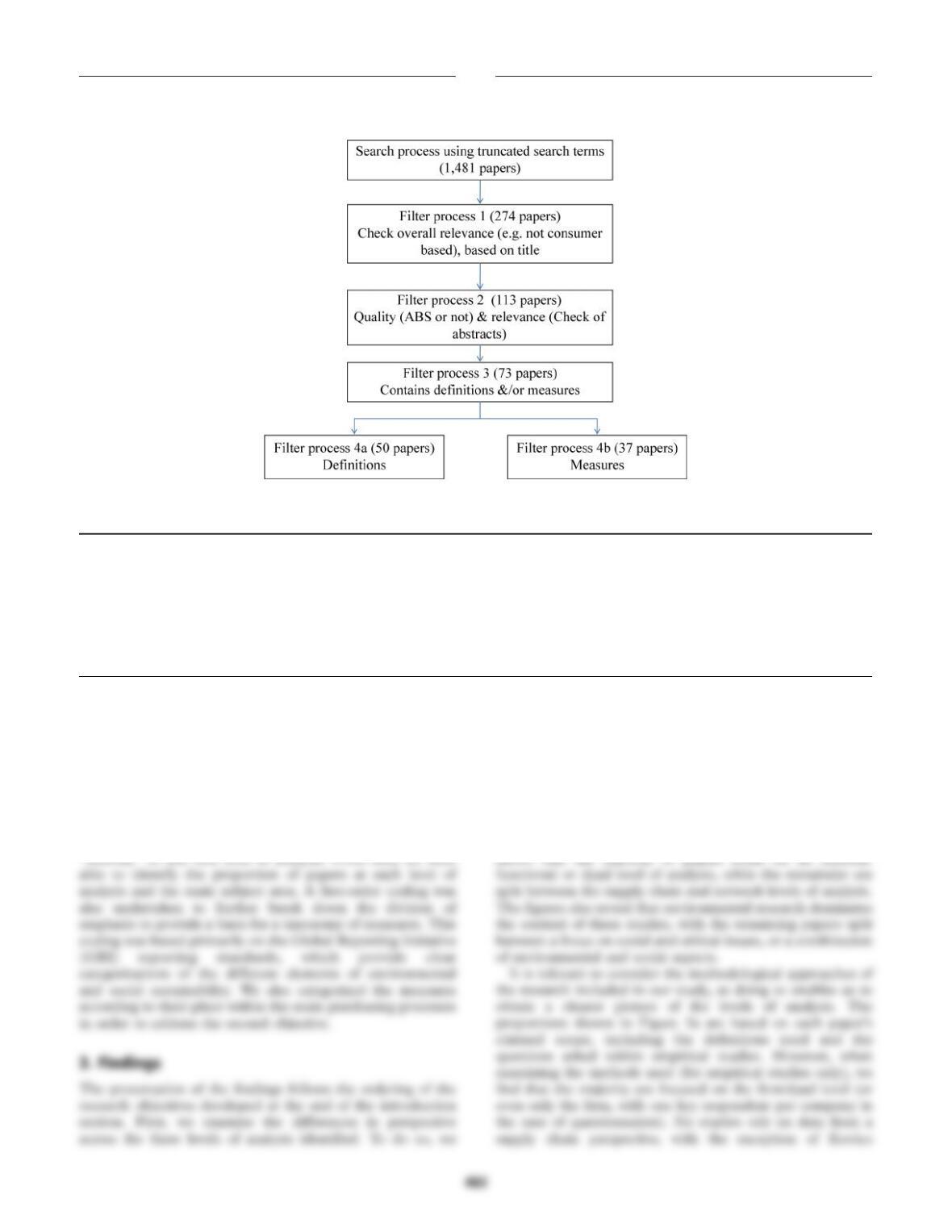
From this initial search, we found 1,481 papers. The titles of
the papers within this initial sample were checked for
relevance, and those papers with a title that was beyond the
scope of this review were removed, including those that dealt
with green logistics and general logistical issues, as well as
those concerning the consumer/marketing end of the supply
chain. This reduced the list to 274 potentially relevant papers.
When the relevance was still unclear based on the title, the
abstract was checked manually.
All of these papers were then filtered according to the
quality of the journal. To ensure that only the highest quality
research is considered, the analysis focuses specifically on
articles published in major English-language North American
and European journals. The analysis considers only those
articles published in journals that are included in the latest
Association of Business Schools (ABS) ranking (Harvey et al.,
2010). The ABS ranking draws from several other highly
regarded journal quality rankings. Although any journal
ranking is inevitably controversial, the ABS ranking is widely
viewed as providing a reliable measure of research rigor and
quality. There was one exception to this requirement, the
Journal of Cleaner Production, which was found to be
significant in the volume of the overall production of papers
related to sustainability. Of the 113 papers remaining after the
quality filter was applied, 73 contained definitions and/or
measures and were included in the full review. Figure 2
summarizes this process.
2.1 Analysis and coding
In order to generate a clearer picture of how the field is
structured in terms of levels of analysis and the research focus,
we undertook a two-stage analysis. In our initial review of the
literature, we found that papers typically included a statement
indicating that the level of analysis was the supply chain.
However, this statement was often contradicted by the fact
that the definitions and empirical research in those papers
focused only on the internal function of the purchasing
department or relationships with immediate suppliers.
Given this inconsistency, we analyzed both the overall
emphasis of the articles, including the definitions, and the
more detailed operationalization of the questions (i.e. the
measures used). Thus, the first analysis was a general review
of the papers in which we categorized each paper into one of
the three levels of analysis, and determined whether the focus
was on environmental or social sustainability. This was done
by reviewing each paper in its entirety and completing a
database entry for each paper. The database included
information on the following variables: study (authors and
year), method (conceptual, case-based, empirical, analytical),
definition (the definition of sustainability if present in the
paper), focus/findings (the main findings of the study), unit of
analysis (firm/dyad, supply chain, network), and whether the
paper was primarily focused on environmental or social
sustainability or both. In order to objectify this process, we
developed a checklist of terms and meanings to search for in
each paper (Table II).
Table I Search terms used and number of relevant papers
Supply Purchasing Procurement Sourcing Network
Green 57 18 13 9 4
Social 33 5 5 51 Not run due to very high return and low relevance
Environment *10 5 5 2 23
Sustainab *93 5 18 21 Not run due to very high return and low relevance
Responsib *15 7 113 62 506
Stakeholder 280 40 57 24 Not run due to very high return and low relevance
Sustainable purchasing and supply management
Joe Miemczyk, Thomas E. Johnsen and Monica Macquet
Supply Chain Management: An International Journal
Volume 17 · Number 5 · 2012 · 478–496
481
In the second stage of analysis, we identified the measures
used in each study (37 papers contained identifiable
measures). The measures were entered into a separate
database, the duplicates were removed, and the data was
coded according to the level of analysis and the main divisions
of social and environmental emphasis using the checklist
(based on Table II). While most measures were of a dyadic
nature, we were able to discern measures that focused solely
on internal processes or issues. Therefore, we added
primarily examine the definitions used to set the scope of the
studies included in the review. We present 32 of the
definitions used in these studies (out of a total 50; we
remove duplicate or very similar definitions). Second, we
identify and categorize the measures used in the papers and
discuss how these measures are represented across the main
purchasing processes. Third, we examine how these measures
reflect the different levels of analysis.
Figures 3a and 3b summarize the study’s overall findings. It
Table II Checklist of terms used to code papers
Level of analysis
Dyadic (or internal) Concerns processes with immediate suppliers or simply internal functions of the firm
Supply chain Concerns suppliers and customers, or suppliers’ suppliers
Network Concerns the extended network, peripheral suppliers, indirect suppliers or other stakeholders with indirect links to the focal firm
Focus of the study
Environmental Environmental, green, waste, pollution, energy use, materials, recycling
Social Community, ethics, diversity, social standards, human rights, child labor
Figure 2 Systematic literature review process
Sustainable purchasing and supply management
Joe Miemczyk, Thomas E. Johnsen and Monica Macquet
Supply Chain Management: An International Journal
Volume 17 · Number 5 · 2012 · 478–496