MBA589 – Exam 2 Review
Chapters 7,8,9,10,11,12,13
CHAPTER 7 – LEAN THINKING AND LEAN SYSTEMS:
Complementary approaches to improvement:
Lean seeks to eliminate waste
Six sigma seeks to eliminate defects
Lean manufacturing includes three elements:
1. Flow – a line synchronization method to make the product flow through
production without interruption
2. Pull – cascade back from actual customer demand by replenishing what the
next operation takes away at short intervals
3. Striving for Excellence – strive for continuous improvement
Lean thinking and lean systems are used to improve operations processes in manufacturing
and services.
•These ideas are also used to improve processes outside of operations, including
software application development and maintenance, annual budgeting, and even
collecting on delinquent accounts
•Lean thinking and lean systems are techniques and principles that can develop
reform in..
•Manufacturing systems
•Administrative systems
•Service systems
•Entire supply chains
Mass Production: The production of standardized discrete products in high volume
Repetitive Manufacturing: A means for Mass Production
•Materials are produced in large batches
•Machines were made to run faster to reduce cost
•In some cases, this resulted in the sacrifice of quality
Toyota Production System (TPS): Toyota did not want to copy this type of production,
because the demand for their product was low, and there were a lack of resources
•Toyota wanted to produce automobiles in smaller batches, with lower inventory,
and using simple but high-quality processes and involving workers as much as
possible
Just-In-Time (JIT) manufacturing: developed from TPS ideas, JIT is the concept that
instead of focusing on transforming the entire system, the focus should be primarily on
inventory reduction

Lean Production: Systematically eliminating waste in all production processes by
providing exactly what the customer needs and no more
•It was noted that the best plants using lean production had a big edge in the
automobile industry anywhere in the world
Lean Thinking: The concepts, principles, and techniques underlying lean production
•These concept are being deployed across a broad spectrum of global firms
•In virtually all instances, lean thinking causes
•Increased turnover
•Superior quality
•Substantial cost savings
Lean thinking is a way of thinking about the processes at work, and this way of thinking is
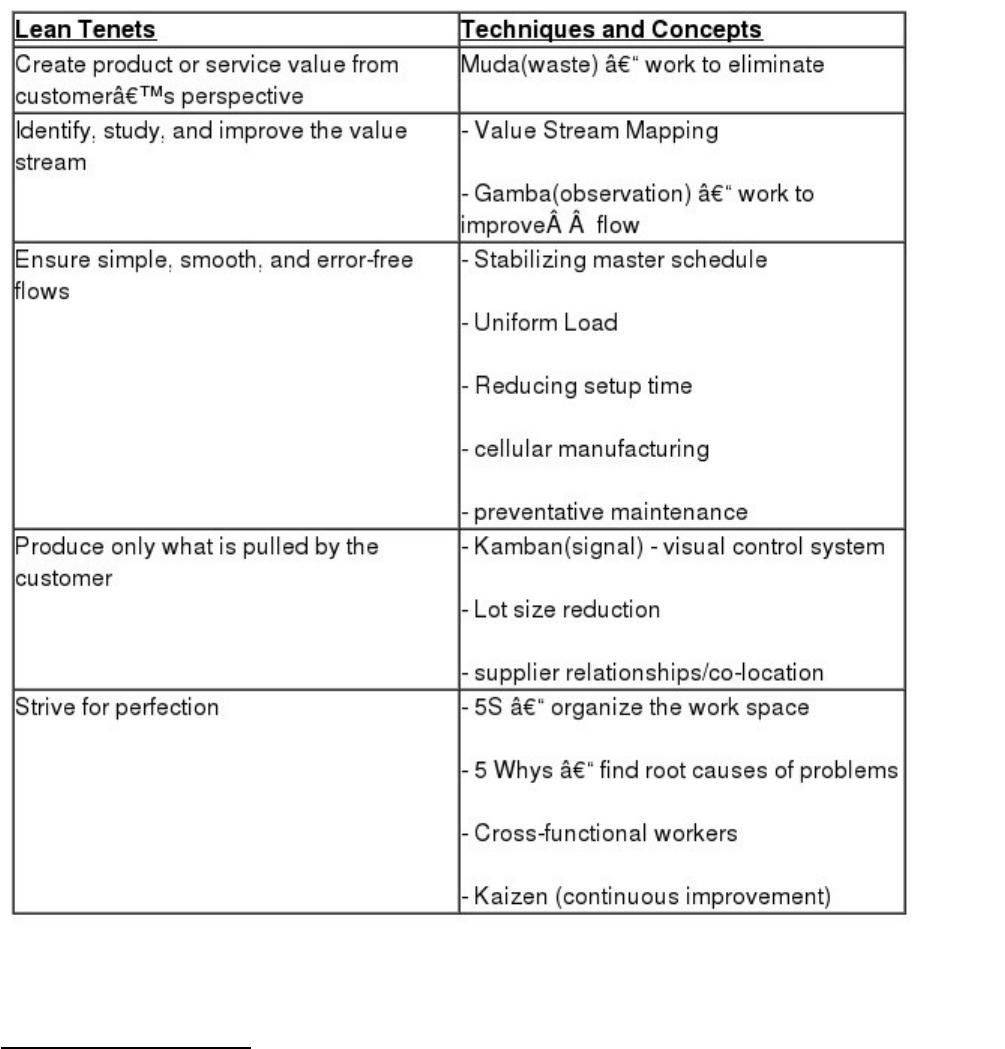
built around 5 tenets, which aim to deliver value to customers efficiently
1.) Specify precisely what about the product or service creates value from the customer’s
perspective
•The value is defined by the customer – value is dynamic in nature, and will change
over time
•Firms should design and deliver product and service features that customers value,
and eliminate activities that are not valued by the customer
•Waste: a.k.a muda – anything that does not contribute to the value of the
product or service being produced and delivered to the customer
•Seven Forms of Waste:

•1.) Overproduction: producing more than the demand of customers,
resulting in unnecessary inventory, handling, paperwork, or
warehouse space
•2.) Waiting Time: operators and machines waiting for parts or work
to arrive from suppliers or other operations; customers waiting in
line
•3.) Unnecessary Transportation: double or triple movement of
materials due to poor layouts, lack of coordination, and poor
workplace organization
•4.) Excess Processing: poor design or inadequate maintenance of
processes, requiring additional labor or machine time
•5.) Too Much Inventory: excess inventory due to large lot sizes,
obsolete items, poor forecasts, or improper production planning
•6.) Unnecessary Motion: wasted movements of people, or extra
walking to get materials
•7.) Defects: Use of material, labor, and capacity for production of
defects, sorting out bad parts, or warranty costs with owners
•Additionally – 8.) Underutilization of Workers: stems from not
recognizing, developing, and utilizing mental, creative, and physical
abilities of employees
2.) Identify, study, and improve the value stream of the process for each product or service
•Value Stream: identifies all the processing steps and tasks undertaken to complete
a product or deliver a service from beginning to end
•a typical value stream can include both value-added and non-value-added
processing steps and tasks
•the goal of value stream is to eliminate the non-value-adding processing
steps and tasks
•Value Stream Mapping: creates a visual representation of the value stream
of a process, much like process flowcharting

•requires the direct observation of work and the flow of work
(gemba) within a process so that opportunities for improvement can
be identified
3.) Ensure that flow within a process is simple, smooth, and error free, thereby avoiding
waste
•ex: lowering inventory to expose problems – inventory can hide problems that
contribute to other sources of waste
•encourages the capacities of workers and suppliers to a great extent
4.) Produce only what is pulled by the customer
•This requires replacing the traditional “push” system of mass production, with the
pull system of lean production
•Push System: aims to produce goods or ensure the delivery of services well
in advance of demand, often according to a scheduling plan or a plan
created from potentially inaccurate forecasts
•Pull System: waits for the process customer to signal a need for the good or
service before producing it to fulfill that need
5.) Strive for perfection
•This requires continuous improvement of all processes, as well as radical redesign
if necessary
•Perfection: an affordable good or service, delivered rapidly and on time, that meets
the needs of the customer
The 5 Whys Technique: a relatively powerful technique for improving production
process, by systematically exploring cause-effect relationships that underlie and observed
problem
•By asking “why” at least 5 times, this technique can be used to deliver insights to a
problem by identifying the root of the problem
The 5S Technique: a technique for organizing a workspace to improve employee morale,
environmental safety, and process efficiency
•To Sort – decide what things should be kept and what things should be discarded so
that only the essential things remain
•To Straighten or Set in Order – arrange essential things in a manner that supports
an efficient flow of work
•To Shine, Sweep, or Clean – assure cleanliness by returning things to their storage
locations and removing things that do not belong
•To Standardize – standardize work and adopt the 3 previous S’s throughout, so
that all employees know what their responsibilities are
•To Sustain – maintain the 4 other S’s as a habit of work and a way to operate
•5S + Safety = 6S!
Stabilizing the Master Schedule: to level the amount of work done each day, so that the
firm can achieve a smooth, error-free flow
•Breaks down the daily production volume needed to make the planned demand
•This is done to achieve a Uniform Load
•The assignment of approximately equal amounts of work to each machine
or worker
Takt Time: the time between successive units of production – this represents the speed of
output
Kanban: the method of production authorization and materials movement in the lean
production system that supports the tenet of producing only what is pulled by the customer
– means “signal”
•Control the timing and sequencing of work through a sequential process
•The purpose of this system is to signal the need for more parts and ensure that those
parts are produced just in time to support the subsequent work centers
•Consists of input areas, and output areas n=(DT)/C
•n = total number of containers
•D = demand rate of the using work center
•C = container size, in number of parts, usually less than 10 percent
of daily demand
•T = time for a container to complete an entire circuit: filled, wait,
moved, used, and returned to be filled again (also called the lead
time)
•Maximum Inventory = nC = DT
Reducing Lead Time: reducing the time required to circulate the container
•Can be accomplished by reducing the fill, wait, move, use, or return times
Reducing Setup Time: reducing the nonproductive time when machines are being
adjusted before beginning work on a new batch of parts
•Reducing setup time is important, because it increases available capacity, increases
flexibility to meet schedule changes, and reduces inventory
•You want the setup time to approach 0 this is the ideal lot size of one unit
•Run times are naturally more important than setup times, but firms should
concentrate on reducing both
Single Setup: Sought out by many companies – refers to a setup time that is completed in
single digit minutes
One-touch Steps: refers to a setup time of less than a minute
These low setup times can often be achieved by designing a two-step process and
separating internal and external setups
•External Setup: all actions that can be done while the machine is operating
•Internal Setup: all actions that require the machine to be inactive
Single-Unit Production: the goal of reducing lot sizes to one
•Can help reduce total system cost
Group Technology (GT) / Cellular Manufacturing: a lean layout where the work centers
have been redesigned so that parts can flow smoothly from one work center to the next
•Most inventory buffers (located next to machine) have been eliminated so there is a
smooth flow
•Effort is still made to reduce lot size to one
Preventative Maintenance: since inventories have been cut to minimal levels a workers
strictly adhere to the daily plan for production, it is critical to avoid unplanned equipment
failures
Multifunction Workers: workers who have a much broader set of skills than their