1. Introduction
A supply chain, consisting manufacturer, suppliers, transporters, warehouses, retailers,
and customers, aims to maximize its overall surplus. A good supply chain decision has a
significant impact on the success of each business, because it can significantly affect
both the generation of business revenues and the expense of cost. However, it is not
necessarily a good decision to reduce the cost of supply chain purely in order to achieve
the maximum supply chain surplus, because such a decision may increase the risk of
product quality and service. Therefore, how to select an appropriate supply chain model
in the context of economic globalization is the focus of this paper.
According to Chopra (2018), the flow of information, products and capital are important
criteria for successful supply chain decision making. He concludes three categories or
phases, which are supply chain strategy, supply chain planning and supply chain
operation, affecting the supply chain decisions. Based on Chopra’s (2018) idea, this
research will take Nissan Motor Manufacturing UK (NMUK) and their global suppliers as
a case study and firstly identify and analyze what is the most appropriate conceptual
supply chain model of NMUK which best presents the strategy, structure, and operation
of NMUK. In the second part of this paper, the most appropriate managerial approaches
to implement the supply chain model of NMUK will be evaluated.
2. Conceptual supply chain models of NMUK
2.1 Case overview
Nearly 40 years after its founding, NMUK has built a strong supplier relationship to
achieve agility, integrity and overall competitiveness in the automotive industry, and to
meet the needs of end customers. But in 2018, NMUK recalled a large number of
Qashqai and 2nd generation of Qashqai (Qashqai+2) vehicles due to quality problems.
There are two main problems in the production of Qashqai series by NMUK. One
problem is that NMUK outsourced technology and unproven technological innovations
to distributors. In order to cut costs and add more value to customers, NMUK entrusted
and outsourced a large number of projects and services to its tier–1 suppliers worldwide,
which increased the risks of product production and ultimately resulted in delayed
delivery of products that reduced NMUK’s credibility. The other problem is that more
than 40% of Qashqai+2 components came from offshore suppliers. Due to the lack of a
lot of continuous communication, Qashqai+2 was responsible for various product
quality risks and was eventually recalled due to a brake fluid leak in Qashqai+2. Those
had left NMUK with a huge loss of financial and credibility.
2.2 Applied supply chain models in NMUK
In NMUK case of producing Qashqai and Qashqai+2, this research considers NMUK
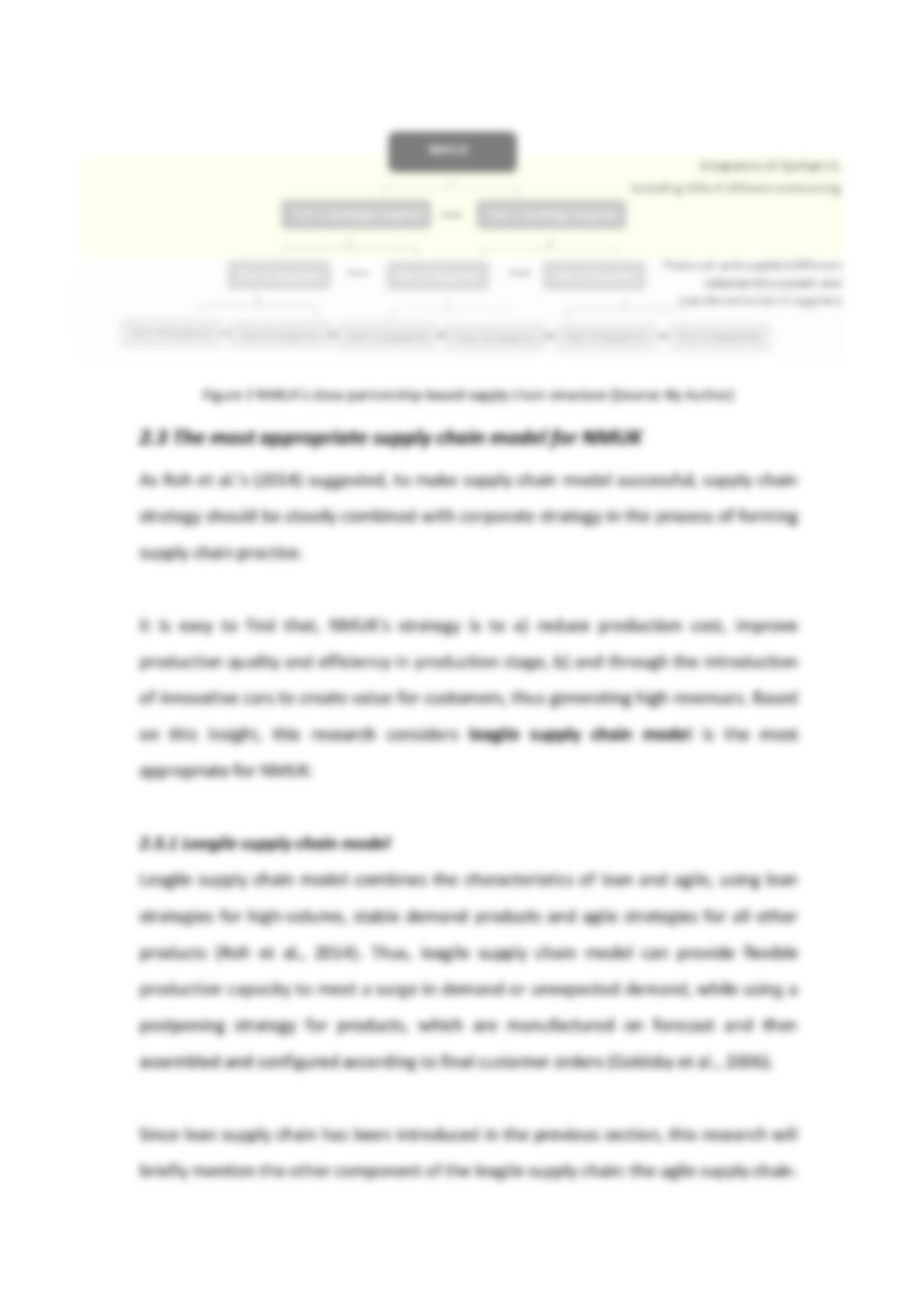
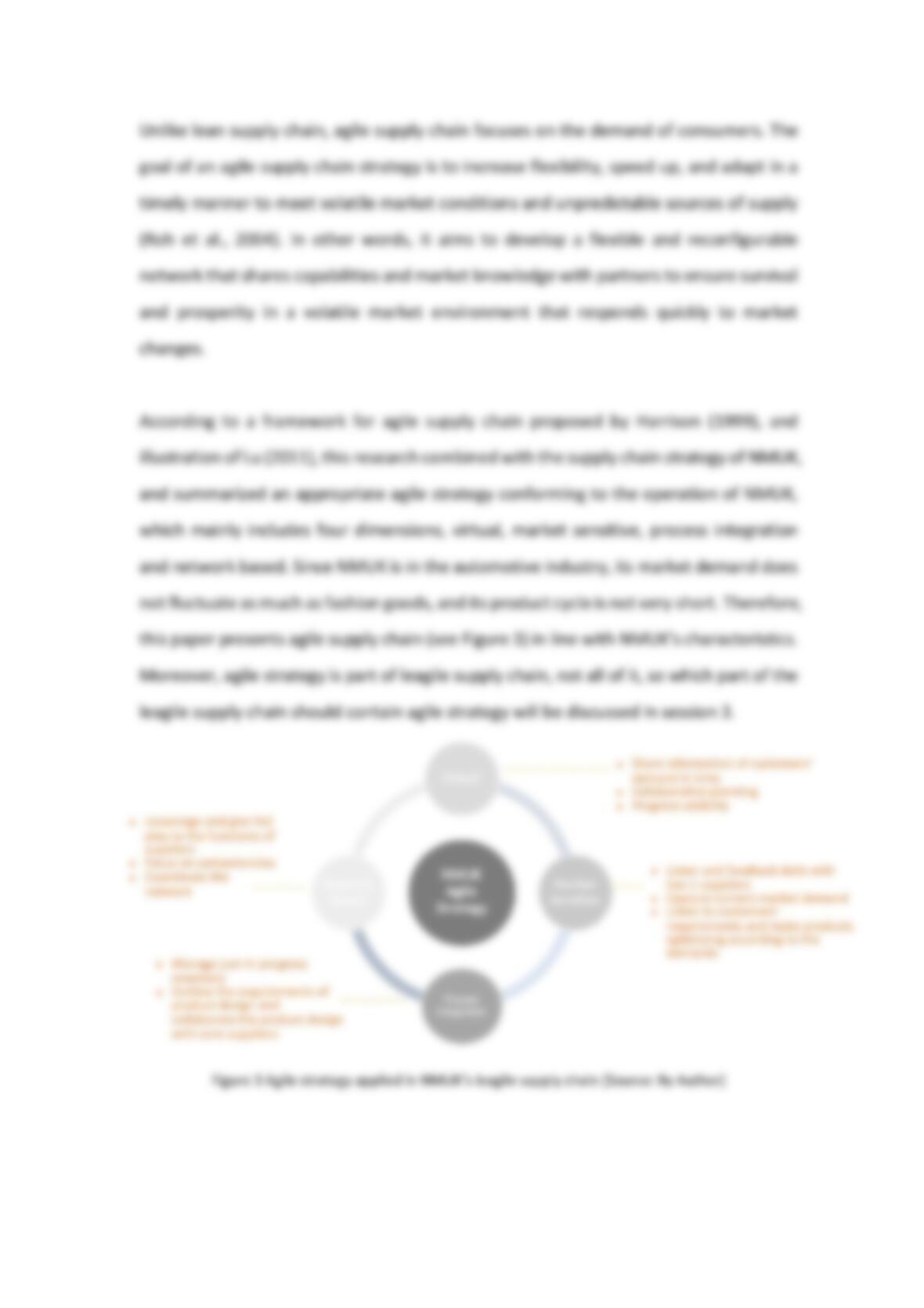
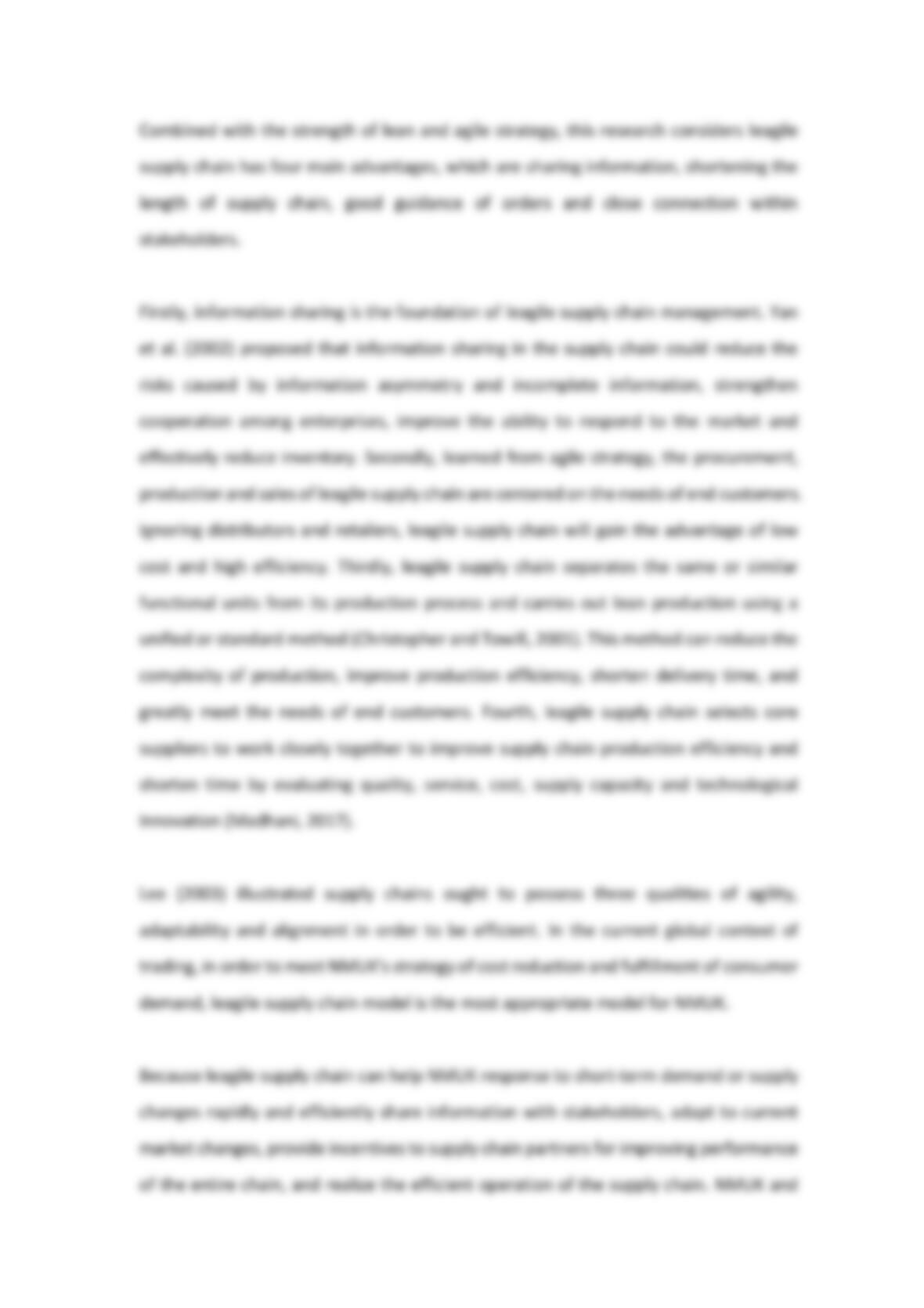
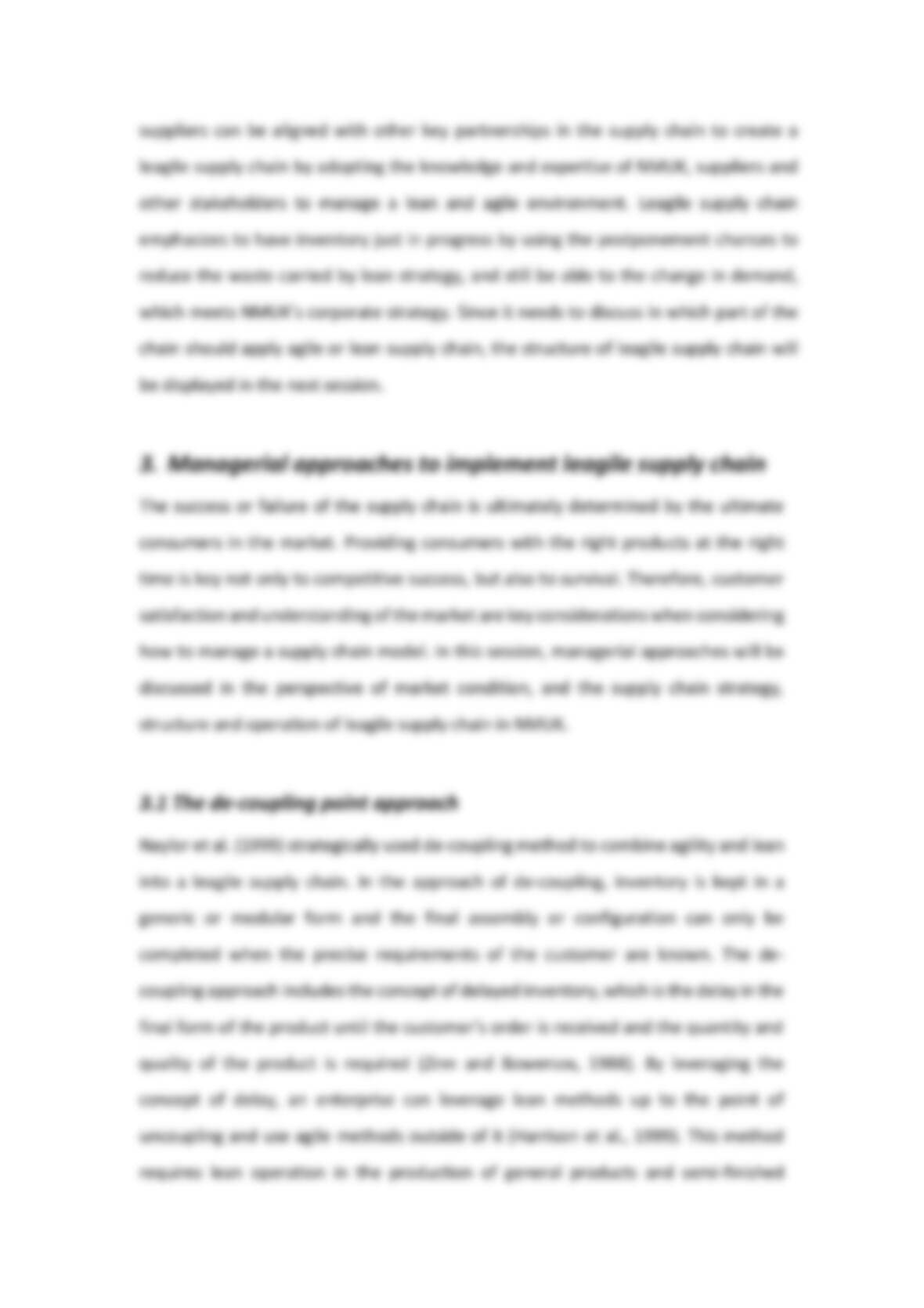
applied both lean and close partnership-based supply chain models in this case.
2.2.1 Lean supply chain
Mason-Jones et al. (2000) pointed out lean supply chain model was to develop a value
stream from suppliers to end customers in order to eliminate various buffering supply
chain costs, to ensure stable production plans to improve process efficiency, and then
to maintain competitive advantage through economies of scale stable and predictable
markets. Vitasek et al. (2005) concluded that lean supply chain model can be defined as
a group of organizations that directly connect products, services, information and funds
flowing upstream and downstream to work together to reduce costs and waste and
effectively meet the needs of individual customers. To be simplified, the lean supply
chain model aims to reduce costs and waste, and fulfill customer requirements,
implemented through a zero-inventory and just-in-time approach.
In line with its NMUK’s corporate strategy, NMUK hoped to improve consumer driving
experience by producing light-component sport utility Qashqai, and to gain a
comparative advantage in the SUV market with cutting-edge and innovative
components and composites. In order to reduce Qashqai’s delivery time, to improve its
quality and production efficiency in the pilot production stage, and to achieve the goal
of reducing overall cost, NMUK used the lean supply chain model in this stage as its
supply chain strategy.
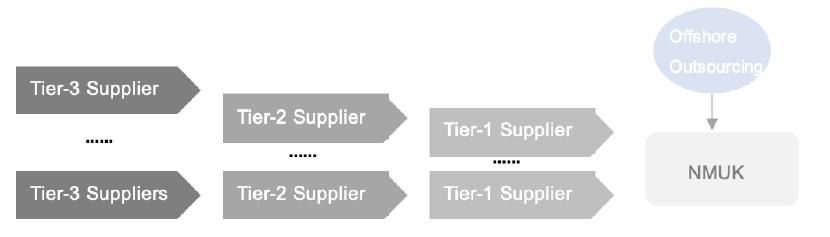
The lean supply chain model of NMUK includes around 5% of offshore outsourcing (see
Figure 1). Through partial outsourcing and collaboration with suppliers, NMUK
improved overall operational efficiency and reduces costs for tier-1 suppliers when
producing Qashqai. And by using cutting-edge and innovative components and
materials, it reduced the overall maintenance and warranty replacement costs for end
customers who purchased Qashqai.
Figure 1 NMUK’s lean supply chain structure (Source: By Author)
Using such a supply chain model may seem to reduce NMUK’s costs, but it actually
creates a number of pitfalls. Myerson (2012) found that there are 8 wastes in lean supply
chain model, which were the waste of inventory, unnecessary transportation or
movement, motion, waiting, overproduction, over-processing, defect or error and non-
utilized talent. In the case of NMUK, many suppliers were involved in the production of
Qashqai. Since NMUK had good control over cost control and operation, it had relatively
small losses in the waste of transportation, motion and overproduction. However,
because NMUK attached too much importance to cost reduction, it ignored quality
control when producing Qashqai, resulting in serious defects in Qashqai’s emissions. The
toxic pollutants discharged into the road are 18 times of the official regulations
(Carrington, 2017), which had dealt a great blow to NMUK’s reputation and earnings.
2.2.2 Close partnership-based supply chain
Close partnership-based supply chain model can reduce costs, significantly improve
product quality and improve manufacturers’ performance in terms of adding new
product designs (Monczka et al., 1993). Metcalf et al. (1992) pointed out that greater
benefits can be derived from closer supplier-manufacturers partnerships. However,
under close partnership-based supply chain model, both suppliers and manufacturers
should share production planning and control data (Spina and Zotteri, 2000), and
communicate products innovate information (Primo and Amundson, 2002). In general,
close relationship with suppliers can bring advantages to manufacturers, but this
method is not a panacea for partnership-based supply chain (Johnson et al., 2004).
Appling close partnership-based supply chain model in the production of Qashqai+2 by
increasing the number of strategic supply chain suppliers, which had a negative impact