Summary Accounting
Accounting (Universiteit van Amsterdam)
Verspreiden niet toegestaan | Gedownload door Jordevie Uvs (jordevie@hotmail.com)
lOMoARcPSD

Accounting
Hoofdstuk 1:
Accounting : is the process of identifying, measuring and communicating economic information
about an organization for the purpose of making decisions and informed judgements.
Identifying Economic For decisions
Measuring information and informed
Communicating about an entity judgements
Users of accounting information:
– management
– investors/shareholders
– creditors/suppliers/bank
– employees
– SEC (Securities and Exchange Commission) and government agencies
Types of accounting:
● Financial accounting: the process that results in the preparation and reporting of financial
statements for and entity. Concerned with historical results.
– bookkeeping: used to accumulate the financial results of many of an entity’s activities.
– controller: used to designate the chief accounting officer of a corporation.
– CPA (Certified Public Accountant): professional designation by fulfilling certain education.
● Managerial accounting / Cost accounting: the use of economic and financial information to plan
and control many activities of the entity and to support the management decision-making process.
– internal orientation
– CMA (Certified Management Accountant)
● Auditing – public accounting: Provide auditing service, which constitutes on important part of
accounting profession.
– interdependent auditor’s report: result of an audit.
Require GAAS (Generally accepted auditing standards) and GAAP (Generally accepted auditing
principles).
– annual report: financial statements and explanatory notes.
● Internal auditing: Public accountant on a smaller scale.
● Governmental and not-for-profit accounting
● Income tax accounting
FASB (Financial Accounting Standards Board): authoritative standard-setting body.
SFAS (Statements of Financial Accounting Standards): standards of accounting and reporting for
particular issues.
PCAOB (Public Company Accounting Oversight Board): set and enforce auditing, attestation, quality
control and ethics.
ISAB: harmonization/comparability between financial statements from other nations/countries.
Ethics and accounting:
– integrity: being honest and forthright in dealings and communication with others.
– objectivity: impartiality and freedom from conflict of interest.
Verspreiden niet toegestaan | Gedownload door Jordevie Uvs (jordevie@hotmail.com)
lOMoARcPSD

– independence: independent in appearance and in fact.
– competent: having knowledge and skills
Accrual accounting: Accounting for the effect of an economic activity, or transaction, on an entity
when the activity has occurred, rather than when the cash receipt or payment takes place.
Hoofdstuk 2:
Transactions: are economic interchanges between entities.
Process:
– Procedures for sorting, classifying
Transactions: and presenting (bookkeeping) Financial statements
– Selection of alternative methods
of reflecting the effects of certain
transactions (accounting)
Balance sheet: a listing of the organization’s assets, liabilities, and owners’ equity at a point of time
(statement of financial position)
Accounting equation/Balance sheet equation: Equality
Assets: are probable future economic benefits obtained or controlled by a particular entity as result
of part transactions or events.
Liabilities: are probable future sacrifices or economic benefits arising from present obligations of a
particular entity to transfer assets or provide services to other entities in the future.
Owners’ equity: is the ownership right of the owner(s) of the entity in the assets that remain after
deducting the liabilities (assets – liabilities = net assets)
Cash: Cash on hand and in the bank.
Accounts receivable: Amounts due from customers.
Merchandise inventory: voorraad
Equipment: inventaris
Accumulated depreciation: afschrijving van inventaris
Account payable: Amounts owed to creditors.
Short-term debt: Pay within one year.
Long-term debt: Longer than one year
Balance sheet:
ASSETS LIABILITIES & OWNERS’ EQUITY
Cash Accounts payable
Accounts receivable Short-term debt
Merchandise inventory Long-term debt
Equipment Owners’ equity
Less: Accumulated depreciation
Verspreiden niet toegestaan | Gedownload door Jordevie Uvs (jordevie@hotmail.com)
lOMoARcPSD

Income statement:
Net sales
Cost of goods sold
Gross profit
Selling, general and administrative expenses
Income from operations
Interest expense
Income before taxes
Income taxes
Net income
Statement of changes in owners’ equity:
– Paid-in capital: total amount invested in the entity by the owners/stockholders
* Common stock
* Additional paid-in capital
Hoofdstuk 3:
Return on investment (ROI): is the label usually assigned to the rate of return calculation made using
data from financial statements.
Formula: Net income / Average total assets (or: Operating income / Average operating assets)
DuPont model: expansion of the basic ROI calculation:
Return on investment: Net income / Sales x Sales / Average total assets
Margin x Turnover
Return on equity (ROE): owners are interested in expressing the profits of the firm as a rate of return
on the amount of owners’ equity.
Formula: Net income / Average owners’ equity
Liquidity: a firm’s ability to meet its current obligations and is measured by relating it current assets
and current liabilities as reported on the balance sheet.
Working capital: Current assets – Current liabilities
Current ratio: Current assets / Current liabilities
Acid-test ratio: Cash + Accounts receivable / Current liabilities
Margin: Net income / Net revenues
Turnover: Net revenues / Average total assets
Verspreiden niet toegestaan | Gedownload door Jordevie Uvs (jordevie@hotmail.com)
lOMoARcPSD
Hoofdstuk 4:
Transactions: economic interchanges between entities that are accounted for and reflected in
financial statements.
Transactions Financial statements
Assets = Liabilities + Owners’ equity
Assets = Liabilities + Paid-in capital + Retained Earnings
Assets = Liabilities + Paid-in capital + Retained Earnings (beginning) + Revenues
– Expenses
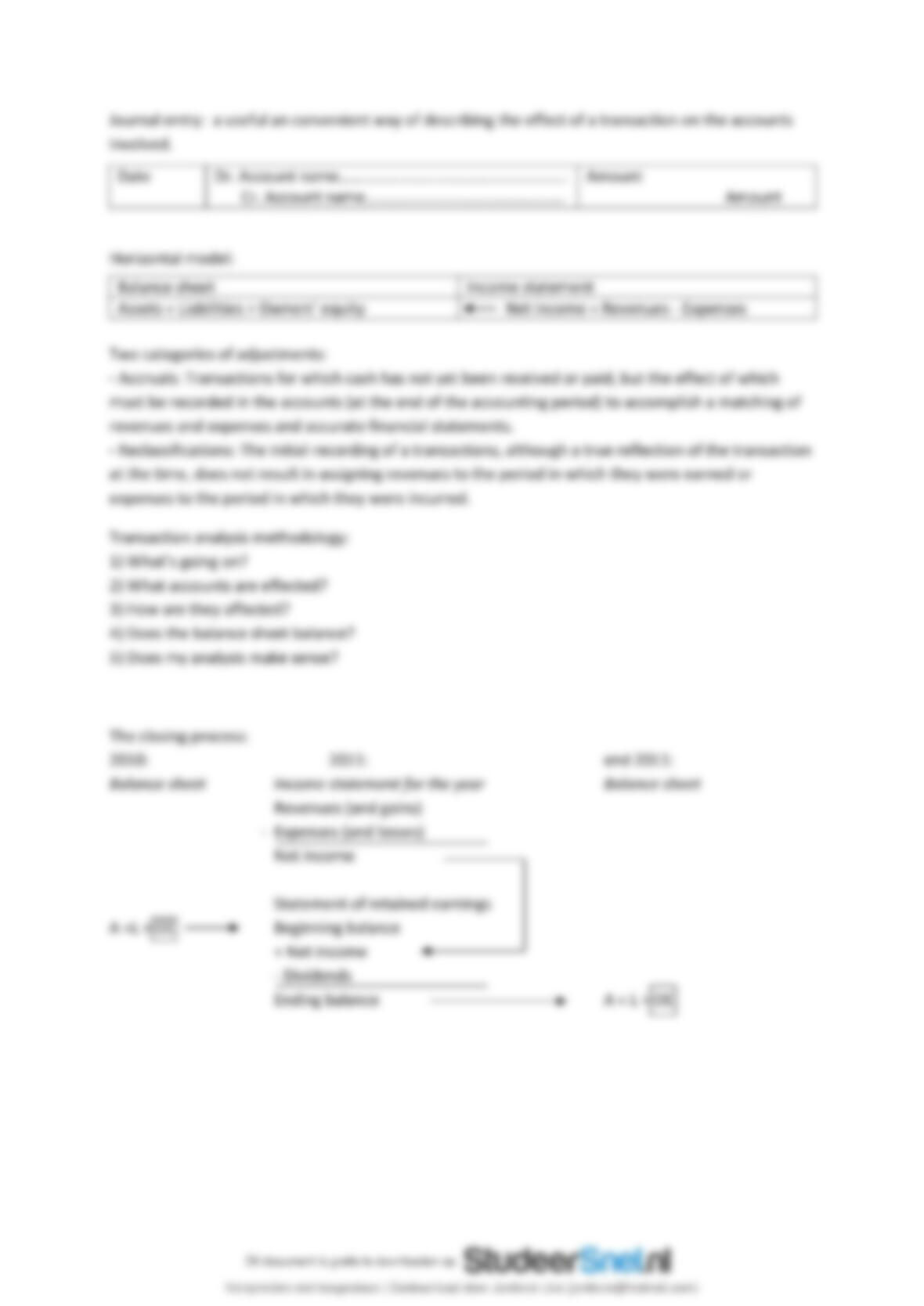
Journal: is a day-by-day, or chronological, record of transactions.
Ledger: A book or file of accounts, records transactions.
Chart of accounts: serves as an index to the ledger, and each account is numbered to facilitate the
frequent written references that are made to it.
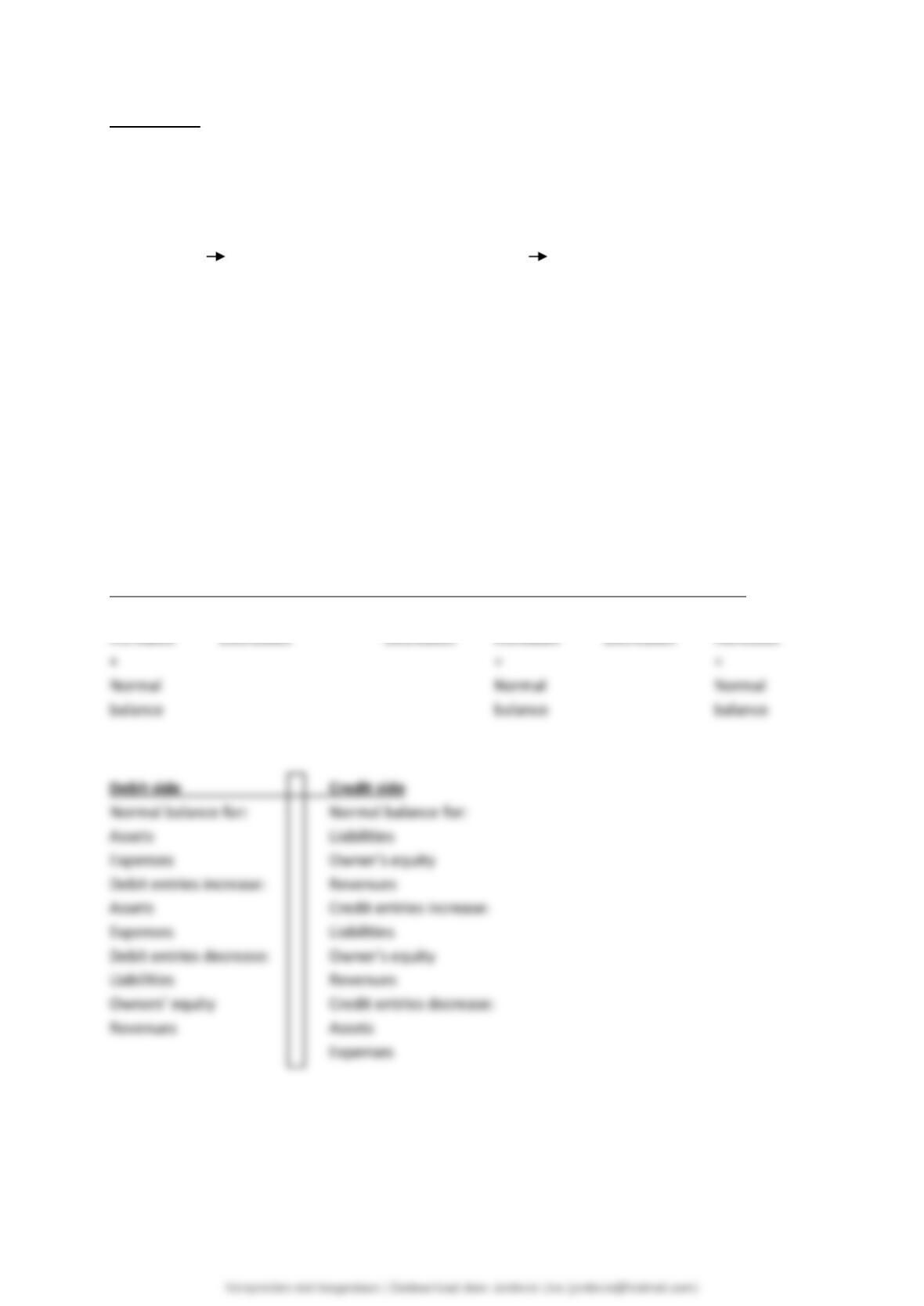
T-account: an account format with a debit (left) side and a credit (right) side.
– ASSETS: LIABILITIES: OWNERS’ EQUITY:
Debit Credit Debit Credit Debit Credit
lOMoARcPSD