Factors affecting the customer satisfaction in Ireland
Student name
Harrisburg University of Science and Technology
Abstract
The objective of the research is to predict the factors that are closely associated with customer
satisfaction in Ireland. The research has surveyed 2038 participants which includes
demographics information, educational and economic condition of the participant. However, the
research has used selected main factors. The survey has explicitly asked whether the
participant is satisfied or not. Considering this as an outcome variable, research has used the
different statistical methods to find the answer of the research questions.
Introduction
The public service is a service which is provided by government to people living within its
jurisdiction, either directly through public sector or by financing provision of service [1]. The
goal of the government should be to provide public service in highly satisfaction level. So, the
quality of public service should be a very high standard. There are many ways the government
can improve the quality of the public service. Improving the capacity of the service provider,
integrating the technologies to facilitate service providing process are the key elements.
However, there are many other indirect ways we can improve the service provider. One method
could be to analyze the feedback and the other different attribute of the service receiver. To
improve the quality of public service, it is important to understand what elements are most
important in determining satisfaction with a public service which are the key drivers [2]. To do
that that the government can get feedback from the service receiver and analyze the data to find
the crucial factors that are associated with the customer satisfaction. One governmental body in
the Ireland has conducted similar research to improve the quality of public service in government
organization. The department has collected the data of the service receiver and this research is
trying to find the crucial factors in the public sector by applying different statistical tools and
methodologies.
Data Collection and Summary
The research has used the survey data collected by the department of public expenditure and
reform, Ireland. The purpose of the survey was to ascertain satisfaction levels with services
received, as well as more general perception of, and attitude to, the Civil Service. The survey
was carried out to meet a commitment in the Government’s Public Service Reform Plan 2014–
2016 to “commission, deliver and disseminate the results of a Civil Service customer satisfaction
survey”. The survey also delivers on a commitment in the Civil Service Renewal plan to “run
regular surveys of Civil Service customer to more fully understand user experiences,
expectations and requirements”. The Survey was undertaken by Ipsos MRBI on behalf of the
Department of Public Expenditure and Reform [3]. The survey was conducted with 2038
participants with diverse age, sex, marital status and other different economic condition. So, this
research tried to use the same survey data to find the main factors in customer satisfactions.
The data it has published was in CSV format which consists of 2025 observations. Each
observation is the information about one participant. The survey has asked so many question
which are related to demographics information and economic background of the participant. The
primary outcome variable is whether the customer is satisfied or not. Among 2025 survey
question, 1022 participant did not give the answer of this question. 14 participants did not give
the definite answer. So, only 989 participants gave whether they were satisfied or unsatisfied.
We removed those observations which does not have answers or do not have definite answers.
So, finally we have used 989 observations for the research. Similarly, the research has collected
other different variables. Most of those variables are categorical variable. We have selected
demographics variables and the variable which describes the economic condition of the
participants. The predictor variables which we have considered were Age, Sex, Marital Status,
participant living place either rural or urban, the accessibility of the internet for the participant
and the participant is chief income earner at house hold or not. The research as analyzed the data
considering those predictor variables and the outcome variables. First the research has analyzed
the summary of each variables and the association between predictors variables and the outcome
variable. The research has analyzed the data using proper data analysis technique considering
alpha level of 0.05
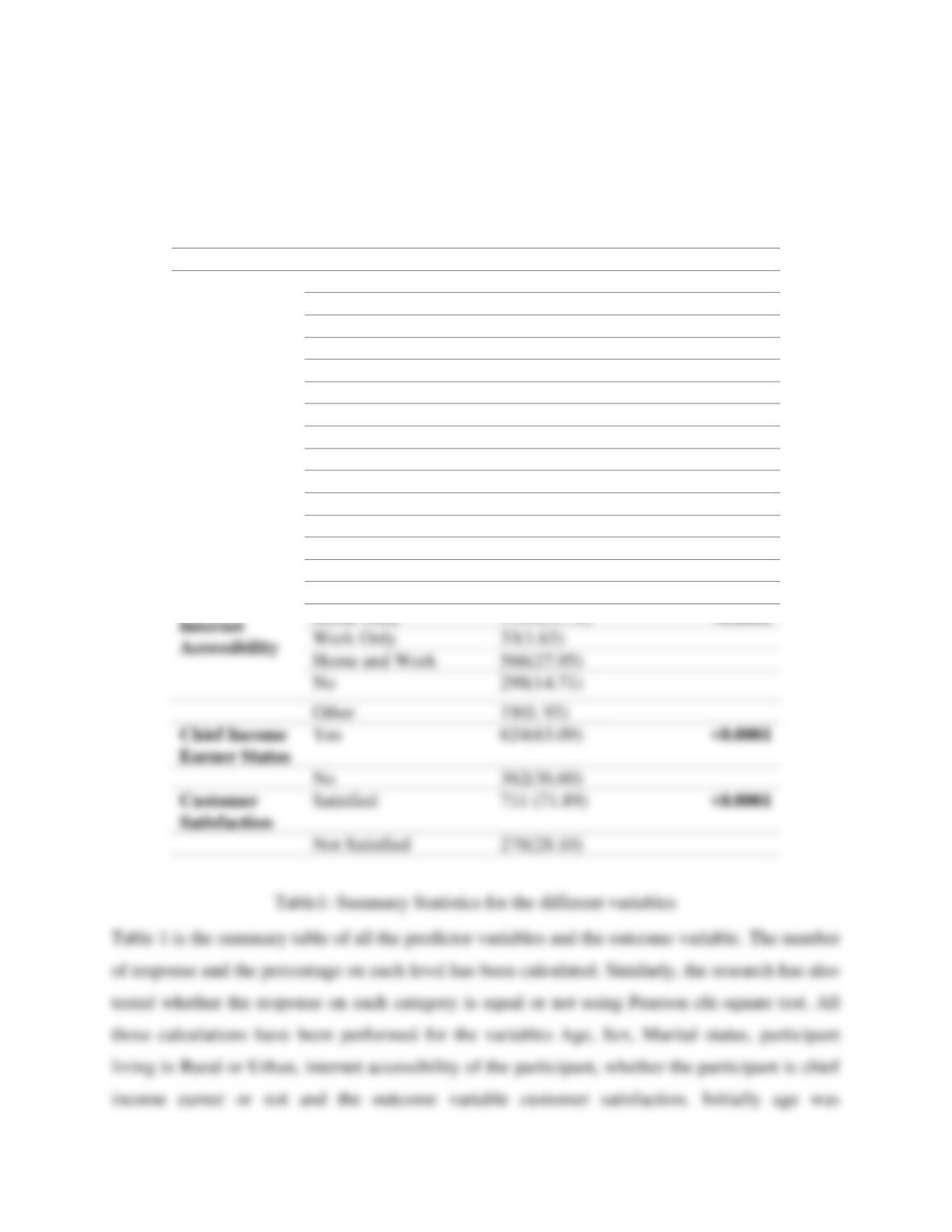
Data Summary and Exploratory Data Analysis
Total Observation(N) = 989
Variable
Levels
n (%)
P value
AGE
Sex
Marital Status
Rural/Urban
(18-29)
161(16.27)
<0.0001
(30-39)
237(26.96)
(40-49)
207(20.93)
(50-59)
194(19.61)
(60-69)
129(13.04)
70+
61(6.16)
Male
493(49.84)
0.9240
Female
496(50.15)
Single
275(27.80)
<0.0001
Married
605(61.17)
Separated
68(6.87)
Widow
39(3.94)
Other
2(0. 20)
Rural
946(46.71)
0.0143
Urban
1077(53.18)
Home Only
1109(54.76)
<0.0001
Work Only
33(1.63)
Home and Work
566(27.95)
Other
19(0. 93)
Earner Status
362(36.60)
Satisfaction
Not Satisfied
278(28.10)