Phases and Composition of Matter
• What is Chemistry?
➢ Chemistry is the science that seeks to understand what matter does by studying what
atoms and molecules do.
• What is Matter?
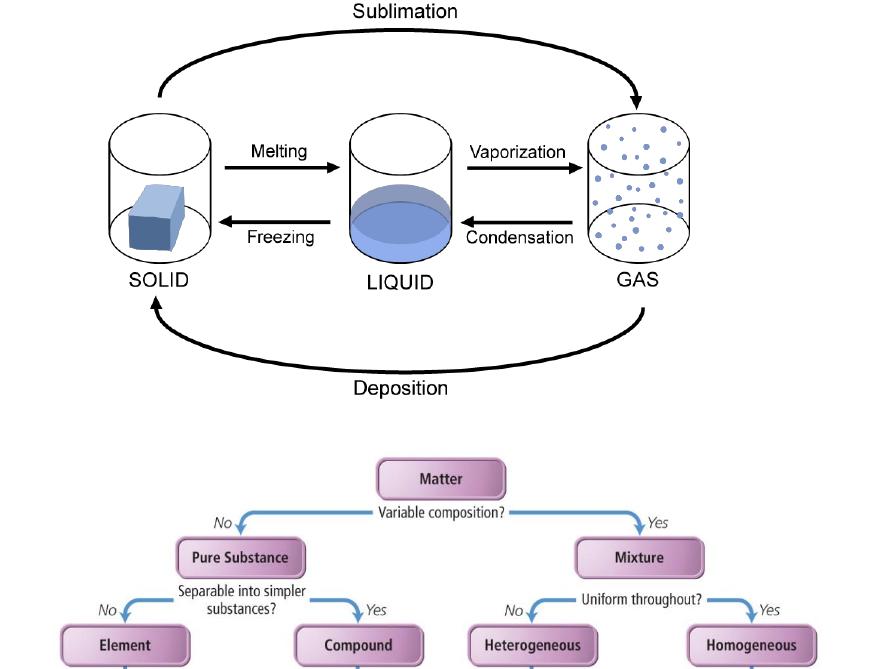
➢ Matter can be classified as solid, liquid, or gas based on what properties it exhibits.
• Scientific Method
➢ A process for trying to understand nature by observing nature and the way it behaves,
and by conducting experiments to test our ideas.
➢ Key characteristics of the scientific method include Observation, formulation of
Hypotheses, Experimentation, and formulation of Laws and Theories.
• Phases of Matter
➢ Solid matter may be crystalline—in which case its atoms or molecules are in patterns
with long-range, repeating order. Others may be amorphous, in which case its atoms or
molecules do not have any long-range order.
➢ In liquid matter, atoms or molecules pack about as closely as they do in solid matter, but
they are free to move relative to
each other.
➢ In gaseous matter, atoms or molecules have a lot of space between them.
• Phase Changes
• Composition of Matter

• Physical Properties: Separation Techniques
➢ Decantation is a process for the separation of mixtures of immiscible liquids or of a
liquid and a solid mixture such as a suspension.
➢ Distillation is the process of separating the components or substances from a liquid
mixture by using selective boiling and condensation.
➢ Chromatography: the separation of a mixture by passing it in solution or suspension or
as a vapor (as in gas chromatography) through a medium in which the components
move at different rates
➢ Evaporation: a technique used to separate out homogenous mixtures where there is
one or more dissolved solids, used primarily to drive off the liquid components from the
solid components
➢ Filtration is the process of separating suspended solid matter from a liquid, by causing
the latter to pass through the pores of some substance, called a filter. The liquid which
has passed through the filter is called the filtrate.
• Chemical and Physical Properties
➢ A chemical property
is a property that a substance displays
only by changing its composition via a chemical change (or chemical reaction).
• The flammability of gasoline, in contrast, is a chemical property.
• Chemical properties include corrosiveness, acidity, and toxicity.
➢ A physical property is a property that a substance displays without changing its
composition.
• Odor, taste, color, appearance, melting point, boiling point, and density are all
physical properties.
• Physical properties can be broken down into two categories:
1. Extensive Properties- Depends on the amount of matter in a sample.
• Examples
• Mass/Weight of a sample
• Volume/Capacity of a sample
• Length/Distance of a sample
• Temperature of a sample
2. Intensive Properties- Independent of the amount of matter in a sample.
Focuses on observable characteristics.
• Examples
• Color, odor, luster
• Hardness, density, specific gravity
• Melting point, freezing point, boiling point
• Malleability, ductility, conductivity
• Physical and Chemical Changes
➢ Physical changes are changes that alter only the state or appearance, but not
composition. (The atoms or molecules that compose a substance do not change their
identity during a physical change.) water boils to water vapor
➢ Chemical changes are changes that alter the composition of the matter. (During a
chemical change, atoms rearrange, transforming the original substances into different
substances.) rusting of an iron nail
Measurements, Sig Figs, Scientific Notation
• Metric and Customary Measurements
➢ Metric system, used in most of the world
➢ English system, used in the United States
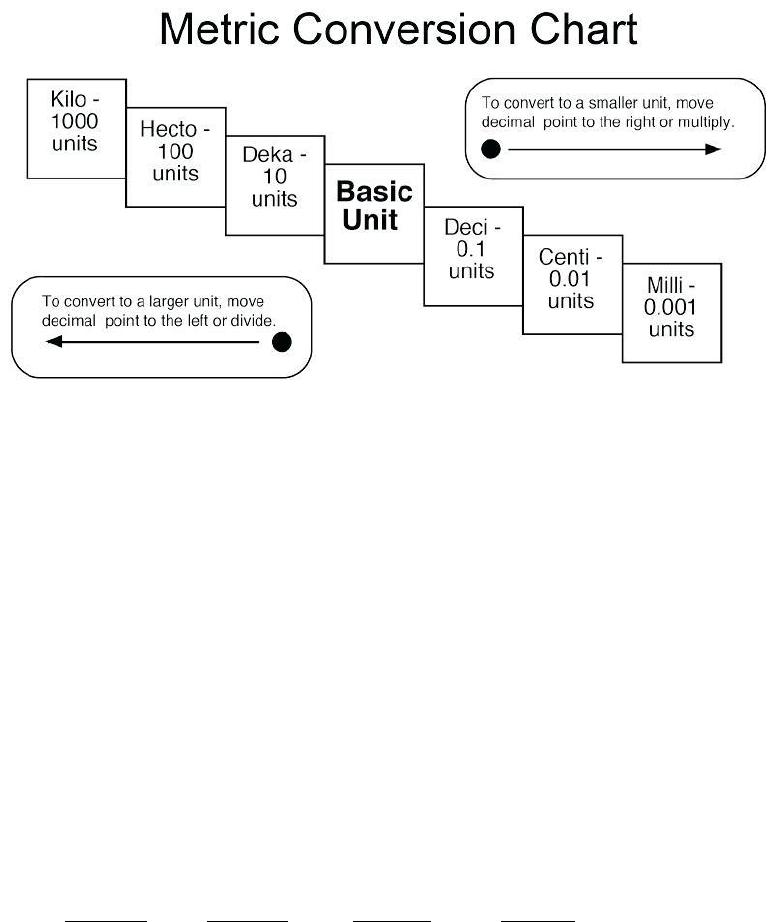
• Metric Conversions (Kilo to Milli)
• Scientific Notation vs Standard Notation
➢ When the exponent on 10 is positive, it means the number is that many powers of 10
larger. Example: Sun’s diameter = 1.392 x 10⁹ m = 1,392,000,000 m.
➢ When the exponent on 10 is negative, it means the number is that many powers of 10
smaller. Example: Average atom’s diameter = 3 x 10⁻¹⁰ m = 0.0000000003 m.
• Accuracy and Precision
➢ Accuracy refers to how close the measured value is to the actual value.
➢ Precision refers to how close a series of measurements are to one another or how
reproducible they are.
• Significant Digits
➢ First, ALL digits 1-9 ARE SIGNIFICANT
➢ Sandwiched zeros: these ARE SIGNIFICANT digits
➢ Trailing zeros BEFORE decimal point: NOT SIGNIFICANT, unless they are followed by a
decimal point.
➢ Trailing zeros AFTER decimal point: SIGNIFICANT
➢ Leading zeros before and after a decimal point are NOT SIGNIFICANT
• Calculations using Significant Digits
➢ Addition/Subtraction
➢ 10.44 17.3355 11.2 1000
+ 1.0771 – 3.4 – 9.9345 + 2.11
11.5171 13.9355 1.2655 1002.11
11.52 13.9 1.3 1002 (Rounded to sig fig)
➢ Multiplication/Division
➢ 3.50 x 1.4500 = 5.075 5.07 (3 sig figs)
➢ 1.77 / 0.50 = 3.54 3.5 (2 sig figs)
➢ 1441 x 3.03 = 4366.23 4370 (4 sig figs)
➢ 1000 / 2.11 = 473.9336 500 (1 sig figs)
• Unit Conversions and Density
• Dimension Analysis Conversions
➢ Conversions of multiple steps
➢ Conversions of units raised to a power
➢ Conversions of rates (multi units)
• Density
➢ Definition of Density- The amount of mass in a given unit of volume. Expressed as a
ratio of mass over volume.
➢ Finding density of geometric shapes- Calculate using formulas for materials that have
shapes similar to geometric figures.
• Cube: V=lwh
• Cylinder: V=𝜋r2h
• Cone: V=1
3 𝜋r2h
• Sphere: V=4
3 𝜋r2h
➢ Finding density of irregular shapes
1. Fill graduated cylinder approx. ½ full of water
2. Record initial volume of water
3. Carefully place object into graduated cylinder