Case Study
Xiaomi Challenges Global Smartphone Leaders
I n December 2014, surprised newspaper readers around the world learned that the most valuable
start-up company was a Chinese company that most had never heard of: smartphone maker
Xiaom i (valued at $45 billion) overtook the worldwide operating taxi-booking company Uber
(valued at $40 billion). Within only four years, Xiaomi became number one in China by units
sold, ahead of Samsung, Apple and Lenovo. In the second quarter of 2014, Xiaomi had
overtaken Samsung to become volume market leader with a 14 per cent market share.
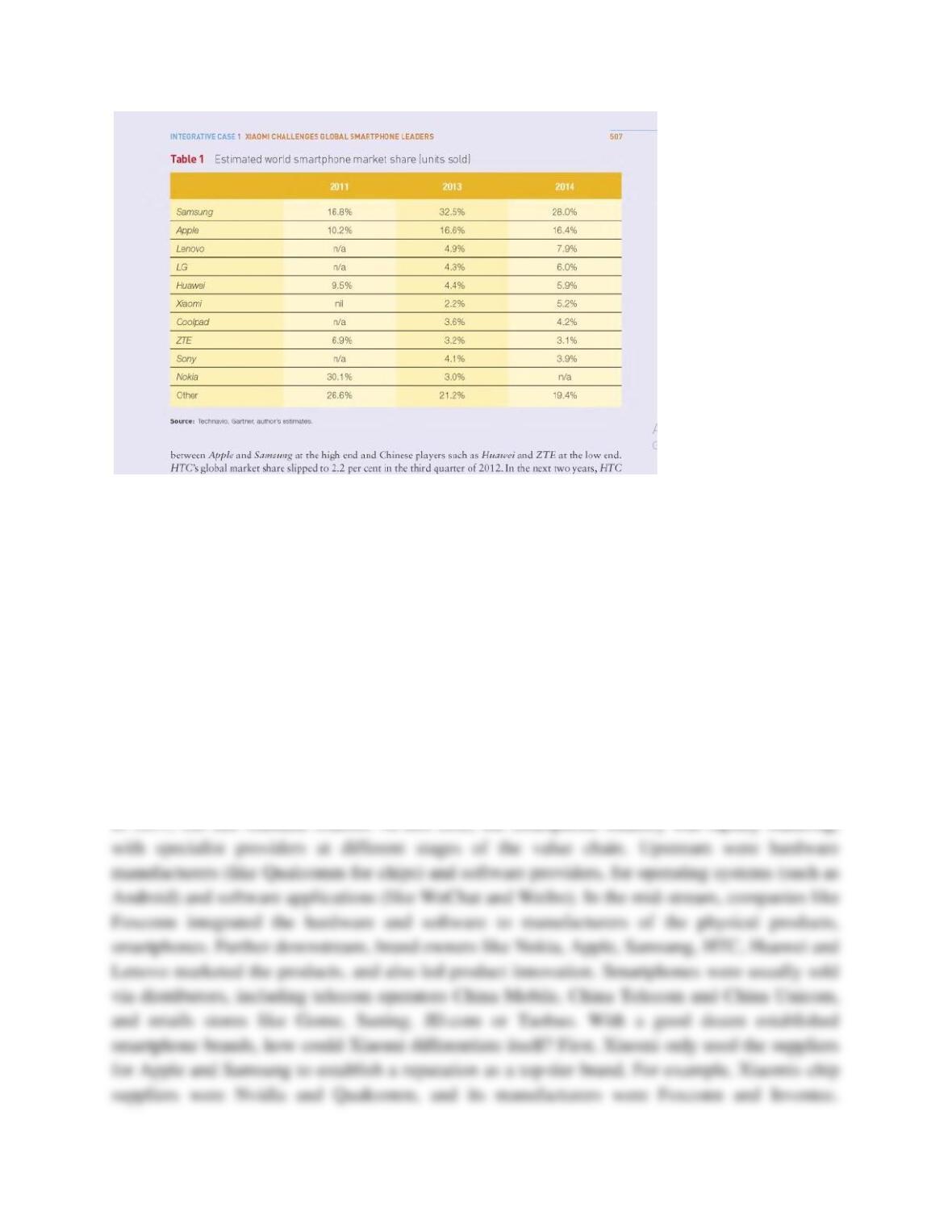
Worldwide, Xiaomi rose to sixth place in 2014, behind Samsung, Apple, Lenovo, LG and
Huawei (Table 1).W hat explains the phenomenal success of Xiaomi?
The Chinese smartphone market has grown to become the largest in the world, overtaking the
USA in 2012, with 31.8 million units sold. The industry was driven by rapid evolution of
smartphone technologies and the availability of Wi-Fi, cheap components, specialized contract
manufacturers and a vast domestic market of budget-conscious consumers. Local Chinese
companies compete head-on against Apple, Samsung and other major global brands, who still
sold about 20 per cent of their global sales in China. Six of the top eight vendors are Chinese
firms that compete intensely among themselves: computer maker Lenovo, telecom equipment
giants Huawei and ZTE, consumer electronics firms TCL and Coolpad and start-up Xiaomi.
Samsung and Apple target the high-end market with handsets for about €500, while domestic
competitors target lower market segments with selling prices set between €100 and €150. Only a
few years ago, the hottest brand in town was HTC. Once a manufacturer of phones for Western
brands, HTC started its own branded smartphone in 2007, and became the top Android-based
smartphone in the USA in 2010. Driven by a fast innovation culture, HTC aimed to launch a new
version every month. Yet with an undifferentiated product and a mid-price positioning, HTC
soon
found itself squeezed between Apple and Samsung at the high end and Chinese players such as
Huawei and ZTE at the low end. HTC ’s global market share slipped to 2.2 per cent in the third
quarter of 2012. In the next two years, HTC launched new high-end phones, but despite awards
and rave reviews, sales remained modest.
ENTREPRENEURSHIP, CHINESE STYLE
One entrepreneur who observed and learned from HTC was Lei Jun. A graduate from Wuhan
University, he spent his early years as a software engineer, later a CEO, at Kingsoft, a software
company competing with Microsoft in China. His first m ajor success as an entrepreneur was
zhuoyue.com, an online book retailer, he sold to Amazon in 2004, earning him €10 million. After
Kingsoft was listed on the Hong Kong Stock Exchange in 2007, Lei resigned as CEO and started
a new career as a venture capitalist, investing in online commerce and social media businesses.