Ch1: Foreign trade
Foreign trade is the exchange of goods across national boundaries. Prof. J.L. Hanson said, “An exchange of various
specialized commodities and services rendered among the corresponding countries is known as foreign trade.”
The balance of trade (BOT), also known as the trade balance, refers to the difference between the monetary value of
a country’s imports and exports over a given time period. A positive trade balance indicates a trade surplus while a
negative trade balance indicates a trade deficit. The BOT is an important component in determining a country’s current
account.
The formula for calculating trade balance is as follows:
Balance of Trade Formula= value of Export- Value of Import
Where:
• Value of Exports is the value of goods and services that are sold to buyers in other countries.
• Value of Imports is the value of goods and services that are bought from sellers in other countries.
In short, the BOT figure alone does not provide much of an indication regarding how well an economy is doing. Economists
generally agree that neither trade surpluses or trade deficits are inherently “bad” or “good” for the economy.
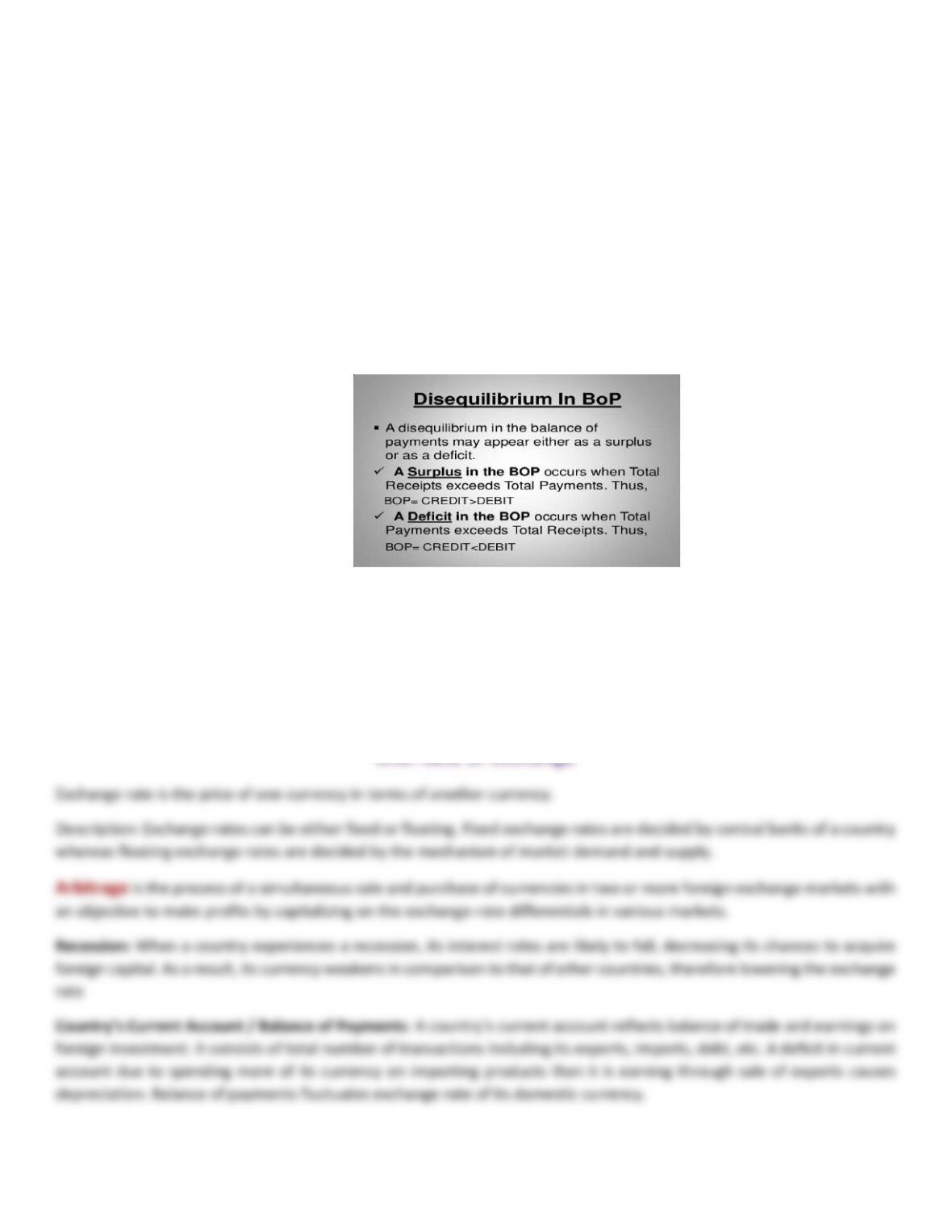
• A positive balance/favorable/surplus occurs when exports > imports and is referred to as a trade surplus.
• A negative trade balance/unfavorable/deficit occurs when exports < imports and is referred to as a trade deficit.
• The balance of trade refers to the difference between a country’s exports and imports.
• This trade figure alone does not provide much insight into the actual health of an economy. (The US is an
example of a country with a long-standing trade deficit but that is currently experiencing one of its longest
expansions in history).
• A positive BOT does not necessarily indicate a healthy economy, nor does a negative one necessarily indicate a
weak economy.
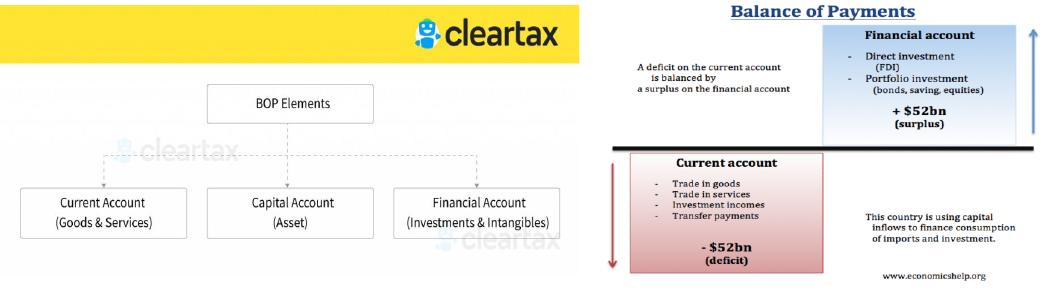
The balance of payments (BOP) is a statement of all transactions made between entities in one country and the rest
of the world over a defined period of time, such as a quarter or a year.
• The balance of payments include both the current account and capital account.
• The current account includes a nation’s net trade in goods and services, its net earnings on cross-border
investments, and its net transfer payments.
• The capital account consists of a nation’s transactions in financial instruments and central bank reserves.
• The sum of all transactions recorded in the balance of payments should be zero
There are 3 major elements of capital account:
• Loans & borrowings – It includes all types of loans from both the private and public sectors located in foreign
countries.
• Investments – These are funds invested in the corporate stocks by non-residents.
• Foreign exchange reserves – Foreign exchange reserves held by the central bank of a country to monitor and
control the exchange rate does impact the capital account.
Financial Account
The flow of funds from and to foreign countries through various investments in real estates, business ventures, foreign
direct investments etc. is monitored through the financial account.
Method 1# Trade Policy Measures: Expanding Exports and Restraining Imports:
Method 2# Expenditure-Reducing Policies:
Method 3# Expenditure – Switching Policies: Devaluation:
Method 4# Exchange Control: