Sommaire
1. Strategic
Analysis…………………………………………………………………………………………………….. 3
A.
Introduction………………………………………………………………………………………………………….. 3
A.1. Background of the company………………………………………………………………………………..
3
A.2. Goals and objectives………………………………………………………………………………………….
3
B. Analysis of the external
environment………………………………………………………………………….. 4
B.1. SWOT Analysis………………………………………………………………………………………………….
4
B.2. PESTEL
Analysis……………………………………………………………………………………………….. 5
B.3. The 5 Forces of PORTER: The current competitive position of
Toyota……………………………. 6
B.4. Analysis of the demand linked to the life cycle of the auto
industry………………………………. 8
C. Analysis of the internal
environment…………………………………………………………………………. 10
C.1. Value Chain Analysis…………………………………………………………………………………………
10
C.2.Firm resources and sustainable competitive
advantage…………………………………………….. 12
C.3. Financial ratio analysis……………………………………………………………………………………..
12
C.4. Customer service perspective…………………………………………………………………………….
13
D. The Key Factors of
Success……………………………………………………………………………………… 13
D.1. A world-class network of suppliers………………………………………………………………………
13
D.2. A Just-In-Time inventory system………………………………………………………………………….
13
D.3. State-of-the-art assembly system……………………………………………………………………….
14
D.4. Intellectual and human capital……………………………………………………………………………
14
2. Strategic
Formulation……………………………………………………………………………………………… 16
A. The Corporate-Level
Strategies……………………………………………………………………………….. 16
B. The Business-Level
Strategy……………………………………………………………………………………. 16
3. Strategic
Implementation………………………………………………………………………………………… 17
Evaluation of the problems and how Toyota dealt with
them……………………………………………… 17
4.
Recommendations………………………………………………………………………………………………….
17
5.
Appendix………………………………………………………………………………………………………………
19
6. References……………………………………………………………………………………………………………
20
1. Strategic Analysis
A. Introduction
A.1. Background of the company
Toyota Motor Corporation (TMC) is a Japanese carmaker headquartered in Toyota, Aichi,
Japan. The company was founded by Kiichiro Toyoda in 1937. TMC is known for its
system of production: Toyotism. Today, the group employs more than 300,000 people
worldwide and is the third largest automobile manufacturer in terms of production behind
General Motors and Volkswagen Group. TMC group companies are Toyota, Lexus,
Daihatsu, and Hino Motors. The current President and CEO of Toyota is M. Akio Toyoda.
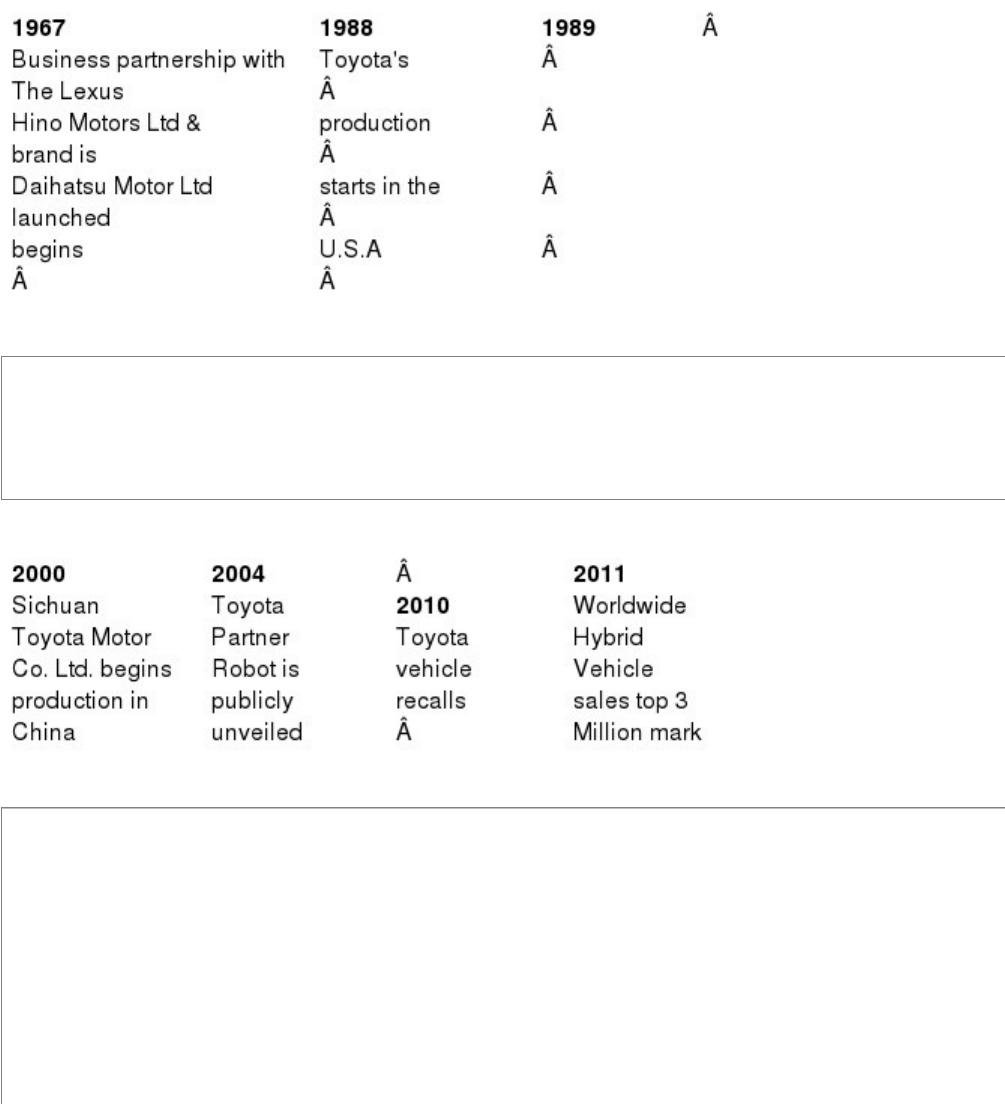
1937
Toyota Motor Co. Ltd is established
1992
Toyota Motor
Manufacturing Ltd. (UK) begins production
1966
Toyota Corolla is launched
1997
The Prius is launched (the world’s 1rst mass-produced hybird car)
A.2. Goals and objectives
One vision: to become the “most respected and admired company”
Moving people in a better way” is a good way to sum up the main mission of Toyota.
This global vision has allowed the group to become one of the best automobile companies
and one of the more popular car brands in the U.S. automobile industry. Toyota’s mission
is to “deliver outstanding automotive products and services to [their] customers, and enrich
[their] community, partners and environment.”
Objective: “making the vehicles ordered by customers in the quickest and most efficient
way, in order to deliver the vehicles as quickly as possible.”
4 core values: Customer first; Respect for people; International focus; Continuous
improvement and innovation.
The corporate philosophy: Respect for the law; Respect for others; Respect for natural
environment; Respect for customers; Respect for employees.
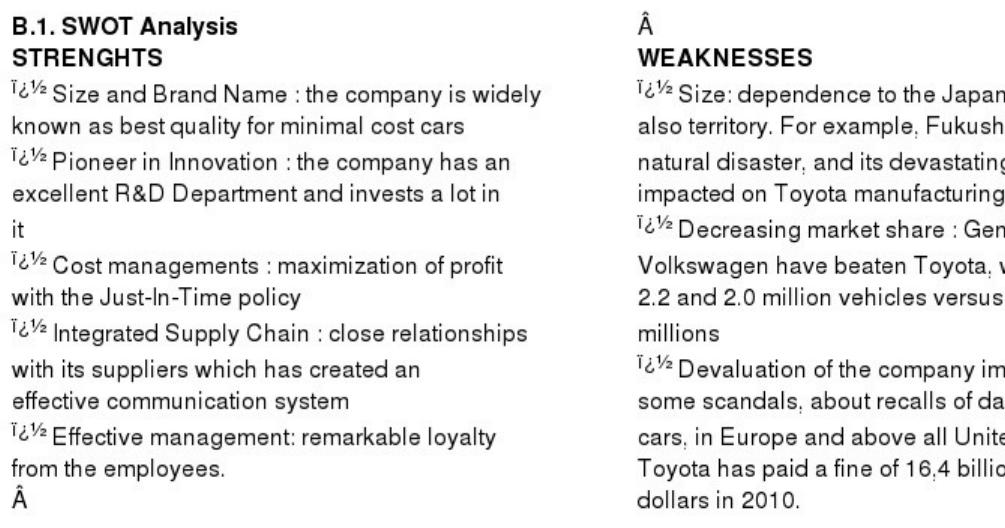
One of the current goals of Toyota is to offer hybrid alternative to every models sold in
the market. This goal has been achieved in 2011 with a total of 3 million hybrid vehicles
sold worldwide within a year. Toyota Company really cares about the protection of the
environment and focus on six different key areas, which are: Environmental Management;
Changes in Energy and Climate; Quality of Air; Concerned Substances; Aspects of
Recycling and Improved Resource utilization; and Societal Cooperation.
B. Analysis of the external environment
B.2. BCG Matrix
STARS:
Toyota Corolla falls into the category of Stars. It generates large amount of cash because of
its strong relative market share, but also consume large amounts of cash because of its high
growth rate; therefore the cash in each direction approximately nets out. However
companies usually invest in star units as they are feeling that the future of their company
depends on the success or failure of that particular unit or product.
Cash Cows:
If Toyota Corolla could maintain its large market share, it will become a Cash Cow when
the market growth rate would decline. The portfolio of a diversified company always
should have stars that will become the next cash cows and ensure future cash generation.
Typically needs this cash to support its rapid and significant growth. It generates large
amounts of cash for the organization and usually segments in which management can
make additional investments and earn attractive returns. In case of Toyota, the RAV4 is a
cash cow for the company which earns a lot of cash for the company and company utilize
this cash to run its future units like Toyota Corolla.
Question Mark:
According to Boston consulting group matrix, a question mark is such a business unit
about which you are not about the success or failure. The unit can be very successful in the
market or it can be simply being ruined of. In case of Toyota, the question mark is actually
the Etios. It is due to the large competition of in this category of cars. Such as the Faw
Citroen’s Elysee and some imported vehicles like polo are already present in the market.
Dogs:

This category of BCG matrix includes the product that has little market share as well as
consuming the large amount of cash instead of generating the cash. But the company also
want to develop that product in order to satisfy the future consuming style which is the like
electro car. It may be a long period of time.
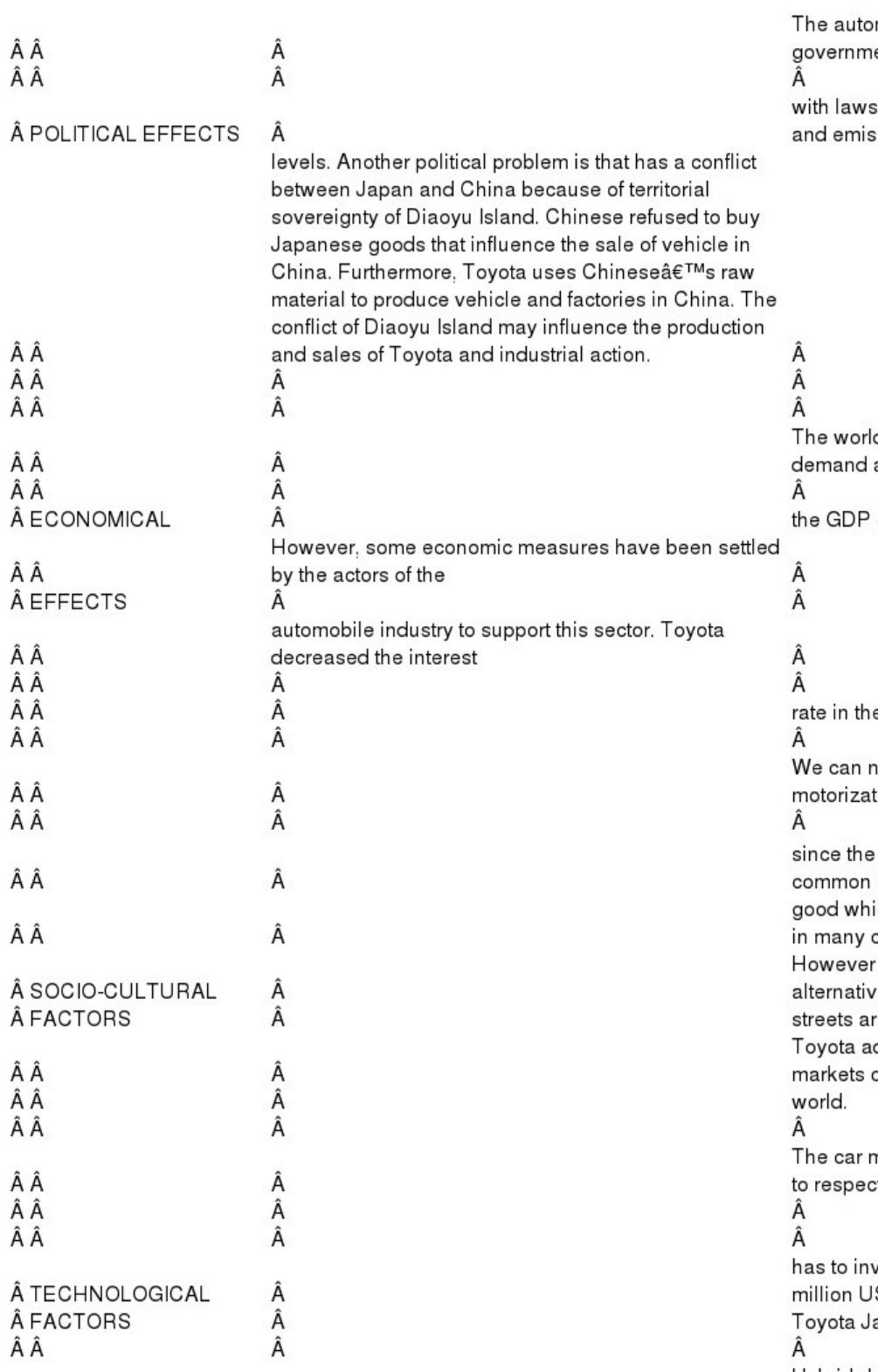
B.3. PESTEL Analysis
B.4. The 5 Forces of PORTER:
The current competitive position of Toyota
“The Porter’s Five Forces analysis evaluates the competitive forces in the industry where
the firm operates. If it determines that the combination of forces in the industry act to
reduce profitability, it is saying the industry is unattractive. The Porter analysis examines
three horizontal forces, or competition in the same industry: Threat of new entrants, threat