1
Masters of Business Administration
Management Policies &Corporate Strategies
Mr Mohd Faizal Abdul Mahad
Exxon Mobil
Name:Abobakar Elsayed Abdelaal Ali
Matric No: G1717363
ExxonMobil Corporation – 2013
2
1.Introduction:
Exxon Mobil is the world’s largest oil company and engages in oil and gas exploration,
production, supply, transportation, and marketing worldwide. Exxon produces about 6.3
million barrels of oil daily by operating more than 37,000 oil wells in 21 different countries,
but the firm also has huge interests in electric power generation. With more than 77,000
employees worldwide. Exxon has ownership interests in 32 refineries in 17 countries.
ExxonMobil has annual revenues of about $500 billion.
In 2012, Apache Corp. acquired ExxonMobil’s North Sea Limited assets including the Beryl
field. In August 2013, ExxonMobil second quarter 2013 results saying its total revenues and
other income would be down 16.4 percent year-over-year to $106.5 billion; the company’s Q2
2013 net income will be down 56.9 percent to $6.9 billion. Weaker refining margins and
volumes associated with planned refinery turnaround and maintenance activities negatively
impacted the company’s Downstream earnings.
1.1History
ExxonMobil has evolved from a regional marketer of kerosene in the U.S. to the largest
publicly traded petroleum and petrochemical enterprise in the world. Today they operate in
most of the world’s countries and are best known by their familiar brand names: Exxon, Esso
and Mobil. They make the products that drive modern transportation, power cities, lubricate
industry and provide petrochemical building blocks that lead to thousands of consumer goods.
ExxonMobil uses innovation and technology to deliver energy and petrochemical products to
meet the world’s growing demand. Their people, technical expertise, financial strength, and
global reach provide a competitive advantage and ensure broad exposure to high-quality
opportunities. Extensive research programs support operations, enable continuous
improvement in each of business lines, and explore new and emerging energy sources and
technologies. The Corporation comprises 10 separate companies, making up the Upstream,
Downstream, and Chemical businesses. ExxonMobil began when John D. Rockefeller’s
Standard Oil was established in 1870. The name Standard was used to denote high, uniform
quality.

3
Important note:
In 2012, Apache Corp. acquired ExxonMobil’s North Sea Limited assets including the Beryl
field. In August 2013, ExxonMobil second quarter 2013 results saying its total revenues and
other income would be down 16.4 percent year-over-year to $106.5 billion; the company’s Q2
2013 net income will be down 56.9 percent to $6.9 billion. Weaker refining margins and
volumes associated with planned refinery turnaround and maintenance activities negatively
impacted the company’s Downstream earnings.
The major issues in the case:
1. The need to inject new investments in the field of oil production.
2. Despite lower revenues in the field of natural gas, the company needs additional
investments to meet expectations of increased demand.
3. Decrease in revenues related to refining operations.
4. The company may need to increase oil tankers to cover the increase in production over
the next years.
1.2Vision Statement
Proposed: To be the world leader in all aspects of oil production while creating a safer and
cleaner environment for everyone.
1.3 Mission Statement
Proposed: To be high quality energy company, (2) competitively priced, (3) using technology
to find cleaner and safer alternatives (4) to provide energy to the world. (5) to develop and
utilize high impact technologies to sustain growth and profitability. (6) to protect the earth and
the people living on it by providing energy safely and ethically and focusing on renewable
efforts.
as we strive to grow profitably for our shareholders (5)
1. Customers
2. Products or services
3. Markets
4. Technology
5. Concern for survival, growth, and profitability
6. Philosophy
7. Self-concept
8. Public image
9. Employees
4
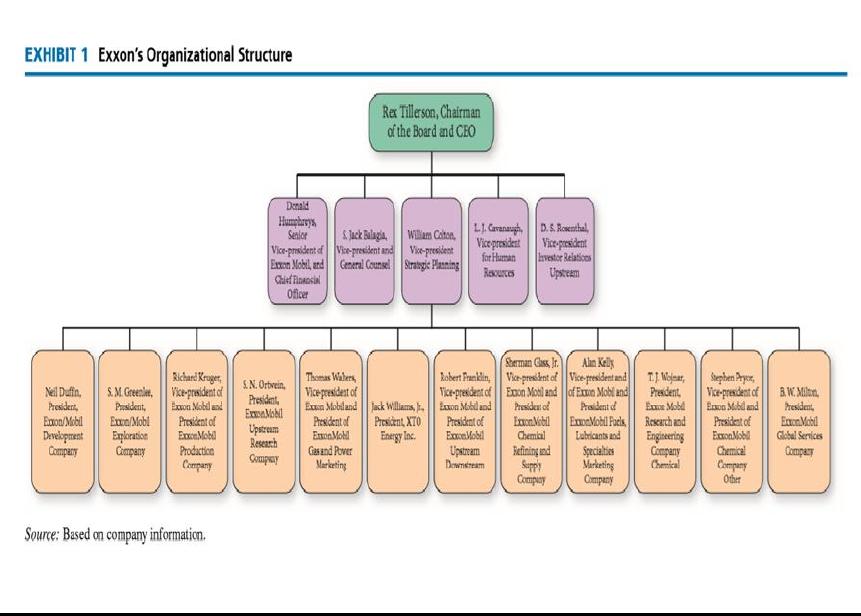
Organizational constructure
It is clear that Exxon Mobil corporation involves a huge number of operations due to the large
number of different activities in the company besides work in 21 countries around the world.
Exxon Mobil has more than 77,000 employees and revenues about $ 500 billion annually.
Thus, the organizational structure should be flexible and take into some important
considerations to utilize the company’s resources the best form.
There are some problems in the company’s organizational structure, they are:
• No chief operations officer (COO) or chief accounting officer (CAO).
• No SBU head for each group.
• zero women, Hispanics, or African Americans among its top corporate executives.
• the lack of diversity.
In our opinions, Exxon Mobil should do the following in its organizational structure:
Review its structure to determine the imperfection, it can do through planning and HR
departments within company or reliance on some experts like management consulting
centers which have long-experiences in this field.

5
Doing redesign for some jobs which related operations, production, financing, and marketing
processes.
The input stage:
Internal Audit
Internal factors mean the company can control them. There are two types of internal factors
(strengths and weaknesses) of a firm. Company can use Internal Factor Evaluation (IFE) matrix
to evaluate main strengths and weaknesses within a company. It could assist a company to
formulate its strategies because IFE matrix is a powerful tool to evaluate a company’s internal
performance. IFE matrix of Exxon can be constructed below.
Strengths
1. Exxon produces about 6.3 million barrels of oil daily.
2. Exxon still employed more single-hull oil tankers than the next 10 largest oil companies
combined
3. Upstream revenues account for over 83% of total revenues after tax in 2012 compared
by 2011 and 2010 it was 82%in both years.
4. almost 66% of all revenues are derived from global market (from outside the USA).
5. About 30% of Exxon’s production comes from North America, but by 2016 this number
is expected to grow to 35%.
6. Exxon is the largest global refiner of oil in the world with downstream operations
refining and distributing products derived from crude oil to customers around the
world.
7. Exxon’s lubricants business in the downstream market continues to grow, and Exxon
is the current market leader in high value synthetic lubricants in many key markets
such as China, India, and Russia.
8. ExxonMobil is one of the largest petrochemical companies in the world, providing
materials for use in products including plastic bottles, synthetic rubber, solvents, and
countless other goods.
Weaknesses
1. Exxon does not report a mission or vision statement.
2. There apparently is no COO or CAO in the Exxon hierarchy, nor an SBU head for each
group. Exxon has virtually no women, Hispanics, or African-Americans among their
top corporate executives.
3. Notable oil spills in the last years have hurt Exxon’s reputation and hurt the firm
financially.
4. Downstream business only attributes about 11 percent of companywide earnings.
6
5. Downstream business remains weak, and Exxon recently divested their downstream
businesses in Argentina, Uruguay, Paraguay, Central America, Malaysia and
Switzerland. In 2012, Exxon announced restructuring of their downstream holdings in
Japan.
6. Over the prior 20-year period, inflation-adjusted refining margins have been flat and
Exxon’s long-term outlook in refining margins will likely remain weak, as competition
grows and capacity additions grow quicker than global demand.
7. Exxon is not taking advantage of cheap financing at historically low rates. with no long–
term debt.
8. Earnings for the Chemical declined 11% from 2010 to 2012.
IEF matrix:
Strengths
Weight
Rating
Weight
score
1-Exxon produces about 6.3 million barrels of oil daily.
0.11
3
0.33
2-Exxon still employed more single-hull oil tankers than the next 10 largest
oil companies combined
0.07
3
0.21
3-Upstream revenues account for over 83% of total revenues after tax in
2012 compared by 2011 and 2010 it was 82%in both years.
0.10
4
0.40
4-Almost 66% of all revenues are derived from global market (from
outside the USA).
0.10
4
0.40
5-About 30% of Exxon’s production comes from North America, but by 2016
this number is expected to grow to 35%.
0.08
4
0.32
6-Exxon is the largest global refiner of oil in the world with downstream
operations refining and distributing products derived from crude oil to
customers around the world.
0.07
4
0.28
7-Exxon’s lubricants business in the downstream market continues to grow,
and Exxon is the current market leader in high value synthetic lubricants in
many key markets such as China, India, and Russia.
0.06
4
0.24
8- ExxonMobil is one of the largest petrochemical companies in the world,
providing materials for use in products including plastic bottles, synthetic
rubber, solvents, and countless other goods.
0.07
4
0.28
Weaknesses
1.Exxon does not report a mission or vision statement.
0.04
1
0.04
2.There apparently is no COO or CAO in the Exxon hierarchy, nor an SBU head for each
group. Exxon has virtually no women, Hispanics, or African-Americans among their top
corporate executives.
0.05
1
0.05
3.Notable oil spills in the last years have hurt Exxon’s reputation and hurt the firm
financially.
0.03
1
0.03
4.downstream business only attributes about 11 percent of companywide earnings.
0.05
2
0.10
5.Downstream business remains weak, and Exxon recently divested their downstream
businesses in Argentina, Uruguay, Paraguay, Central America, Malaysia and Switzerland.
In 2012, Exxon announced restructuring of their downstream holdings in Japan.
0.06
2
0.12
6.Over the prior 20-year period, inflation-adjusted refining margins have been flat and
Exxon’s long-term outlook in refining margins will likely remain weak, as competition
grows and capacity additions grow quicker than global demand.
0.03
1
0.03
7.Exxon is not taking advantage of cheap financing at historically low rates. with no long-
term debt.
0.03
2
0.06
8.Earnings for the Chemical declined 11% from 2010 to 2012.
0.05
1
0.05
Total
1.00
2.95