Solar Plant
STEM Research Brief
Teachers’ Notes
Curriculum Coverage : Subject Knowledge and Understanding
Photosynthesis is a process used by
plants to convert light energy into
chemical energy and storing it in the form
of sugar.
In nature, leaves of a plant are
arranged on its stem in order to be able to
expose it to the most sunlight. The leaf
arrangement is related to the Fibonacci
sequence or other sequences.
A solar cell, or a photovoltaic cell, is
an electrical device that directly
converts light energy into electricity.
Typical solar cells are made of 2
different types of semiconductors
namely p–type and n–type.
The factors effecting electrical power
generated by a solar cell are angles,
temperature and light intensity on the
surface of the cell.
Introduction
Teacher assigns task to students
through the memorandum which
provides general information about the
project, then use background paper and
questions to guide them through the
concepts they should be concerned
about when designing a solar plant
model. After that, teacher will let
students start planning, investigating,
designing, building the model and
writing the report to EGAT.
Background knowledge
Mathematics – Sequences
Biology – Photosynthesis
Chemistry – Semiconductor,
solar cells
Physics –
Ohm’s law, electrical
circuit, electrical power and electrical
energy
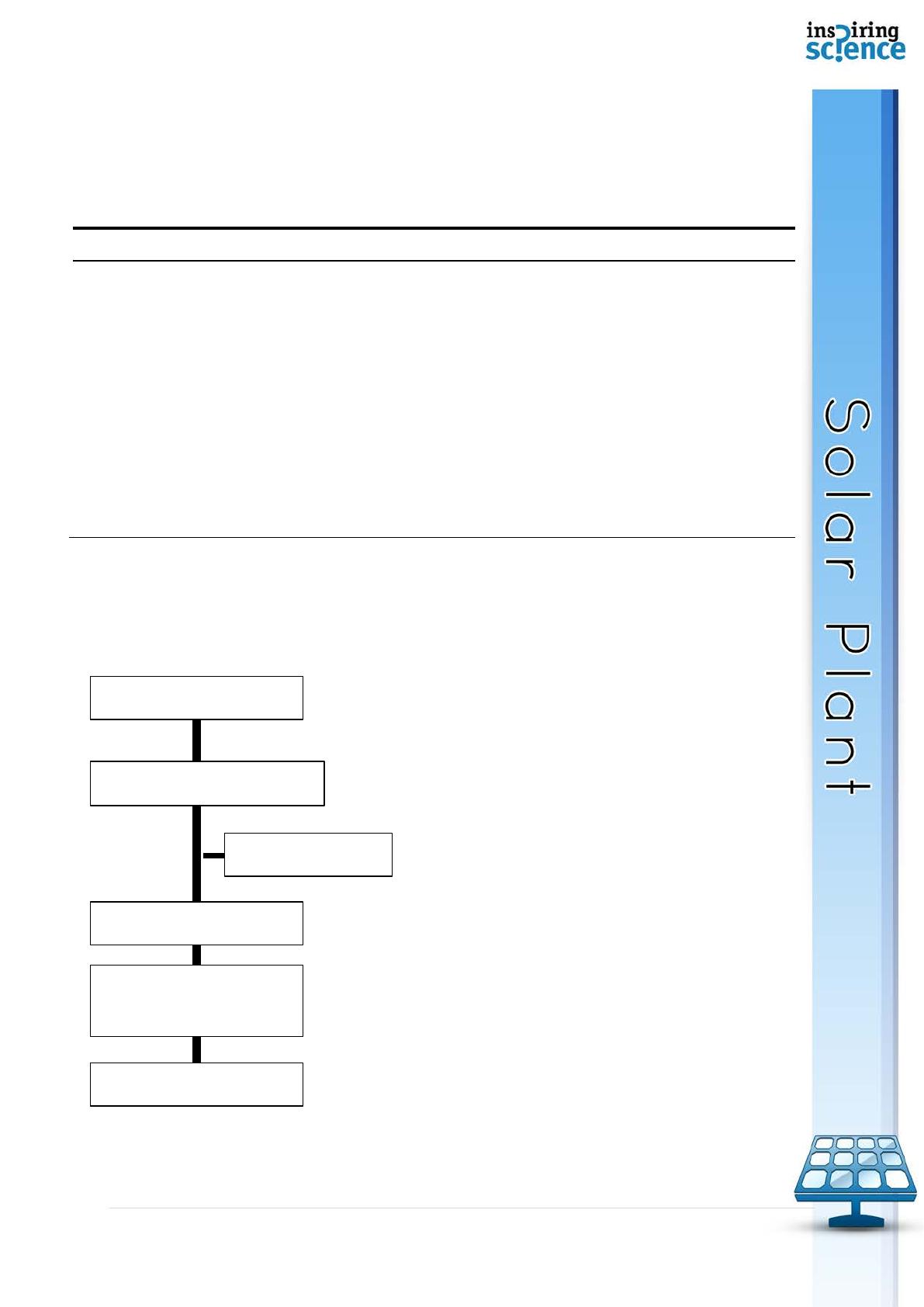
Route through the Brief
Memo
Background paper 1-5
Suggestion
Inquiry
Design and build
model
Report
1 | STEM Project
Running the Brief
Student grouping
Memo – whole class; teacher leads pupils
through the sheet setting the scene and let
student observe leaf arrangement from real
plant stems
Background paper 1 – groups of 3 – 4
Background paper 2 – groups of 3 – 4
Background paper 3 – groups of 3 – 4
Background paper 4 – groups of 3 – 4
Background paper 5 – groups of 3 – 4
Investigation – groups of 3 – 4
Making the report – groups of 3 – 4
Presentation – groups of 3 – 4
Timing
The STEM Research brief takes 8 hours.
Step
Time(mins)
Step 1: Engaging
students,Identifying problem
30
Background paper 1
Background paper 1 provides
background information about
photosynthesis.
Background paper 2
Background paper 2 provides
background information about the
Fibonacci sequence. This will inspire
students with an idea about the
arrangement of a solar plant model.
Background paper 3
Background paper 3 provides
general information about solar cells.
The questions in this page will
encourage students to think about the
type of solar cells that they will use in
their solar plant.
Background paper 4
Background paper 4 provides
general information about electrical
Step 3: Planning and
Step 5: Report and