2013/2014
304SM – Strategic Sales Management
Assignment Brief 1 of 2
Business Case of 3500 words
CONTENTS
Introduction. – 1 –
ANALYSIS. – 2 –
1. External environment. – 2 –
1.1 P.E.S.T.E.L. – 2 –
1.2 Five forces. – 5 –
2. Internal environment. – 7 –
2.1 S.W. – 7 –
2.2 Value of the company. – 8 –
evaluation AND STRATEGY. – 10 –
1. Strategy chosen. – 10 –
2. Evaluation and recommendations. – 10 –
2.1 Starbucks’ services: – 10 –
2.2 Starbucks’ products. – 12 –
2.3 Customers’ needs. – 14 –
IMPLEMENTATION. – 15 –
1. Starbucks’ loyalty cards. – 15 –
1.1 Rewards for spending. – 15 –
1.2 Motivation. – 15 –
2. Starbucks’ employees. – 16 –
2.1 Partners. – 16 –
2.2 Rewards. – 17 –
conclusion. – 18 –
REFERENCES LIST. – 19 –
Introduction
In 1971, the first Starbucks’ store opened in Seattle (Bussing Burks, 2009: 1). Starbucks
began as a retailer of bean coffee and tea. However, since Howard Schultz joined the
company as the Director of Retail Operations, the firm had changed. Milan and Italy
inspired him; he was impressed by their coffee houses (Ngoni Tawengwa, 2011). He
decided to create that same coffee house culture in Seattle. So, he advised the company to
sell brewed coffee and espresso beverages in coffee houses. The brand began quickly
famous so the company expanded all over the country. In 1994, Starbucks had opened 425
stores countrywide. Then, in 1996, the company also decided to expand internationally.
Their first store outside the United States had been opened in Japan. Today, it has more
than 18,000 establishments in 62 countries (Starbucks, 2013).
This assignment will try to implement a new Customer Relationship Management
(C.R.M.) strategy to Starbucks’ Company. The structure of this report will be inspired by
the study of Pettigrew and Whipp (1992) about the management of change. First, the
report will analyze external and internal environments. Then, it will choose the good
strategy for the company before the evaluation and the implementation of it.
ANALYSIS
To understand the environment of Starbucks’ Company, external and internal analysis will
be used.
1. External environment
The models exploited will be PESTEL for a macro-environment and Porter’s five forces
(1985) for a micro-environment.
1.1 P.E.S.T.E.L.
1.1.1 Political
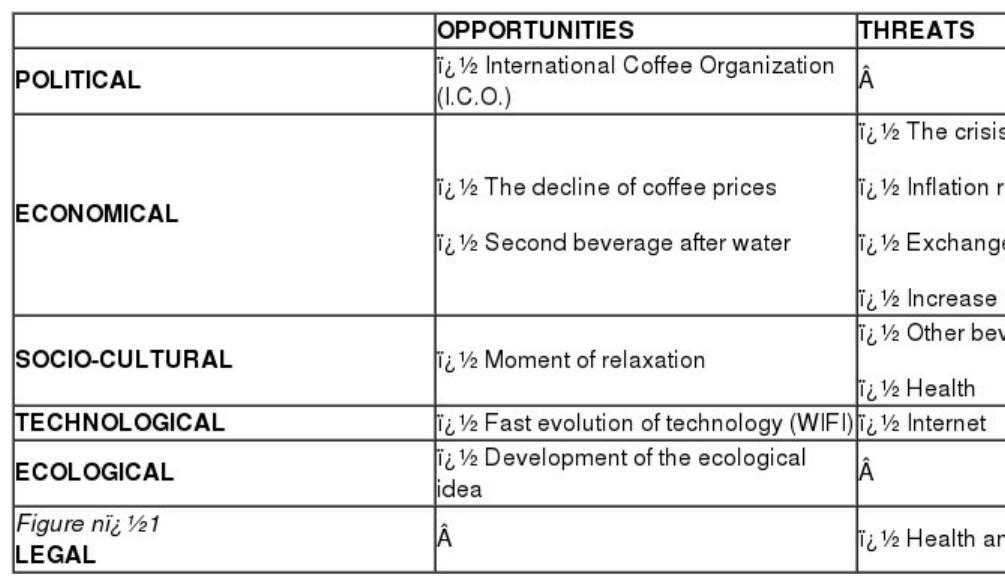
There is the International Coffee Organization which is composed of importers and
exporters of coffee. Its main mission is to administer international agreements for the
coffee (I.C.O., 2013).
1.1.2 Economical
The increase or the decrease in raw materials can have a very big impact on sales.
According to the I.C.O. (2013), since September 2011, the average price of coffee has been
declining. So, it is a good opportunity for Starbucks to increase its profit.
Moreover, Harvard School of Public Health (n.d.) claims that the coffee is the most
consumed beverage after water. According to the Fair-trade Foundation (2012), “global
consumption has almost doubled in the last 40 years and is forecast to reach 9.09 million
tonnes by 2019″, which is a good news for Starbucks’ sales.
However, because of the crisis, household budgets are tight and the coffee will not be a
priority purchase anymore.
Also, Starbucks, which has a lot of shops abroad, exports and imports a lot of products. In
most of these countries, there are high inflation rates and exchange rates which may affect
sales and profits of the company.
1.1.3 Socio-cultural
Coffee is seen as a relaxation time, a discussion, a meeting with other persons. At work,
people drink a coffee during a break. They are accustomed to go to a coffee shop to share a
good time. “Coffee shops make up the fastest growing part of the restaurant business,
checking in with a 7% annual growth rate” (Coffee-Statistics.com, 2012).
It’s not everyone who likes coffee, so people can be attracted by other beverages, such as
Coke, Fanta, etc.
Also, people are becoming more health conscious. According to the Healthy Eating
Consumer Trend Report (2013), “Sixty-four percent of consumers today—up from 57
percent in 2010—agree that it is important to eat healthy and pay attention to nutrition”.
That why, Starbucks needs to use lower calorie ingredients in their products.
1.1.4 Technological
The technology continues to evolve every day and it is a good thing to Starbucks. Indeed,
thanks to this technology, Starbucks can provide to its customers WIFI in all its shops.
Also, it helps the firm to improve its Customer Relationship Management (C.R.M.). For
example, in 2011, the company creates an application that allows consumers to pay via
their mobile phone, but also to track their spending and rewards. Starbucks can also use
coffee machines more efficient such as the Clover machine which produces the ideal flavor
(Adkins, n.d.).
But on the other hand people can use the Internet to say their opinions about a product. A
lot of negative opinions can be found on the web (Hightower, 2013).
1.1.5 Ecological
Fair-trade is fashionable. Global sales of fair-trade coffee increased steadily from year to
year: Sales (in tonnes) were multiplied by nine from 2000 to 2010 (Faire-Trade
Foundation, 2012). Many consumers are motivated by ecological approaches. They care
about trees, pollution, waste, etc. In France, 47% of French people (against 40% in 2011)
say they are concerned with the ecology (ConsoGlobe, n.d.).
1.1.6 Legal
There are Health and safety regulations such as caffeine production and consumption can
impact the company.