Fall 2020 – MGMT 308 – Ethical, Political, and Social Environment of Business
Stakeholder_Analysis_Assignment 1
Insuring Uber’s App-On Gap: Stakeholder Analysis Exercise
Submitted 10/26/2020
1. Who are Uber’s relevant market and nonmarket stakeholders in this situation? (please,
select at least five stakeholders that are clearly involved in the case). 15 points
Stakeholders are parties or investors directly or indirectly influenced or be affected by
the actions and outcomes of the business. In this stakeholder analysis Uber has two
types of stakeholders. The relevant market stakeholders in this situation are the
workers and interested parties such as the shareholders, the driver, customers, and the
insurance provider of the car.
The non-market stakeholders would be the outside parties that include the society/
people in the city especially the girl’s family, governing bodies/city council (legislator
Susan Bonilla), and other similar businesses such as other rideshare companies and
taxi companies, and trade association (high technology and Internet based firms), cab
drivers, other ride-hailing companies.
2. What are the various stakeholders’ interests? Please indicate if each stakeholder would
likely support, or oppose, a requirement for Uber to extend its insurance to cover the
app-on gap. 15 points
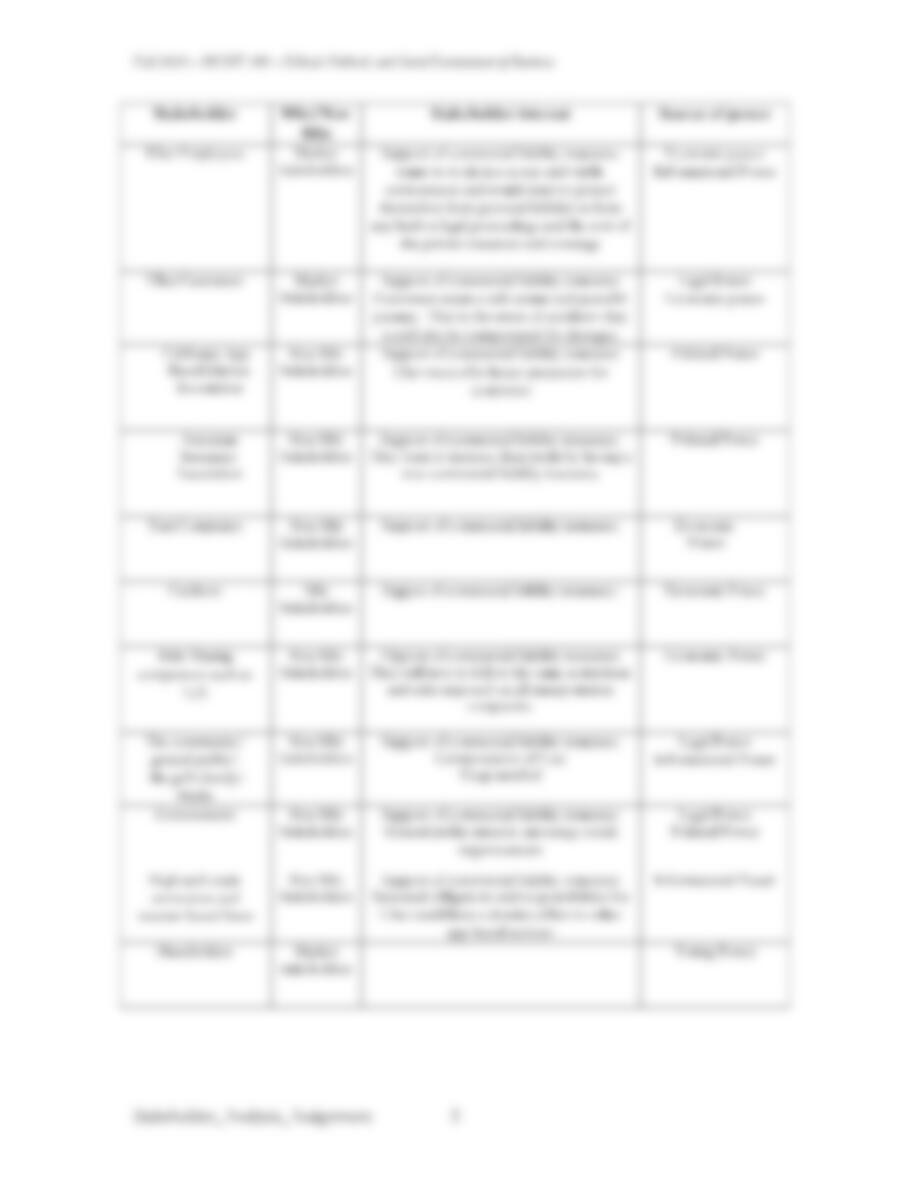
These various stakeholder interest may not always align but they still should have
some power to protect their interests for which they are motivated. After
identification of the stakeholders in this case we are now to prioritize them by
assessing the interest, influence/power, and level of participation in the issue of
extending the insurance to cover app-on gap with the company.(Please see Table on
Page 3.)
OPPOSE insurance on App-On Gap
The Uber Owners/Shareholders opposes the insurance due to their financial
interests as it will be an additional expense on their part consequently resulting in
lesser dividends to be received and ultimately a less secure retirement security is also
at stake but due legal issues and Corporate Social Responsibility they should adhere to
the proposal of this bill in order to avoid negative publicity.
The Uber employees would of course want to have a fair pay and wants job security
as well as sustainable working environment and would want to protect themselves
from any kind or legal proceedings but opposes the insurance on App-On Gap due to
the burden of the additional expense of insurance.
SUPPORT insurance on App-On Gap
The Uber customers and potential customers would want a safe and peaceful
journey knowing that in the event of an accident they will be fully compensated. They
Fall 2020 – MGMT 308 – Ethical, Political, and Social Environment of Business
want a fair value on the amount of money they pay for their rides with Uber and not
blown up by the additional costs of Insurances coverages.
The government like the rest of the public interest group below (CADA and AIA)
and local communities have a broader stake than just the financial stake of the above-
mentioned stakeholders while ensuring human rights and justice is served to those
who are wronged, they also have to uphold the law and make changes through a bill if
necessary as in this case.
The California App-Based Driver’s Association or CADA who also represents
owners and drivers from Uber, Lyft, Sidecar, Toro Ridge, Opali and other non-profit
organizations needs to be informed at all times. They support this insurance as they
also promote, fairness, justice and transparency in the app-based drivers throughout
California. They have
American Insurance Association or AIA on the other hand just needs a low-level
monitoring due to low interest and low influence. These insurance companies would
support this based on their monetary interest.
3. What sources of power do the relevant stakeholders have? 25 points
After prioritizing stakeholders by assessing their interests, we are now going to look at
the various influence/power, and level of participation in the issue of extending the