1.
Under the proportionate consolidation concept, which of the following statements is
true?
A)
The accounting emphasis in preparing consolidated financial statements is placed
on the business combination being formed.
B)
Holding control of a subsidiary provides the parent with an indivisible interest in
that company.
C)
The objective of consolidated financial statements is to serve as a report to the
stockholders of the parent company.
D)
The proportional consolidation concept is a hybrid of the proportionate
consolidation concept and the parent company concept.
E)
The economic unit concept is no longer allowed according to SFAS 141.
2.
Bowler Inc. owns 30% of Yarby Co. and applies the equity method. During the current
year, Bowler bought inventory costing $66,000 and then sold it to Yarby for $120,000.
At year-end, only $24,000 of merchandise was still being held by Yarby. What amount
of unrealized gain must be deferred by Bowler?
A)
$ 6,480
B)
$ 3,240
C)
$10,800
D)
$ 5,920
E)
$ 6,610
Inventory at year-end $ 24,000.00
Gross profit markup ($54,000 ÷ $120,000) × .45
Unrealized gain $ 10,800
Ownership share × .30
Intercompany unrealized gain — deferred $ 3,240
3.
Red Co. purchased 100% of Green, Inc. on October 1, 2003. On January 1, Green had
inventory with a book value (BV) of $42,000 and a fair market value (FMV) of $52,000.
This inventory had not yet been sold at December 31, 2003. Green had a building with
a book value of $200,000 and a FMV of $390,000. Green had equipment with a book
value of $350,000 and a FMV of $280,000. The building had a 10-year remaining
useful life and the equipment had a 5-year remaining useful life. Goodwill of $220,000
was recognized as part of this acquisition. How much amortization expense will be on
the consolidated financial statements for the year ended on December 31, 2003 related
to the acquisition of Green?
A)
$43,000
B)
$33,000
C)
$ 5,000
D)
$15,000
E)
-0-

4.
The hardware operating segment of Bloom Corporation has the following revenues for
the year ended December 31, 2004:
Sales to outsiders $ 417,000
Intersegment transfers 23,000
Interest revenue – outsiders 7,000
Interest revenue – intersegment loans 33,000
For purposes of the Revenue Test, what amount will be used as total revenues of the
hardware operating segment?
A)
$ 417,000
B)
$ 440,000
C)
$ 424,000
D)
$ 460,000
E)
$ 480,000
5.
When a company applies the cost method in accounting for its investment in subsidiary
and the subsidiary reports income in excess of dividends paid, what worksheet entry
would be made?
A)
Retained earnings
Investment in subsidiary
B)
Investment in subsidiary
Retained earnings
C)
Investment in subsidiary
Equity in subsidiary’s income
D)
Equity in subsidiary’s income
Investment in subsidiary
E)
Additional paid-in capital
Retained earnings
Use the following to answer question 6:
On January 1, 2003, Dawson, Incorporated, paid $100,000 for a 30% interest in Sacco
Corporation. This investee had assets with a book value of $400,000 and liabilities of $150,000.
A patent held by Sacco having a book value of $10,000 was actually worth $40,000 with a six
year remaining life. Any goodwill associated with this acquisition will not be amortized. During
2003, Sacco reported income of $50,000 and paid dividends of $20,000 while in 2004 it reported
income of $75,000 and dividends of $30,000. Assume Dawson has the ability to significantly
influence the operations of Sacco.

6.
The amount allocated to goodwill at January 1, 2003, is
A)
$25,000.
B)
$13,000
C)
$ 9,000.
D)
$16,000.
E)
$10,000.
7.
Which of the following statements is true regarding an acquisition?
A)
The original companies dissolve while remaining as separate divisions of a newly
created company.
B)
Both companies remain in existence as legal corporations with one corporation
now a subsidiary of the acquiring company.
C)
The acquired company dissolves as a separate corporation and becomes a division
of the acquiring company.
D)
The acquired company dissolves and goes out of business.
E)
None of the above.
Use the following to answer question 8:
Dean Hardware, Inc. is comprised of five operating segments. Information about each of these
segments is as follows (in thousands):
Rakes Pails Shovels Hardware Accessories
Sales to outsiders $ 94 $506 $44 $122 $28
Intersegment transfers 4 26 14 30 24
Interest revenue – outsiders 2 – 4 8 –
Interest revenue – intersegment – 6 – – 22
Operating expenses –outsiders 116 414 40 102 26
Operating expenses – intersegment 2 20 6 16 22
Interest expense – 12 – 2 22
Income taxes (4) 10 4 6 2
Tangible assets 18 116 12 12 8
Intangible assets – – 4 8 6
Intersegment loans 8 6 – – –
8.
What is the total amount of revenues in applying the revenue test?
A)
$ 794
B)
$ 808
C)
$ 906
D)
$ 916
E)
$ 934
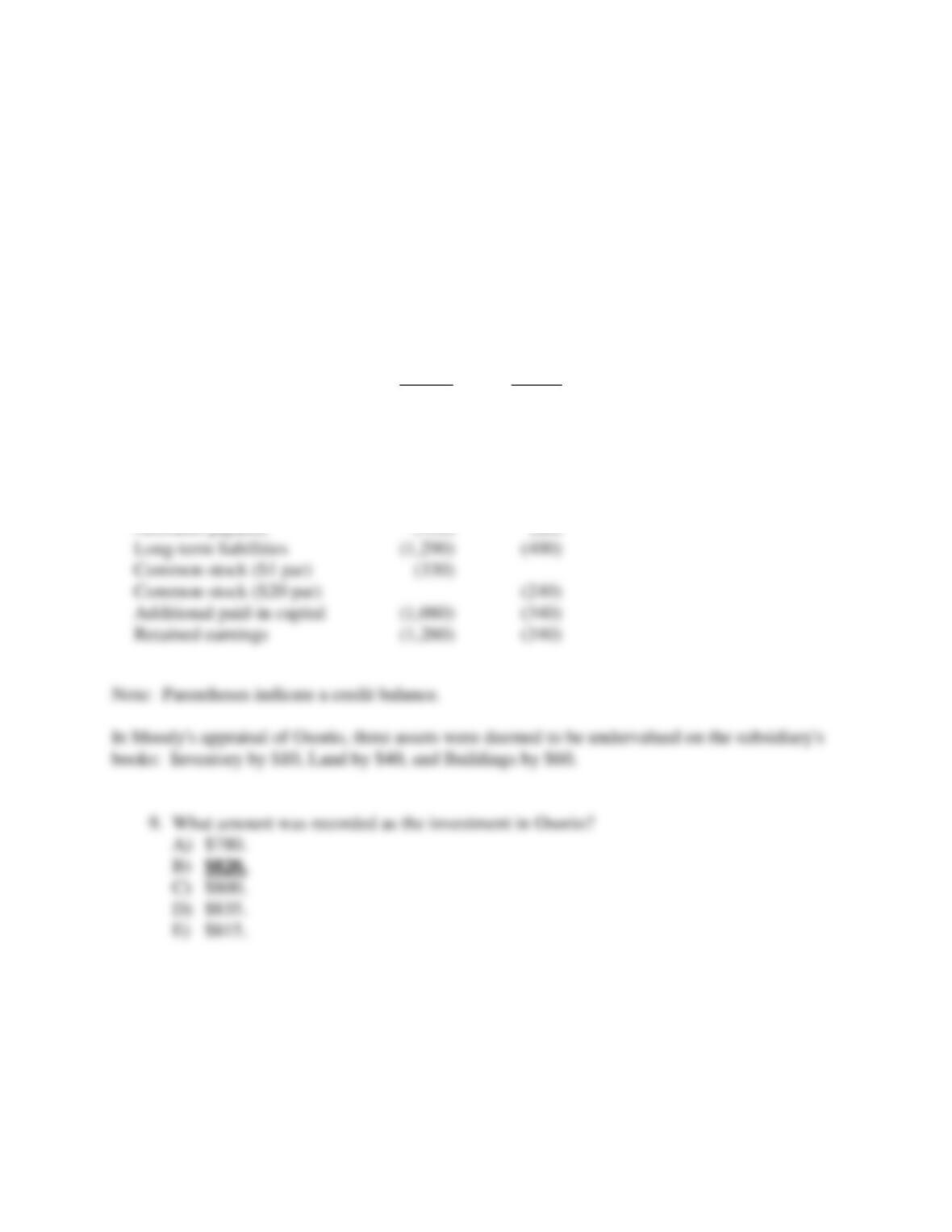
Use the following to answer question 9:
On January 1, 2003, the Moody company purchased 100% of the outstanding common stock of
Osorio Company. To acquire these shares, Moody issued $400 in long-term liabilities and 40
shares of common stock having a par value of $1 per share but a fair market value of $10 per
share. Moody paid $20 to lawyers, accountants, and brokers for assistance in bringing about this
purchase. Another $15 was paid in connection with stock issuance costs.
Prior to these transactions, the balance sheets for the two companies were as follows:
Moody Osorio
Cash $ 180 $ 40
Receivables 810 180
Inventories 1,080 280
Land 600 360
Buildings (net) 1,260 440
Equipment (net) 480 100