08
Fall
Man Nga Lee (Sara) Samantha Christy Nuryadi
Rimma Shkinder Sherly Susanty
Country Analysis Report
Sri Lanka
I BUS 300 A
December 1, 2014

IV. INTERNATIONAL COMPETITORS
Tourism is one of the main sectors that significantly help Sri Lanka’s economic growth.
The country currently aims to secure annual foreign exchange earnings of $2.75 billion by 2016.1
Further, it is expected that 500,000 people will depend on the industry for jobs by that year.2
International hotel chains such as Hyatt Hotels Corporation, Marriott International, Inc.
and Hilton Worldwide have successfully extended their presence in Sri Lanka. Marriott
International, Inc. signed an agreement in 2012 with Weligama Hotel Properties Ltd., a private
company based in Sri Lanka, to open its first hotel in Sri Lanka in 2014.3 The Weligama Bay
Marriott Resort & Spa in Weligama is a five-star resort with a beach frontage in the Southeast of
the country.4 Hyatt Hotels Corporation has entered into a management agreement with Sinolanka
Hotels and Spa, for its first Hyatt-branded hotel in Sri Lanka in 2014. It will be on one of the
arterial roads in the central business district area.5 Hilton Colombo Residences is a four-star hotel
in Colombo close to the international airport and a few attractions in the city, aiming to attract
people travelling there for business.6
More hotels are expected to open in Sri Lanka in the near future. For example, Shangri-
La Hotels and Resorts broke ground for a resort on the southern coast of Sri Lanka in 2012 and
are due to open in 2015. The resort will complement Shangri-La Hotel, Colombo, which is
currently under construction and is expected to open in 2017. The two properties mark the entry
of the hotel group into Sri Lanka.7
1 Rebecca Bundhun, Tourism Boom Proof of Sri Lanka’s Emergence from Decades of Conflict
2 Ibid.
3 Daniel Ford, Marriott International Announces its First Hotel in Sri Lanka – The Weligama Bay Marriott Resort & Spa
4 Ibid.
5 Hyatt Signs Its First Hotel in Sri Lanka
6 Hilton Worldwide, Hilton Colombo Residences
7 Shangri-La Hotels and Resorts, Shangri-La’s Hambantota Resort & Spa, Sri Lanka to Open in 2015
The hospitality industry sees Sri Lanka as a growing market and is full of potential. Many
companies have invested their properties there to build brand recognitions in South Asia and as a
key gateway to enter the market.8
V. ECONOMIC ENVIRONMENT
GDP, GNI, PPP Adjustments, Growth Rate, and Inflation Rate
Sri Lanka’s 2012 Gross National Income (GNI) per capita was $2,761.3.9 Sri Lanka’s
2013 estimated GDP – adjusted with purchasing power parity – was $134.5 billion; 2013
estimated GDP per capita – adjusted with purchasing power parity – was $6,500. This is a 6.3%
estimated growth since 2012.10 According to the World Bank, inflation rate on October 2014 was
1.7%.11 The average has been 1.27% from 1986 to date.12
Unemployment Rate and Distribution of Income
Sri Lanka’s estimated unemployment rate in 2013 was 5.1%. It increased by 1.1% since
2012.13 Distribution of family income according to the Gini index in 2010 was 49, indicating a
more unequal distribution compared to the Gini index of 46 in 1995.14
Heritage Foundation Economic Freedom Index
8 Hyatt Signs Its First Hotel in Sri Lanka
9 World Statistics Pocketbook, Sri Lanka
10 Central Intelligence Agency, The World Factbook – Sri Lanka
11 The World Bank, Inflation, Consumer Prices (Annual %)
12 Trading Economics, Sri Lanka Inflation Rate
13 Ibid.
14 Ibid.
Sri Lanka’s economic freedom score in 2014 is 60.0.15 This puts the country in the last
position in the ‘moderately free’ category, ranking 90th in the freest economy this year. The 0.7-
point decrease compared to last year was caused by the decline in trade freedom, business
freedom, labor freedom, and monetary freedom.
Stability of Currency Exchange Rate
In the last decade, Sri Lankan Rupee (LKR) has been volatile. It has been depreciating in
value since 2010. In 2012, Sri Lanka floated the rupee, which caused a sharp depreciation. Now
1 USD equals 132.38 LKR. This is a significant increase compared to 2000 when 1 USD equals
72.7 LKR. Meanwhile, 1 GBP equals 209.42 LKR, 1 Euro equals 165.48 LKR, 1 JPY equals
1.15 LKR, and 1 SGD equals 103.07 LKR.16
VI. GEOGRAPHIC ENVIRONMENT
Region, Topography, and Climate
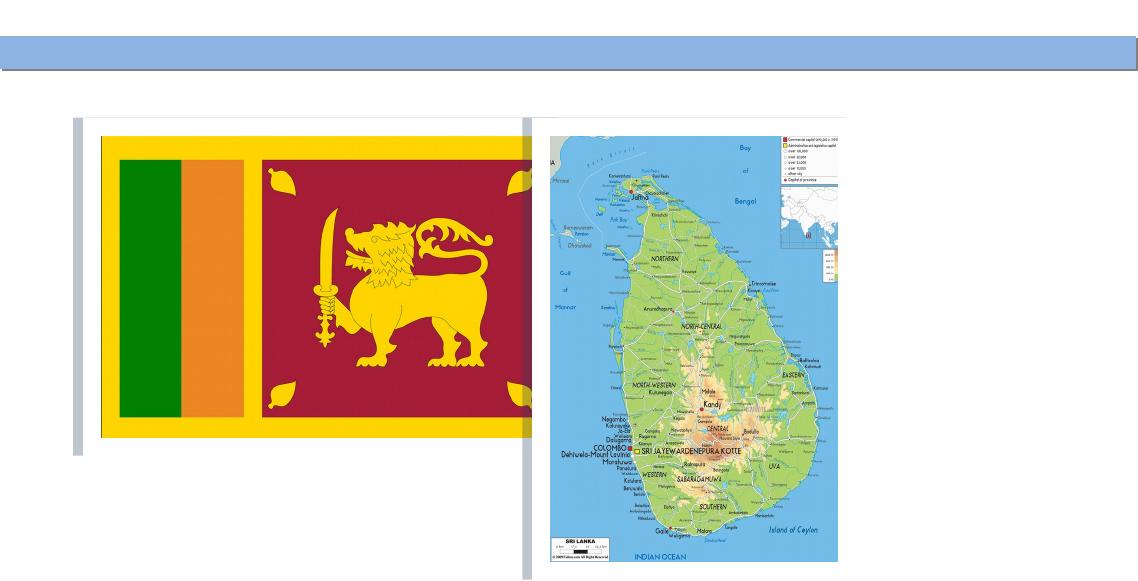
Sri Lanka is a Southern Asian island country in the Northern Indian Ocean, with a
strategic location near major Indian Ocean sea-lanes. It is separated from the Indian Subcontinent
by the Gulf of Mannar and Palk Strait.
The total land area of Sri Lanka is 65,610 square kilometers – which ranks 122nd in the
world – with a 1,340 km long coastline.17 The country can be divided into three major areas
based on topographic features: the Central Highlands, the Plains, and the Coastal Belt. Sri Lanka
is mostly made up of low, flat to rolling plains while there are mountains in south-central interior.
15 The Heritage Foundation, 2014 Index of Economic Freedom – Sri Lanka
16 Central Bank of Sri Lanka, Current Economic Indicators – Exchange Rates
17 Central Intelligence Agency, The World Factbook – Sri Lanka

Sri Lanka has a tropical monsoon climate. This means that the Northeast monsoon lasts
from December to March and the Southwest monsoon lasts from June to October.18
Natural Resources, Environmental issues, and Potential Natural Disasters
Main natural resources in Sri Lanka include limestone, graphite, mineral sands, gems,
phosphates, clay, and hydropower. Hydropower is the major source of electricity in Sri Lanka.19
Sri Lanka currently deals with numerous environmental issues. They comprise of:
deforestation, soil erosion, wildlife populations threatened by poaching and urbanization, coastal
degradation from mining activities and increased pollution, freshwater resources polluted by
industrial wastes and sewage runoff, waste disposal, and air pollution in Colombo.20 Potential
natural disasters in Sri Lanka are occasional cyclones and tornadoes.21
To help preserve natural resources, Sri Lanka becomes a part of many international
environmental agreements. These agreements concern the followings: biodiversity, climate
change, climate change – Kyoto Protocol, desertification, endangered species, environmental
modification, hazardous wastes, Law of the Sea, Ozone Layer Protection, ship pollution, and
wetlands.22 Sri Lanka also signed, but not ratified, an international environmental agreement
regarding marine life conservation.23
Population Distribution
18 Ibid.
19 Ibid.
20 Ibid.
21 Ibid.
22 Ibid.
23 Ibid.

Sri Lanka’s 2014 estimated population and population growth rate are 21,866,445 and
0.86% respectively. 24 It is the 57th largest country in the world. Based on statistics from 2010, the
most populated areas include its capital city Colombo (2,553,000), Gampaha (2,177,000),
Kurunegala (1,563,000), Kandy (1,431,000), Kalutara (1,135,000), and Ratnapura (1,125,000).
These towns are all located in Western or Central Sri Lanka.25
VII. DEMOGRAPHIC AND SOCIO-CULTURAL ENVIRONMENT
Age Demographics, Life Expectancy, and Health
Sri Lanka’s 2014 estimated age structure is as follows: 24.7% between 0-14 years old,
14.9% between 15-24 years old, 42.1% between 25-54 years old, 9.5% between 55-64 years old,
and 8.7% between 65 years old and over.26 The country’s gender ratio is 0.96 male per female;
birth and death rates, per 1,000 population, are 16.24 and 6.06 respectively.
The estimated life expectancy of the population of Sri Lanka is 76.35 years; 72.85 years
for males and 79.99 years for females. The country’s estimated infant mortality rate is 9.02
deaths per 1,000 live births; 9.98 deaths per 1,000 live births for male and 8.02 deaths per 1,000
live births. Sri Lanka’s Human Development Index (HDI) rank 73rd in the world and as of 2013,
the country’s HDI value is 0.750.27 This is a slight increase from 0.745 in 2012.
Drinking water source and sanitation facility access in Sri Lanka have significantly
improved. 2012 estimates show that the improved drinking water source is 99.1% of the
population for urban area, 92.9% of population for rural area, and 93.8% in total.28 As for
24 Ibid.
25 The Economist Intelligence Unit – Sri Lanka
26 Central Intelligence Agency, The World Factbook – Sri Lanka
27 United Nations Development Programme, Table 1: Human Development Index and Its Components
28 Central Intelligence Agency, The World Factbook – Sri Lanka
improved sanitation facility access, 2012 estimates show that it is 82.9% of the population for
urban area, 93.9% of the population for rural area, and 92.3% of the population in total.29
Language, Ethnic and Religion, and Literacy Rate
The official and national language of Sri Lanka, spoken by 74% of the population, is
Sinhala. The country’s other national language, Tamil, is spoken by 18% of the population.
English, on the other hand, is competently spoken by only 10% of the population, most of which
are from the government.30
Sri Lanka’s most dominant ethnic group is Sinhalese, constituting 73.8% of the
population. The country’s other ethnic groups such as Sri Lankan Moors, Indian Tamil, and Sri
Lankan Tamil, constitute 15.7% of the population. 0.5% of the population belongs to other ethnic
group, while 10% of the population’s ethnic group is unspecified.31
69.1% of Sri Lanka’s population is Buddhist, the country’s official religion. Other