SMCM MODULES AND REINFORCEMENT TASKS (SMART)-PRE6
MIDTERM
1
SUBJECT DESCRIPTION: Accounting for Special Transactions
TOPICS: Lesson 1: (1) Corporate Liquidation and (2) Joint Arrangement
PROGRAME OUTCOME/S:
1. Resolve business issues and problems, with a global and strategic perspective using
knowledge and technical proficiency in the areas of financial accounting and reporting,
cost accounting and management, accounting and control, taxation, and accounting
information system.
2. Apply knowledge and skills to successfully respond to various types of assessment
(including professional licensure and certifications); and
3. Confidently maintain a commitment to good corporate citizenship, social responsibility
and ethical practice in performing functions as an accountant.
GRADUATE OUTCOME/S: The graduate of SMCM will be able to:
1. Analyze problems and provides meaningful solutions for greater understanding (critical
thinking)
2. Show determination to do responsibilities in dealing with life realities to make lives better
for others and themselves (Career and Life)
LEARNING OUTCOME/S: At the end of the module, I can:
1. Describe the accounting for corporate liquidation;
2. Construct statement of affairs;
3. Explain the concepts and characteristics of joint arrangement;
4. Differentiate joint operation and joint venture;
5. Illustrate the accounting for joint operations;
6. Describe the accounting requirements for joint venture.
ICV/RV: Excellence (Integrity and Competence)
SOCIAL AWARENESS: Socio-political, tax reform and foreign policies; Justice and Peace
ACROSS DISCIPLINE: Law and Taxation
BIBLE PASSAGE: “Come to Me, all you who labor and are heavy laden, and I will give you
rest.” (Matthew 11:28)
Think and Play!
1. Compare dissolution and liquidation of partnership and corporation.
______________________________________________________________________________
______________________________________________________________________________
______________________________________________________________________________
______________________________________________________________________________
TAP

SMCM MODULES AND REINFORCEMENT TASKS (SMART)-PRE6
MIDTERM
2
2. Make a comparison of partnership and joint venture as a business organization.
______________________________________________________________________________
______________________________________________________________________________
______________________________________________________________________________
______________________________________________________________________________
Read On
(Concepts and Rules)
CORPORATE LIQUIDATION
Liquidation – is the termination of business operations or the winding up of affairs. It is a
process by which the assets of the business are converted into cash, the liabilities of the business
are settled, and remaining amount is distributed to the owners.
Measurement of Net Assets
– Assets are measured at net realizable value, which is estimated selling price less
estimated costs to sell.
– Liabilities are likewise measured at net realizable value, which the expected net
settlement amount.
Financial Reports
1. Statement of Affairs – prepared at the start of liquidation process, preparation of which is
similar to the balance sheet except the value of net assets are restated to net realizable
value
2. Statement of Realization and Liquidation
3. Additional statements such as disclosures and summary of cash receipts and
disbursements.
Statement of Affairs
– Assets are classified into the following:
1. Assets pledged to fully secured creditors
– NRV of pledged assets ≥ related liabilities
2. Assets pledged to partially secured creditors
– NRV of pledged assets < related liabilities
3. Free assets
– Assets not pledged
– Excess of assets pledged fully to secured creditors
– Liabilities are classified into the following:
READA

SMCM MODULES AND REINFORCEMENT TASKS (SMART)-PRE6
MIDTERM
3
1. Unsecured liabilities with priority
– Not secured by any asset but the law mandates that it should be given
preference over other unsecured liabilities.
2. Fully secured creditors
– NRV of pledged assets ≥ related liabilities
3. Partially secured creditors
– NRV of pledged assets < related liabilities
4. Unsecured liabilities without priority
– Other liabilities not classified under (1), (2) and (3)
Procedures in Preparing Statement of Affairs
1. Restate assets and liabilities to realizable values.
2. Identify the classifications of assets and liabilities.
3. Compute the Estimated Recovery Percentage of unsecured creditors without priority
(optional)
Estimated Recovery Percentage = 𝑛𝑒𝑡 𝑓𝑟𝑒𝑒 𝑎𝑠𝑠𝑒𝑡𝑠
𝑡𝑜𝑡𝑎𝑙 𝑢𝑛𝑠𝑒𝑐𝑢𝑟𝑒𝑑 𝑙𝑖𝑎𝑏𝑖𝑙𝑖𝑡𝑖𝑒𝑠 𝑤𝑖𝑡ℎ𝑜𝑢𝑡 𝑝𝑟𝑖𝑜𝑟𝑖𝑡𝑦
4. Prepare the statement of affairs
Statement of Realization and Liquidation
– This is prepared to provide periodic financial reports to show information on the progress
of liquidation process.
– This is depicted like a T-account
Debits Credits
Assets to be realized, excluding cash Asset realized
Assets acquired Asset not realized
Liabilities liquidated Liabilities to be liquidated
Liabilities not liquidated Liabilities assumed
Supplementary expenses Supplementary income
– Assets to be realized (beginning balance), assets acquired and assets not realized (ending
balance) are recorded at book values while the assets realized are recorded at disposal
value, hence the difference between the total debits and total credits represent the gain or
loss on the disposal or realization of non-cash assets.
– Liabilities to be liquidated (beginning balance), liabilities assumed and liabilities not
liquidated are recorded at book values while the liabilities liquidated are recorded at
settlement value, hence the difference between the total debits and total credits represents
the gain or loss on the settlement of liabilities.
– Net gain or loss is computed as follows:

SMCM MODULES AND REINFORCEMENT TASKS (SMART)-PRE6
MIDTERM
4
Net (loss) gain on sale of assets xxx
Net (loss) gain on the settlement of liabilities xxx
Supplementary (expenses) income xxx
Net (loss) gain during the period xxx
JOINT ARRANGEMENT
Joint Arrangement – an arrangement of which two or more parties have joint control.
Joint Control – contractually agreed sharing of control of an arrangement, which exist only
when the decisions about the relevant activities require the unanimous consent of the parties
sharing control.
Types of Joint Arrangement
1. Joint operation – where the parties that have joint control of the arrangement have rights
to the assets and obligations for the liabilities, relating to the arrangement. Those parties
are called joint operators.
– Joint arrangement that is not structured through a separate vehicle.
2. Joint venture – where the parties that have joint control of the arrangement have rights to
the net assets (equity) of the arrangement. Those parties are called joint venturers.
– Joint arrangement that is structured through a separate vehicle.
Separate vehicle – a separately identifiable financial structure, including separate legal entity or
entities recognized by statute, regardless of whether those entities have a legal personality.
Note: To determine the type of joint arrangement, always look at the intention of the
contract; what is really agreed upon by the contracting parties.
Accounting for Joint Operations
– Joint operator recognizes its own assets, liabilities, income and expenses plus its share in
the joint operation’s assets, liabilities, income and expenses. These items are accounted
for under other PFRS applicable.
– When an entity acquires interest in a joint operation whose activity constitutes a business,
the entity accounts for its share as a business combination.
– Accounting for joint operation may either be: (1) no separate book are maintained; or
separate books are maintained.
No Separate Book are Maintained for Joint Operation
– Each joint operator shall establish a “joint operation” account and personal account (e.g.
receivables or payables) of other joint operators in its regular books. These accounts shall
be included alongside each other joint operator’s regular account.
– The following T-account may use as guide to assess the performance of joint operations.
Joint Operations
SMCM MODULES AND REINFORCEMENT TASKS (SMART)-PRE6
Merchandise contribution xx Merchandise withdrawals xx
Purchases and freight in xx Purchase returns, discounts,
And allowances xx
Sales returns, discounts,
And allowances xx Sales and other items of
Income xx
Expenses xx Unsold merchandise, if any xx
Debit balance > Credit balance = loss, otherwise profit
Separate Books are Maintained
– A manager is appointed, which is one of the joint operators, who will take charge of the
recording of the transaction of joint operations in a separate record.
– When separate record for joint operation is established, transactions will be recorded in a
regular manner similar to ordinary business.
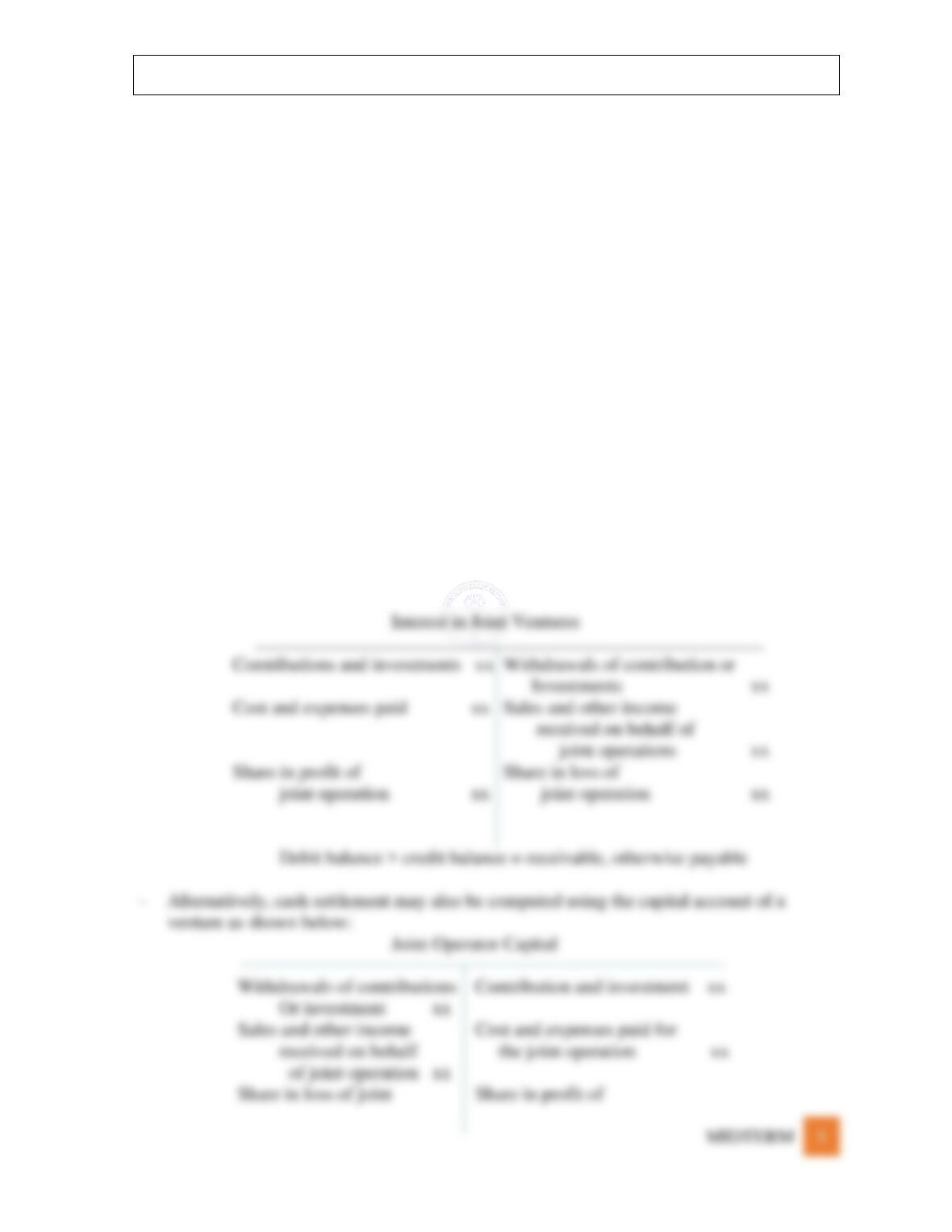
– However, each joint operator shall establish in its record an account “Interest in Joint
Operation” to monitor its investment, withdrawals, and share in the profits and losses of
the joint operations.
– Cash settlement between ventures may be computed using the T-accounts as follows: