PROPRIETARY AND CONFIDENTIAL
This Manual is the proprietary property of The McGraw-Hill
Companies, Inc. (“McGraw-Hill”) and protected by copyright and other
state and federal laws. By opening and using this Manual the user
agrees to the following restrictions, and if the recipient does not agree
to these restrictions, the Manual should be promptly returned unopened
to McGraw-Hill: This Manual is being provided only to authorized
professors and instructors for use in preparing for the classes using
the affiliated textbook. No other use or distribution of this Manual
is permitted. This Manual may not be sold and may not be
distributed to or used by any student or other third party. No part
of this Manual may be reproduced, displayed or distributed in any
form or by any means, electronic or otherwise, without the prior written
permission of McGraw-Hill.
Solutions Manual, Chapter 10 – Approximate Solutions of the N-S Equation
Chapter 10
Approximate
Solutions of the
Navier-Stokes
Equation
General and Introductory Problems, Modified Pressure, Fluid Statics
10-1C
Solution We are to discuss the difference between an “exact” solution and an
approximate solution of the Navier-Stokes equation.
Analysis In an “exact” solution, we begin with the full Navier-Stokes
equation. As we solve the problem, some terms may drop out due to the specified
geometry or other simplifying assumptions in the problem. In an approximate
solution, we eliminate some terms in the Navier-Stokes equation right from the
start. In other words, we begin with a reduced or simplified approximate form of the
equation.
Discussion The approximations are based on the class of flow problem and/or the
region in which such approximations are appropriate (e.g. irrotational, boundary
layer, etc.).
10-1
Solutions Manual, Chapter 10 – Approximate Solutions of the N-S Equation
10-2C
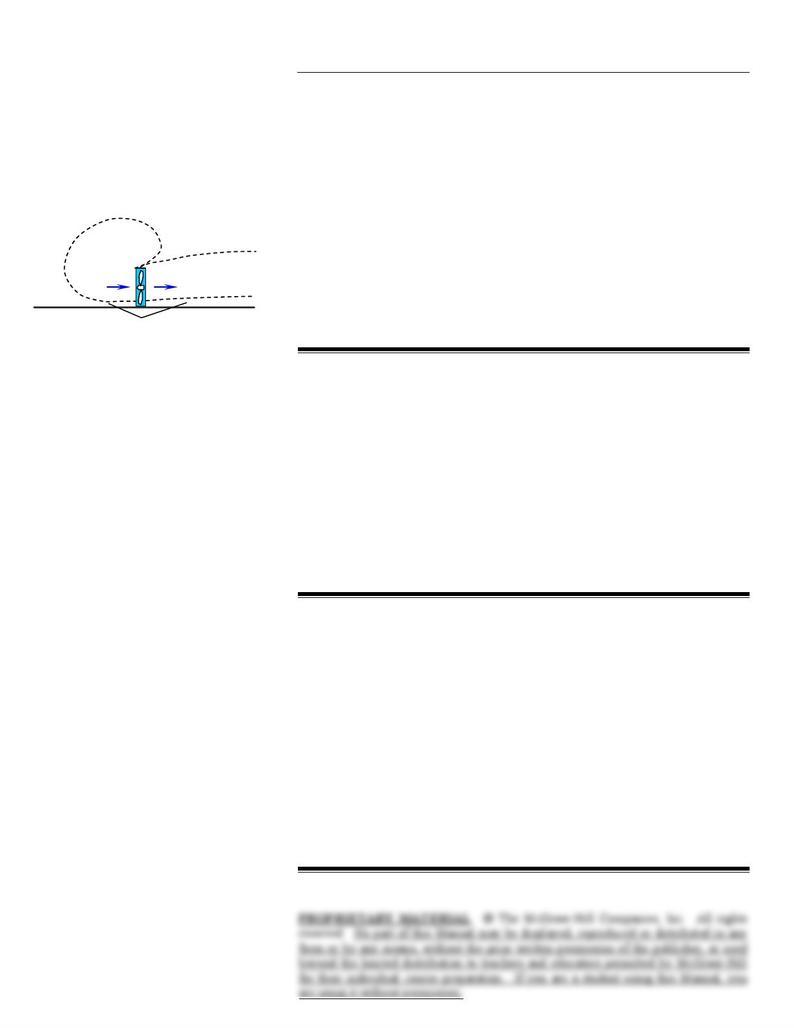
Solution We are to label regions in a flow field where certain approximations
are likely to be appropriate.
Assumptions 1 The flow is incompressible. 2 The flow is steady in the mean (we
ignore the unsteady flow field close to the rotating blades).
Irrotational
Static Static
Boundary layer
Full Navier-
Stokes
FIGURE 1
Regions of appropriate approximations for
the flow produced by a box fan sitting on the
floor of a large room.
Analysis A boundary layer grows along the floor, both upstream and
downstream of the fan. The flow upstream of the fan is largely irrotational except
very close to the floor. The air is nearly static far upstream and far above the fan.
Downstream of the fan, the flow is most likely swirling and turbulent, and none of the
approximations are expected to be appropriate there. In other words, the full Navier-
Stokes equation must be solved in that region. We sketch all these regions in Fig. 1.
Discussion The regions sketched in Fig. 1 are not well defined, nor are they
necessarily to scale.
10-3C
Solution We are to discuss the role of nondimensionalization of the Navier-
Stokes equations.
Analysis When we properly nondimensionalize the Navier-Stokes equation, all
the terms are re-written in the form of some nondimensional parameter times a
quantity of order unity. Thus, we can simply compare the orders of magnitude of
the nondimensional parameters to see which terms (if any) can be ignored because
they are very small compared to other terms. For example, if the Strouhal number is
much smaller than the Euler number, we can ignore the term that contains the
Strouhal number, but must retain the term that contains the Euler number.
Discussion This method works only if the characteristic scales of the problem
(length, speed, frequency, etc.) are chosen properly.
10-4C
Solution We are to discuss the most significant danger that arises with an
approximate solution, and we are to come up with an example.
Analysis The danger of an approximate solution of the Navier-Stokes equation
is this: If the approximation is not appropriate to begin with, our solution will be
incorrect – even if we perform all the mathematics correctly. There are many
examples. For instance, we may assume that a boundary layer exists in a region of
flow. However, if the Reynolds number is not large enough, the boundary layer is too
thick and the boundary layer approximations break down. Another example is that we
may assume a fluid statics region, when in reality there are swirling eddies in that
region. The unsteady motion of the eddies makes the problem unsteady and dynamic
– the approximation of fluid statics would be inappropriate.
Discussion When you make an approximation and solve the problem, it is best to
go back and verify that the approximation is appropriate.
10-2
Solutions Manual, Chapter 10 – Approximate Solutions of the N-S Equation
10-5C
Solution We are to discuss the criteria used to determine whether an
approximation of the Navier-Stokes equation is appropriate or not
Analysis We determine if an approximation is appropriate by comparing the
orders of magnitude of the various terms in the equations of motion. If the
neglected terms are negligibly small compared to other terms, then the approximation
is appropriate. If not, then it is not appropriate to neglect those terms.
Discussion It is important that the proper scales be used for the
nondimensionalization of the equation. Otherwise, the order of magnitude analysis
may be incorrect.
10-6C
Solution We are to discuss the physical significance of the four
nondimensional parameters in the nondimensionalized incompressible Navier-Stokes
equation.
Analysis The four parameters are discussed individually below:
Strouhal number: St is the ratio of some characteristic flow time to some
period of oscillation. If St << 1, the oscillation period is very large compared
to the characteristic flow time, and the problem is quasi-steady; the unsteady
term in the Navier-Stokes equation may be ignored. If St >> 1, the
oscillation period is very short compared to the characteristic flow time, and
the unsteadiness dominates the problem; the unsteady term must remain.
Euler number: Eu is the ratio of a characteristic pressure difference to a
characteristic pressure due to fluid inertia. If Eu << 1, pressure gradients are
very small compared to inertial pressure, and the pressure term can be
neglected in the Navier-Stokes equation. If Eu >> 1, the pressure term is
very large compared to the inertial term, and must remain in the equation.
Froude number: Fr is the ratio of inertial forces to gravitational forces.
Note that Fr appears in the denominator of the nondimensionalized Navier-
Stokes equation. If Fr << 1, gravitational forces are very large compared to
inertial forces, and the gravity term must remain in the Navier-Stokes
equation. If Fr >> 1, gravitational forces are negligible compared to inertial
forces, and the gravity term in the Navier-Stokes equation can be ignored.
Reynolds number: Re is the ratio of inertial forces to viscous forces. Note
that Re appears in the denominator of the nondimensionalized Navier-Stokes
equation. If Re << 1, viscous forces are very large compared to inertial
forces, and the viscous term must remain. (In fact, it may dominate the other
terms, as in creeping flow). If Re >> 1, viscous forces are negligible
compared to inertial forces, and the viscous term in the Navier-Stokes
equation can be ignored. Note that this applies only to regions outside of
boundary layers, because the characteristic length scale for a boundary layer
is generally much smaller than that for the overall flow.
Discussion You must keep in mind that the approximations discussed here are
appropriate only in certain regions of the flow field. In other regions of the same flow
field, different approximations may apply.
10-3
Solutions Manual, Chapter 10 – Approximate Solutions of the N-S Equation
10-7C
Solution We are to discuss the criterion for using modified pressure.
Analysis Modified pressure can be used only when there are no free surface
effects in the problem.
Discussion Modified pressure is simply a combination of thermodynamic
pressure and hydrostatic pressure. It turns out that if there are no free surface effects,
the hydrostatic pressure component is independent of the flow pressure component,
and these two can be separated.
10-8C
Solution We are to discuss which nondimensional parameter is eliminated by
use of the modified pressure.
Analysis Modified pressure effectively combines the effects of actual pressure
and gravity. In the nondimensionalized Navier-Stokes equation in terms of modified
pressure, the Froude number disappears. The reason Froude number is eliminated
is because the gravity term is eliminated from the equation.
Discussion Keep in mind that we can employ modified pressure only for flows
without free surface effects.
10-9
Solution We are to plug the given scales for this flow problem into the
nondimensionalized Navier-Stokes equation to show that only two terms remain in
the region consisting of most of the tank.
Assumptions 1 The flow is incompressible. 2 d << D. 3 D is of the same order of
magnitude as H.
Analysis The characteristic frequency is taken as the inverse of the
characteristic time, f = 1/tdrain. The Strouhal number is thus
Strouhal number:
drain
St ~ 1
fL H
VtV
== (1)
St is of order of magnitude 1 since the order of magnitude of tdrain is H/V. The Euler
number is
Euler number:
24
jet
0
222
Eu ~ ~
V
PP
4
g
HD
VVV
ρ
ρρ
∞
−
== d
(2)
where we have used the order of magnitude estimate that jet gHV~ . We have also
used conservation of mass, namely Vjetd2 = VtankD2. Similarly, the Froude number is
10-4