Solutions to Lectures on Corporate Finance, Second Edition
Peter Bossaerts and Bernt Arne Ødegaard
2006
Contents
1 Finance 1
2Axioms of modern corporate finance 2
3 On Value Additivity 3
4 On the Efficient Markets Hypothesis 4
5 Present Value 6
6 Capital Budgeting 14
7 Valuation Under Uncertainty: The CAPM 21
8 Valuing Risky Cash Flows 25
9 Introduction to derivatives. 28
10 Pricing Derivatives 34
11 Pricing of Multiperiod, Risky Investments 36
12 Where To Get State Price Probabilities? 39
13 Warrants 40
14 The Dynamic Hedge Argument 42
15 Multiple Periods in the Binomial Option Pricing Model 49
16 An Application: Pricing Corporate Bonds 55
17 Are capital structure decisions relevant? 60
18 Maybe capital structure affects firm value after all? 64
19 Valuation Of Projects Financed Partly With Debt 68
20 And What About Dividends? 70
21 Risk And Incentive Management 73

Finance 1
Chapter 1
Finance

2Axioms of modern corporate finance
Chapter 2
Axioms of modern corporate finance

On Value Additivity 3
Chapter 3
On Value Additivity
Problems
3.1 Ketchup [2]
As an empirical investigation, check your local supermarket. Does 2 ketchup bottles of 0.5 litres cost the same
as one ketchup bottle of 1 liter? What does this tell you about value additivity in financial markets?
3.2 Milk [2]
Why is skimmed milk always cheaper than regular milk even if it is healthier?
Solutions
3.1 Ketchup [2]
3.2 Milk [2]

4 On the Efficient Markets Hypothesis
Chapter 4
On the Efficient Markets Hypothesis
Problems
4.1 Interest Rates [2]
Consider the following statement.
Long term interest rates are at record highs. Most companies therefore find it cheaper to finance with
common stock or relatively inexpensive short-term bank loans.
What does the Efficient Market Hypothesis have to say about the correctness of this?
4.2 Semistrong [3]
Can you expect to earn excess returns if you make trades based on your broker’s information about record earnings
for a stock, rumors about a merger of a firm, or yesterday’s announcement of a successful test of a new product,
if the market is semi-strong form efficient?
4.3 UPS [3]
On 1/10/85, the following announcement was made: “Early today the Justice Department reached a decision
in the UPC case. UPC has been found guilty of discriminatory practices in hiring. For the next five years, UPC
must pay $2 million each year to a fund representing victims of UPC policies.” Should investors not buy UPC
stock after the announcement because the litigation will cause an abnormally low rate of return over the next five
years?
4.4 Management [3]
Your broker claims that well–managed firms are not necessarily more profitable investment opportunities than
firms with an average management. She cites an empirical study where 17 well–managed firms and a control
group of 17 average firms were followed for 8 years after the former were reported in the press to be “excelling” as
far as management is concerned. Is this evidence that the stock market does not recognize good management?
4.5 TTC [3]
TTC has released this quarter’s earning report. It states that it changed how it accounts for inventory. The
change does not change taxes, but the resulting earnings are 20% higher than what it would have been under the
old accounting system. There is no other surprises in the earnings report.
1. Would the stock price now jump on the release of this earnings report?
4.6 Investing? [3]
Does the following statement make sense in view of the Efficient Markets Hypothesis (EMH)?
The Japanese economy has deep structural problems, which the Japanese seem reluctant to overcome.
We do not see any major change in this situation over the next two to three years. Hence, we advise
against investing in the Tokyo stock market, because we expect returns to be below average for the
next two to three years.

On the Efficient Markets Hypothesis 5
Solutions
4.1 Interest Rates [2]
Remember the first lesson about market efficiency: Markets have no memory. Just because long-term interest rates
are high relative to past levels does not mean that they won’t go higher still. Unless you have special information
indicating that long-term rates are too high, issuing long-term bonds should be a zero-NPV transaction. So
should issuing short-term debt or common stock.
4.2 Semistrong [3]
All of these are public information, you do not expect them to explain future changes in stock price. Hence, you
can not expect to make excess returns using this information. You can only use private information to generate
excess returns.
4.3 UPS [3]
Once the announcement is made and the price has reacted (downward) to the lower (discounted) future dividend
stream, there is no further effect. The average return over the next five years will still be determined solely by
risk and not by the fact that dividends will be $2 million lower. For instance, if risk continues to be high, average
returns will also be.
4.4 Management [3]
The evidence that the 17 well-managed firms did not outperform the market merely confirms an implication of
the efficient markets hypothesis: Average returns are only determined by risk. The fact that the firms were run
by good managers was known 8 years earlier and already properly reflected in prices at that time.
4.5 TTC [3]
1. The changes in the accounting treatment do not change cash flows, even if reported earnings change. A
possible channel for cash flow changes could have been the timing of taxes, but that is explicitly ruled out.
The stock price should therefore not be affected by the accounting change.
4.6 Investing? [3]
No. Average returns are determined solely by risk. If there is a lot of risk, average returns are high, etc. The
economic situation does not affect average returns.

6 Present Value
Chapter 5
Present Value
Problems
5.1 Present Value [3]
You are given the following prices Pttoday for receiving risk free payments tperiods from now.
t= 1 2 3
Pt= 0.95 0.9 0.85
1. Calculate the implied interest rates and graph the term structure of interest rates.
2. Calculate the present value of the following cash flows:
t= 1 2 3
Xt= 100 100 100
5.2 Borrowing [2]
BankTwo is offering personal loans at 10%, compounded quarterly. BankThree is offering personal loans at
10.5%, compounded annually. Which is the better offer?
5.3 Arbitrage [4]
You are given the following prices Pttoday for receiving risk free payments tperiods from now.
t= 1 2 3
Pt= 0.95 0.9 0.95
There are traded securities that offer $1 at any future date, available at these prices.
How would you make a lot of money?
5.4 Bank Loans [2]
Your company is in need of financing of environmental investments. Three banks have offered loans. The first
bank offers 4.5% interest, with biannual compounding. The second bank offers 4.3% interest, with monthly
compounding. The third bank offers 4.25% with annual compounding.
Determine which is is the best offer.
5.5 Stock [4]
A stock has just paid a dividend of 10. Dividends are expected to grow with 10% a year for the next 2 years.
After that the company is expecting a constant growth of 2% a year. The required return on the stock is 10%.
Determine todays stock price.
5.6 Bonds [6]
You observe the following three bonds:
Cashflow in period
Bond Price 1 2 3
A 95 100 0 0
B 90 10 110 0
C85 10 10 110

Present Value 7
1. What is the current value of receiving one dollar at time 3?
Consider now the bond D, with the following characteristics
Cashflow in period
Bond 1 2 3
D 20 20 520
2. What is the current price of bond D?
Consider next bond E, which last for four periods. Bond E has the following characteristics:
Cashflow in period
Bond 1 2 3 4
E 10 10 10 110
3. If the market does not allow any free lunches (arbitrage), what is the maximal price that bond E can have?
5.7 Growing Perpetuity [8]
The present value of a perpetuity that pays X1the first year and then grows at a rate geach year is:
P V =
∞
X
t=1
X1(1 + g)t−1
(1 + r)t
Show that this simplifies to
P V =X1
r−g
5.8 Annuity [6]
Show that the present value of an annuity paying Xper period for Tyears when the interest rate is rcan be
simplified as
P V =
T
X
t=1
X
(1 + r)t=X1
r−1
r
1
(1 + r)T
5.9 Stock [2]
The current price for a stock is 50. The company is paying a dividend of 5 next period. Dividend is expected to
grow by 5% annually. The relevant interest rate is 14%. In an efficient market, can these numbers be sustained?
5.10 Growing Annuity [6]
Consider an T-period annuity that pays Xnext period. After that, the payments grows at a rate of gper year
for the next Tyears.
The present value of the annuity is
P V =
T
X
t=1
X(1 + g)(t−1)
(1 + r)t
Can you find a simplified expression for this present value?

8 Present Value
5.11 Jane [3]
Jane, a freshman in college, needs 55000 in 4 years to start studying for an MBA. Her investments earn 5%
interest per year.
1. How much must she invest today to have that amount at graduation?
2. If she invested once a year for four years beginning today until the end of the 4 years how much must she
invest?
5.12 Bonds [3]
The current interest rate is 7%. Given the opportunity to invest in one of the three bonds listed below, which
would you buy? Sell short?
Bond Face Annual Maturity Price
value coupon rate
A 1000 4% 1 year 990
B 1000 7.5% 17 years 990
C 1000 8.5% 25 years 990
Solutions
5.1 Present Value [3]
1. The implied interest rates rtare found as:
P1= 0.95 = 1
1 + r1
r1=1
0.95 −1 = 5.26%
P2= 0.9 = 1
1 + r22
r2=r1
0.9−1 = 5.41%
P3= 0.85 = 1
1 + r33
r3=3
r1
0.85 −1 = 5.57%
2. The present value is found as
P V = 100 ·0.95 + 100 ·0.9 + 100 ·0.8 = 265
or alternatively, using interest rates, as
P V = 100 1
1.0526+ 100 1
1.05412
+ 100 1
1.05573
≈265

Present Value 9
5.2 Borrowing [2]
The offers need to be made comparable. This is typically done by finding the equivalent annual interest rates and
comparing those. In annual terms, BankTwo is charging
1 + 0.1
44
−1≈10.38%
When borrowing, one wants the lowest possible interest rate, which means that the 10.5% interest rate offered
by BankThree is dominated by the 10.38% interest rate (in annual terms) offered by BankTwo.
5.3 Arbitrage [4]
This data implies an arbitrage opportunity. Note that the price of the risk free security offering $1 in period 3 is
higher than the price of the risk free security offering $1 in period 2. What does this mean? It means you have
to pay less today for receiving money sooner! To make a lot of money, short the risk free security for period 3,
and use $0.9 of the $0.95 proceeds to buy the period 2 risk free security. The $1 you get in period 2 can be kept
as money and used to cover your obligation in period 3. For each of these transactions you get $0.05 now. To
get very rich, do a lot of these transactions.
5.4 Bank Loans [2]
1. Annualize the interest rates to make them comparable:
First bank:
1 + 0.045
22
−1 = 4.55%
Second bank:
1 + 0.043
12 12
−1 = 4.39%
Third bank
4.25%
The offer from the third bank is preferable.
5.5 Stock [4]
D1= 10(1.1) = 11
D2= 10(1.1)2= 12.1
Calculate the time 2 value of the stock as a growing perpetuity.
D3=D2(1.02) = 12.1·1.02 = 12.34
P2=D3
r−g=12.34
0.1−0.02 = 154.27
Then find the current stock price as the present value:
P0=D1
1.1+D2+P2
1.12=11
1.1+12.1 + 154.27
1.12= 10 + 137.5 = 147.5
10 Present Value
5.6 Bonds [6]
This is easiest solved using the current prices Ptof securities offering $1 in period t.
For simplicity, let us formulate this as a linear algebra problem.
Let the matrix Ccontain the bond payoffs:
C=
100 0 0
10 110 0
10 10 110
and the vector Bcontain the bond prices:
B=
95
90
85
For a given vector Pof prices of zero coupon bonds
P=
P1
P2
P3
we leave it to the reader to confirm that the bond prices Bcan be found as:
B=CP.
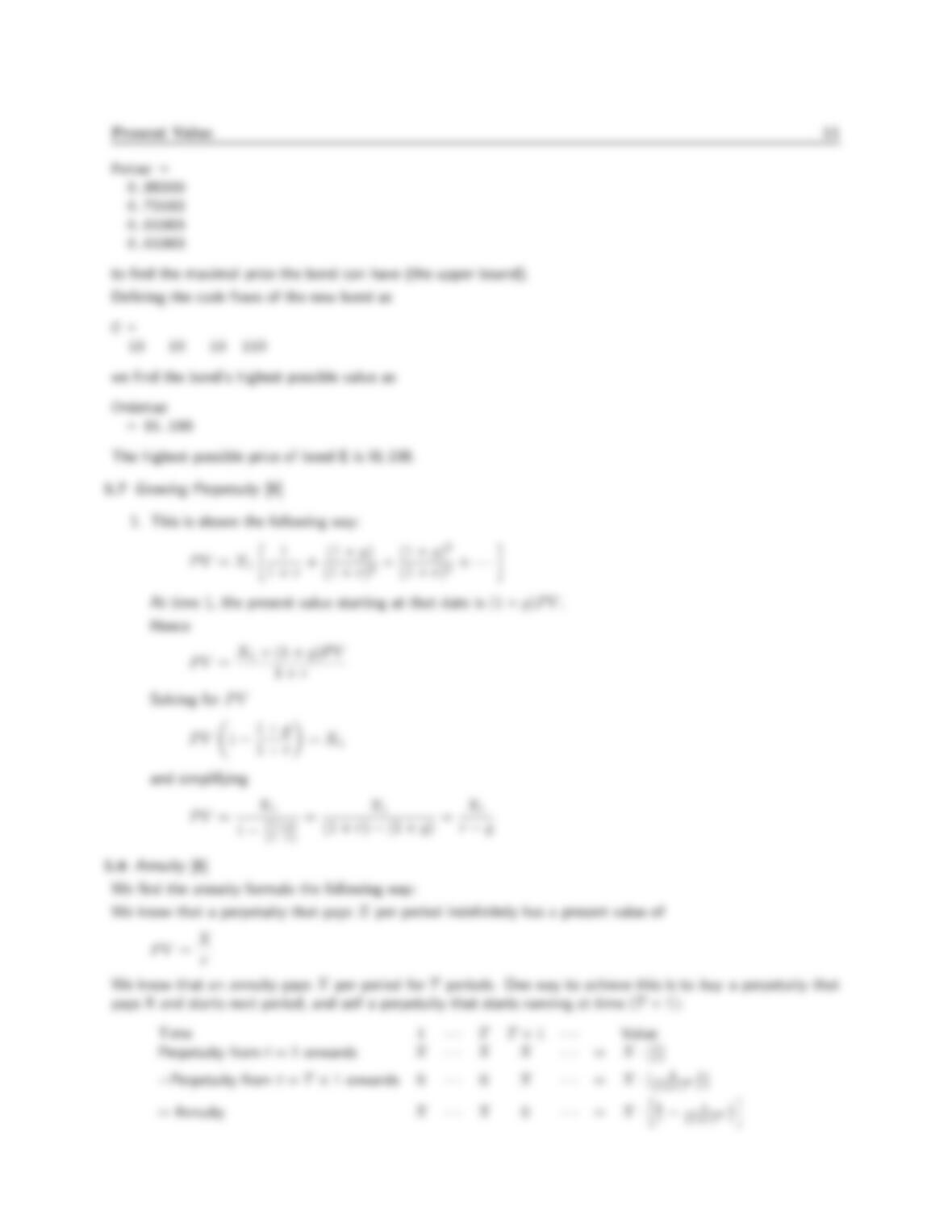
It is then a standard linear algebra operation to calculate Pas