ASSIGNMENT:
Course Title: Introduction to Sociology
Course Code: GEN 1224
Section: 1
SUBMITTED TO:
Ms. Syka Parvin Purba
Lecturer
Southeast Business School
Southeast University
Banani, Dhaka.
SUBMITTED BY:
SL.
Group Members
ID
1.
Rokey Chandra Paul
2018010000104
2.
Rema Rani Paul
2018010000105
3.
Esmita Hasan Ela
2020120106002
4.
Sheikh Tasfia Karim
2018010000099
Date of Submission: September 22, 2020

Page 2 of 11
The Self Theory of George Herbert Mead
This is the most popular theory among all the self-theories. G. H mead was more powerful and
influential in his self-theories.
In our daily lives we can see how an individual communicates with another individual in their
social life. So, in our daily lives we can see that when an individual talks, the individual uses
different types of facial expressions, bodily gestures which indicate different meanings in
different situations.
For example: When we meet our friends in the morning by seeing them, we give a smile. So, this
smile is a facial expression which indicates that we are greeting them maybe by saying a good
morning. Also, when a person expresses bodily gesture by raising his shoulder means that he is
confused.
Expressions has different meaning
Every expression has a different meaning. So, using different expressions at different times which
has a meaning and all these works as a symbol.
Symbol: A symbol is something that indicates a different meaning or something else. So, the
different expressions that are used is a symbol using which people communicate to one another.
Verbal and Non-verbal: Verbal and non-verbal expressions indicate a symbol that in return
indicates something some other meaning. G.H Mead started with symbol/gesture and he said
that through symbols or gestures, an individual can communicate with one another. So, this is
the process that G.H Mead that was showed through the diagram.
Gestures: Gestures are the symbols like words, body movements, facial expressions etc. through
which social communication takes place. In simple words, gestures are a bunch of symbols that
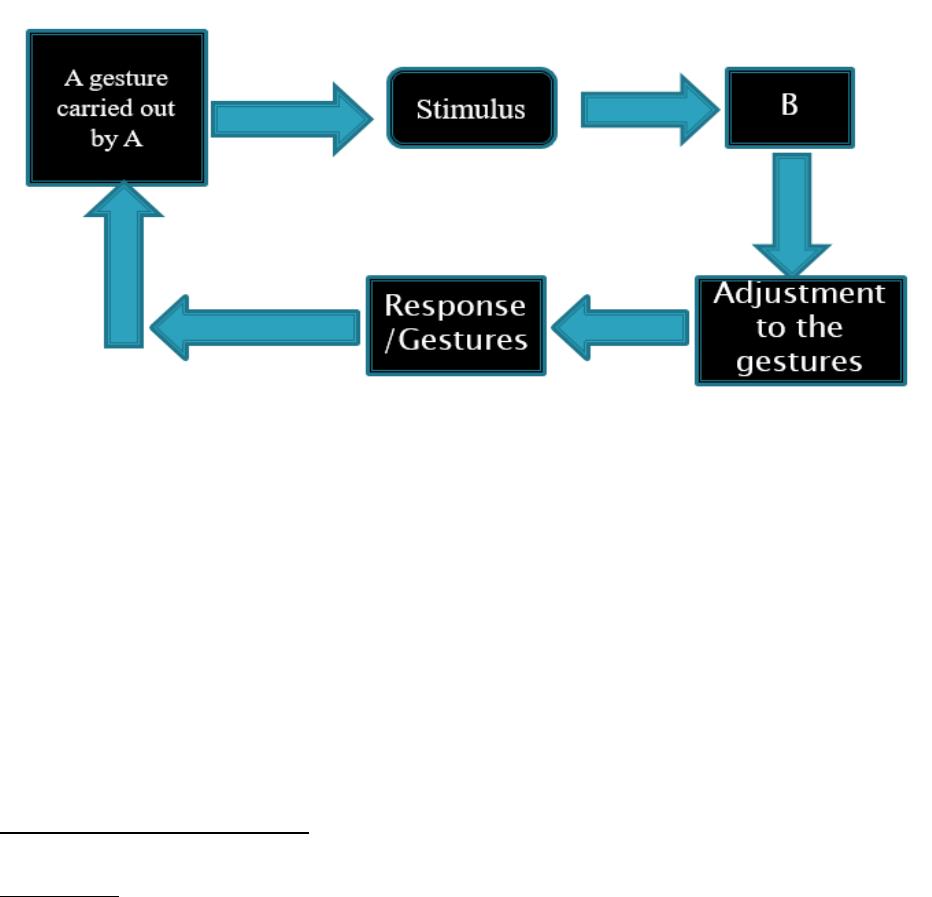
helps an individual to communicate with other people. So, let’s see the process that takes places
between A and B how do they communicate or interact with one another which can be seen in
the below diagram.
Page 3 of 11
At first A provides a gesture towards B, which can be a verbal or non-verbal expression. Then the
gesture provided by A works as a Stimulus towards B that pushes B to take an action. Then B can
either react spontaneously or before taking an action B can make an adjustment to the gestures.
In this adjustment stage, B has its thinking process involved. So, before reacting to the situation,
B makes an adjustment to the gesture and then sends it to A.
Therefore, in our daily lives there is an exchange of symbols or gestures. In the conversation
process, the exchange of gestures is the whole process of having conversation with one another
in our daily lives.
Role taking and Reflexivity
Role Taking: Role Taking is when an individual puts himself or herself in the other persons
situation and then thinks from their point of view. While role taking an individual takes the role
of others to understand their view points or stand points.
In this, G.H mead said that there can be two kinds of Actions taken:
• One is when an individual takes an action, he/she doesn’t think before that and act
spontaneously.
• Other one is when taking an action, the individuals thought process is involved here. So, this
work is done through role taking.
Reflexibility: Self-development mechanism. It is the ability to put oneself into other’s position
and to act as they act. When one role takes and reflect others behavioral expectations in yourself.
An individual can do role taking for Reflexibility.
Role taking can be of two types:
1. Individual Role Taking: Individual Role Taking means placing yourself in the place of another
individual to understand their point of view.
For example: An old man enters the bus in which you are travelling in which there are no
empty seats left. You are young and can think of yourself in similar position at old age and
feel sympathy towards the old man and allow the old man to sit in your seat.