Chapter 10 – Social Stratification 1
Chapter 10 – Social Stratification
What is Social Stratification?
Social stratification, a system by which a society ranks categories of people in a hierarchy, is
based on four basic principles:
1. Social stratification is a trait of society, not simply a reflection of individual
differences. Many of us think of social standing in terms of personal talent and effort
and, as a result, we often exaggerate the extent to which we control our own fate. Did a
higher percentage of the first-class passengers on the Titanic survive because they were
better swimmers than second- and third-class passengers? No. They did better because of
their privileged position on the ship, which gave them first access to the lifeboats.
Similarly, children born into wealthy families are more likely than children born into
poverty to enjoy good health, do well in school, succeed in a career, and live a long life.
Neither the rich nor the poor created social stratification, yet this system shapes the lives
of us all.
2. Social stratification carries over from generation to generation. We have to look only
at how parents pass their social position on to their children to see that stratification is a
trait of societies rather than individuals. Some individuals, especially in high-income
societies, do experience social mobility, a change in position within the social hierarchy.
Social mobility may be upward or downward. Our society celebrates the achievements of
a Jean Chrétien, a Céline Dion, a Jim Carrey, or a Wayne Gretzky, all of whom rose to
prominence from modest beginnings. We also acknowledge that people move downward
as a result of business setbacks, unemployment, or illness. More often, people move
horizontally, exchanging one occupation for another at a comparable level. The social
standing of most people remains much the same over their individual lifetimes.
3. Social stratification is universal but variable. Social stratification is found
everywhere. Yet what is distributed unequally and the extent of inequality vary from one
society to another. In some societies, inequality is mostly a matter of prestige; in others,
wealth or power is the key element of difference. In addition, some societies contain
more inequality than others. The Thinking about Diversity box picks up the theme of the
Titanic tragedy opener—that social class can be a matter of life and death.
4. Social stratification involves not just inequality but beliefs as well. Any system of
inequality not only gives some people more than others but also defines these
arrangements as fair. Like the what of inequality, the explanation of why people should
be unequal differs from society to society.

Chapter 10 – Social Stratification 2
10.1 Quiz
1. Taking a sociological survey of inequality around the world, social stratification is
found everywhere, but exactly what is unequal and the degree of inequality differ
from society to society
2. Which of the following statements is correct? All human societies have been socially
stratified although in variable ways.
3. A system by which a society ranks categories of people in a hierarchy is called social
stratification
4. In high-income societies, when people experience social mobility they are most likely to
experience horizontal mobility
Caste and Class Systems
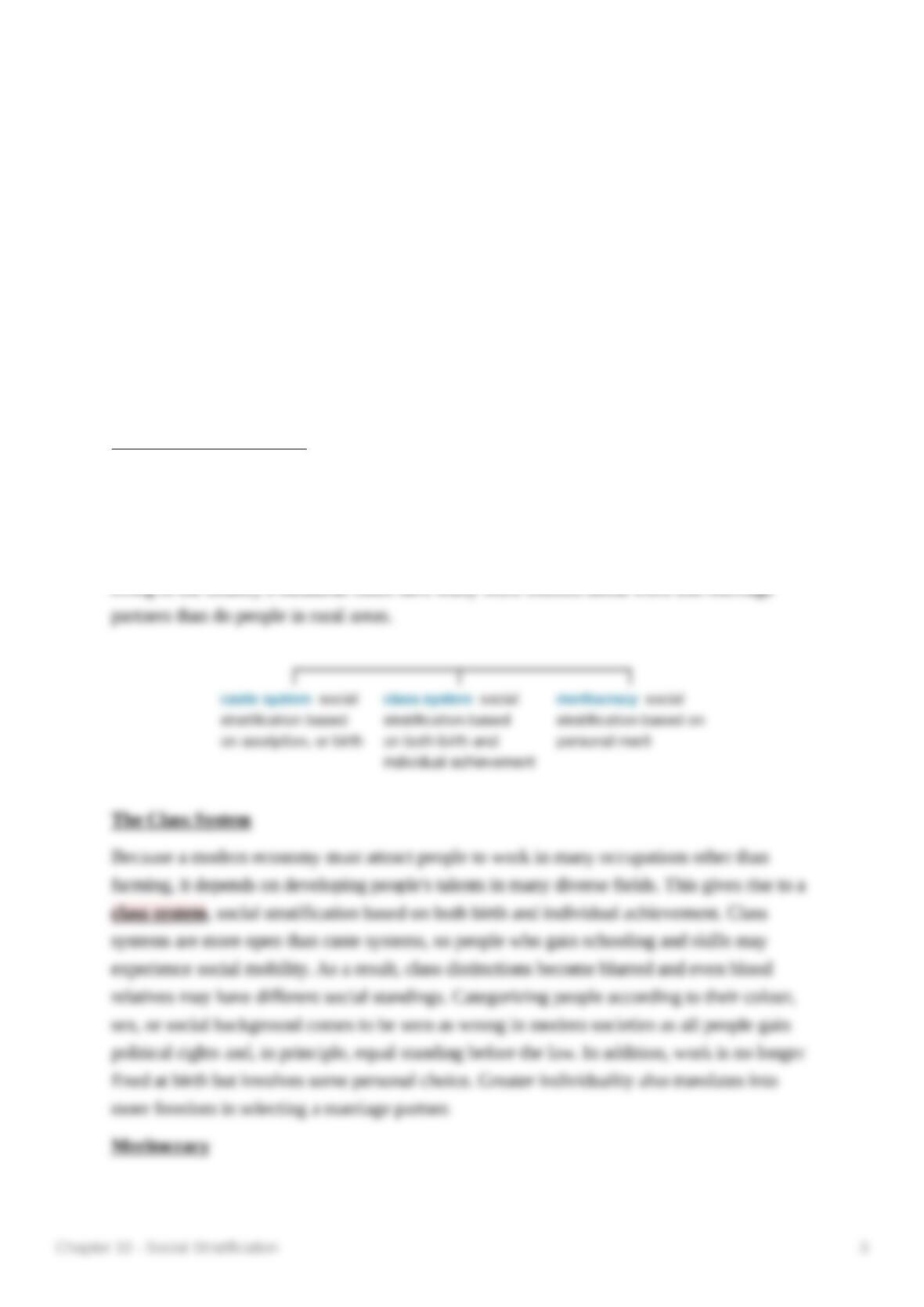
Sociologists distinguish between closed systems, which allow for little change in social
position, and open systems, which permit much more social mobility (Tumin, 1985). The
caste system is closed, and the class system is more open.
The Caste System
A caste system is social stratification based on ascription, or birth. A pure caste system is
closed because birth alone determines a person’s entire future, allowing little or no social
mobility based on individual effort. People live out their lives in the rigid categories assigned
to them, without the possibility of change for the better or worse. Many of the world’s
societies, most of them agrarian, are caste systems. In India, for example, much of the
population still lives in traditional villages where the caste system persists more than 60 years
after being formally outlawed.
An Illustration: India
The Indian system identifies four major castes (orvarna,a Sanskrit word that means
“colour”): Brahman, Kshatriya, Vaishya, and Shudra. On the local level, each of these is
composed of hundreds of subcaste groups (orjati). From birth, a caste system determines the
direction of a person’s life:
1. First, with the exception of farming, which is open to everyone, families in each caste
perform one type of work, as priests, soldiers, barbers, leather workers, sweepers, and so
on.
2. Second, a caste system demands that people marry others of the same ranking. If people
were to have “mixed” marriages with members of other castes, what rank would their
children hold? Sociologists call this pattern of marrying within a social
categoryendogamousmarriage (endostems from the Greek, meaning “within”).
According to tradition—this practice is now rare and found only in remote rural areas—
Indian parents select their children’s marriage partners, often before the children reach
their teens.
3. Third, caste guides everyday life by keeping people in the company of “their own kind.”
Norms reinforce this practice by teaching, for example, that a “purer” person of a higher
caste is “polluted” by contact with someone of lower standing.
4. Fourth, caste systems rest on powerful cultural beliefs. Indian culture is built on the
Hindu tradition that doing the caste’s life work and accepting an arranged marriage are
moral duties.
Caste and Agrarian Life
Caste systems are typical of agrarian societies because agriculture demands a lifelong routine
of hard work. By teaching a sense of moral duty, a caste system ensures that people are
disciplined for a lifetime of work and are willing to perform the same jobs as their parents.
Thus, the caste system persists in rural areas of India. Although caste still matters, people