Anyone who uses social media such as Facebook, Reddit, Twitter, Instagram, etc. can all attest
to the number of photos that circulate. Photos are everywhere. Lately, there has been an ever-
increasing number of memes that are created every day. Some are funny, some offensive, some sad,
some sell products, and some just help you indicate how weird the internet can be. Regardless of the
material, it is impossible to avoid the photo abundancy all together. While we are seeing an increase in
the number of selfies circulating the web, we are also exploring how campaigns and advertisements use
the popularity of photos to increase profit, uncaring to the problem with body-image it may create. So,
if you cannot beat them, I guess you will have to join them.
In 1979, the first publication for Killing Us Softly was released. Jean Kilbourne was exploring the
way in which advertisers use images of women to sell products. The advertisements she found, which
were everywhere, showed a common trend: objectify the women, photoshop her body to look flawless,
and sell a product that has nothing to do with the women in the photo. Kilbourne goes onto explain how
advertisements have used photos for as long as anyone can remember. Being an over $250 billion a year
industry in the United States, it is obvious how relevant ads are. So relevant that the average American
is exposed to over 3,000 ads every single day. Whether you are at a football game, school, mall,
downtown strip, everywhere you turn you will see an ad. Since 82% of the information we retain from
ads is subconscious, those making advertisements had to find a way to play on this. We might see ads
once or twice or maybe a hundred times, but after we are done viewing them they are processed within
the subconscious of the brain repeatedly (00:01:00-00:05:00). This is easily applied to real world
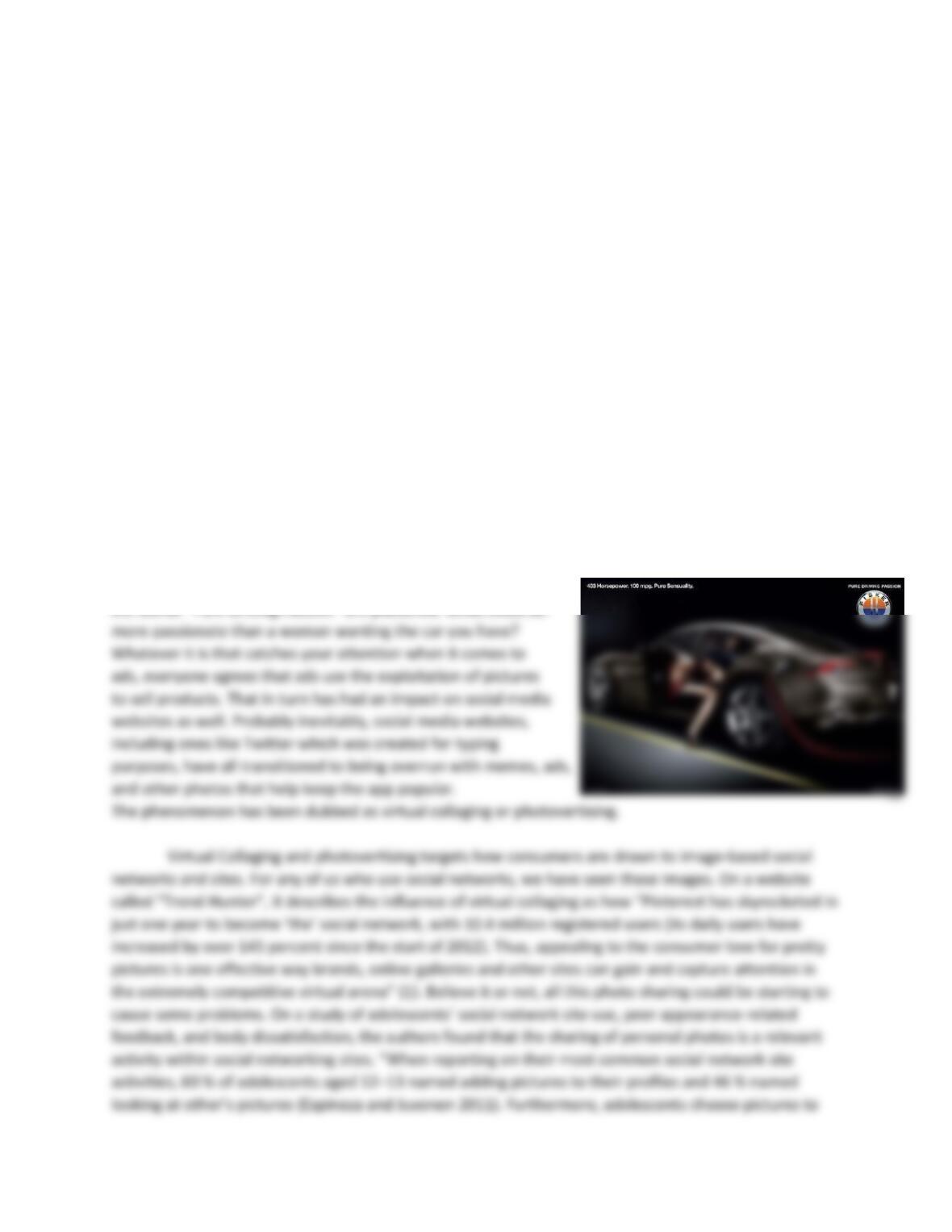
applications. Want to drive a new Fisker? Here, look at this photo of a women standing seductively bent
over in the car with her butt propped up in the air. In the top right,