HOW IMPORTANT IS SOCIAL MEDIA?
What is Social Media?
“Social media are interactive computer-mediated technologies that facilitate the
creation and sharing of information, ideas, career interests and other forms of
expression via virtual communities and networks.” – Wikipedia
“Social Media forms of electronic communication (such as websites for social
networking and microblogging) through which users create online
communities to share information, ideas, personal messages, and other content
(such as videos)”. – Merriam Webster
“Social media is computer-based technology that facilitates the sharing of ideas,
thoughts, and information through the building of virtual networks and
communities. By design, social media is internet-based and gives users quick
electronic communication of content. Content includes personal information,
documents, videos, and photos. Users engage with social media via computer,
tablet or smartphone via web-based software or web application, often utilizing
it for messaging.” – Investopedia
History of Social Media
Social Media Before 1900
The earliest methods of communicating across great distances used written
correspondence delivered by hand from one person to another. In other words,
letters. The earliest form of postal service dates back to 550 B.C., and this
primitive delivery system would become more widespread and streamlined in
future centuries.

In 1792, the telegraph was invented. This allowed messages to be delivered over
a long distance far faster than a horse and rider could carry them. Although
telegraph messages were short, they were a revolutionary way to convey news
and information
Although no longer popular outside of drive-through banking, the pneumatic
post, developed in 1865, created another way for letters to be delivered quickly
between recipients. A pneumatic post utilizes underground pressurized air
tubes to carry capsules from one area to another.
Two important discoveries happened in the last decade of the 1800s: The
telephone in 1890 and the radio in 1891. Both technologies are still in use today,
although the modern versions are much more sophisticated than their
predecessors. Telephone lines and radio signals enabled people to
communicate across great distances instantaneously, something that mankind
had never experienced before.
Social Media in the 20th Century
Technology began to change very rapidly in the 20th Century. After the first
super computers were created in the 1940s, scientists and engineers began to
develop ways to create networks between those computers, and this would
later lead to the birth of the Internet.
The earliest forms of the Internet, such as CompuServe, were developed in the
1960s. Primitive forms of email were also developed during this time. By the
70s, networking technology had improved, and 1979’s UseNet allowed users to
communicate through a virtual newsletter.
By the 1980s, home computers were becoming more common and social media
was becoming more sophisticated. Internet relay chats, or IRCs, were first used
in 1988 and continued to be popular well into the 1990’s.
The first recognizable social media site, Six Degrees, was created in 1997. It
enabled users to upload a profile and make friends with other users. In 1999,
the first blogging sites became popular, creating a social media sensation that’s
still popular today.
Social Media Today
After the invention of blogging, social media began to explode in popularity.
Sites like MySpace and LinkedIn gained prominence in the early 2000s, and
sites like Photobucket and Flickr facilitated online photo sharing. YouTube
came out in 2005, creating an entirely new way for people to communicate and
share with each other across great distances.
By 2006, Facebook and Twitter both became available to users throughout the
world. These sites remain some of the most popular social networks on the
Internet. Other sites like Tumblr, Spotify, Foursquare and Pinterest began
popping up to fill specific social networking niches.
Today, there is a tremendous variety of social networking sites, and many of
them can be linked to allow cross-posting. This creates an environment where
users can reach the maximum number of people without sacrificing the
intimacy of person-to-person communication. We can only speculate about
what the future of social networking may look in the next decade or even 100
years from now, but it seems clear that it will exist in some form for as long as
humans are alive.
Social Media: A Theoretical Framework
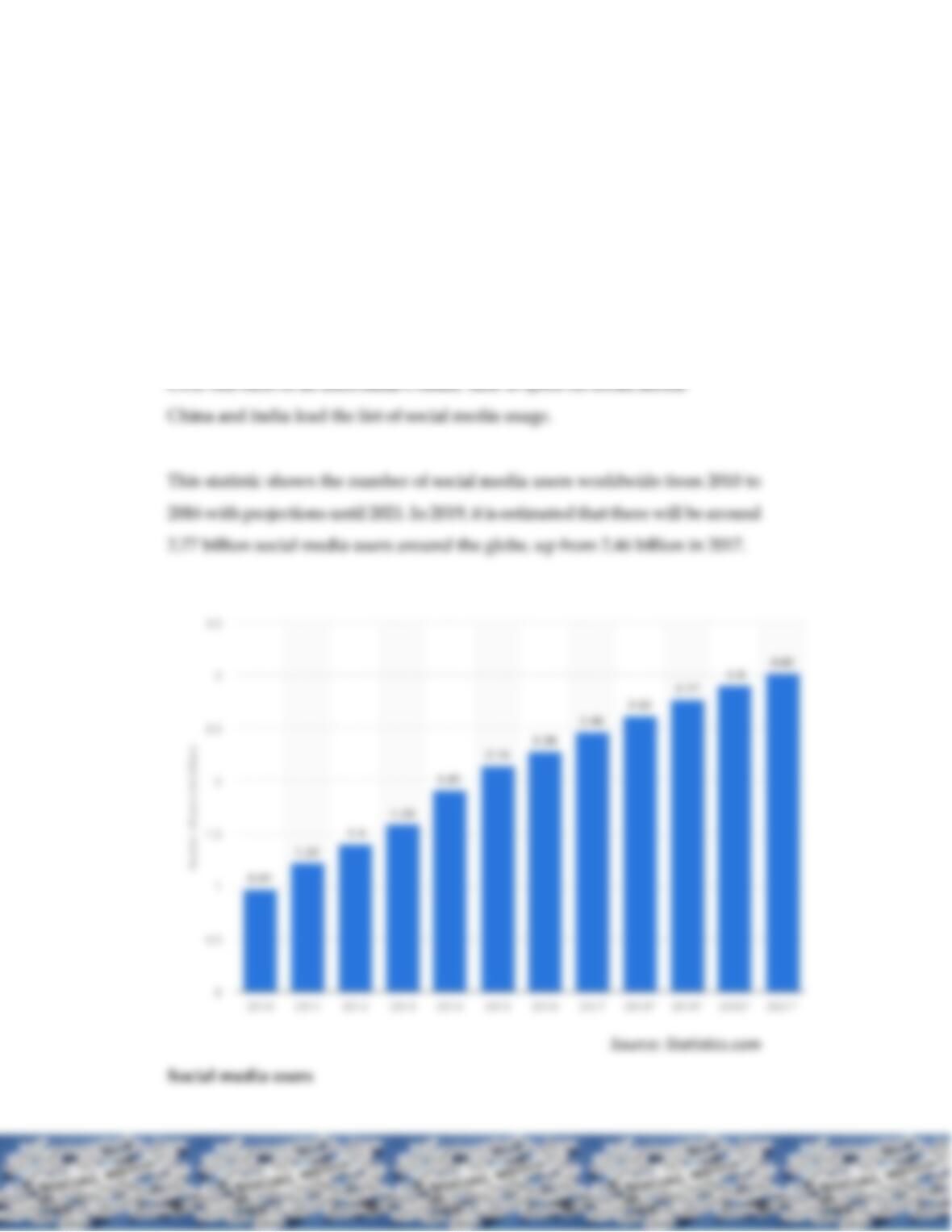
Globally, there are almost 3 billion social media users. Social media is an ever-
changing and ever-evolving web-based platform.
According to the Pew Research Center, social media users tend to be younger.
Nearly 90 percent of people between the ages of 18 and 29 used at least one
form of social media. Further, these users tend to be better educated and
relatively wealthy.
Fast Facts
Social media is interactive and Web 2.0 based
Features user-generated profiles
Content is generated by users
An estimated 69 percent of Americans used social media as of 2018