12–1
CHAPTER 12
PRICING DECISIONS AND COST MANAGEMENT
12–1 The three major influences on pricing decisions are
1. Customers
2. Competitors
3. Costs
12–2 Not necessarily. For a one–time–only special order, the relevant costs are only those costs
that will change as a result of accepting the order. In this case, full product costs will rarely be
relevant. It is more likely that full product costs will be relevant costs for long–run pricing
decisions.
12–3 Two examples of pricing decisions with a short–run focus:
1. Pricing for a one–time–only special order with no long–term implications.
2. Adjusting product mix and volume in a competitive market.
12–4 Activity–based costing helps managers in pricing decisions in two ways.
1. It gives managers more accurate product–cost information for making pricing decisions.
2. It helps managers to manage costs during value engineering by identifying the cost impact
of eliminating, reducing, or changing various activities.
12–5 Two alternative starting points for long–run pricing decisions are
1. Market–based pricing, an important form of which is target pricing. The market–based
approach asks, ―Given what our customers want and how our competitors will react to what we
do, what price should we charge?‖
2. Cost–based pricing which asks, ―What does it cost us to make this product and, hence,
what price should we charge that will recoup our costs and achieve a target return on investment?‖
12–6 A target cost per unit is the estimated long–run cost per unit of a product (or service) that,
when sold at the target price, enables the company to achieve the targeted operating income per
unit.
12–7 Value engineering is a systematic evaluation of all aspects of the value–chain business
functions, with the objective of reducing costs while satisfying customer needs. Value engineering
via improvement in product and process designs is a principal technique that companies use to
achieve target cost per unit.
12–8 A value–added cost is a cost that customers perceive as adding value, or utility, to a
product or service. Examples are costs of materials, direct labor, tools, and machinery. A
nonvalue–added cost is a cost that customers do not perceive as adding value, or utility, to a
product or service. Examples of nonvalue–added costs are costs of rework, scrap, expediting, and
breakdown maintenance.
12–9 No. It is important to distinguish between when costs are locked in and when costs are
incurred, because it is difficult to alter or reduce costs that have already been locked in.
© 2012 Pearson Education, Inc. Publishing as Prentice Hall. SM Cost Accounting 14/e by Horngren
12–2
12–10 Cost–plus pricing is a pricing approach in which managers add a markup to cost in order to
determine price.
12–11 Cost–plus pricing methods vary depending on the bases used to calculate prices. Examples
are (a) variable manufacturing costs; (b) manufacturing function costs; (c) variable product costs;
and (d) full product costs.
12–12 Two examples where the difference in the costs of two products or services is much
smaller than the differences in their prices follow:
1. The difference in prices charged for a telephone call, hotel room, or car rental during busy
versus slack periods is often much greater than the difference in costs to provide these services.
2. The difference in costs for an airplane seat sold to a passenger traveling on business or a
passenger traveling for pleasure is roughly the same. However, airline companies price
discriminate. They routinely charge business travelers––those who are likely to start and complete
their travel during the same week excluding the weekend––a much higher price than pleasure
travelers who generally stay at their destinations over at least one weekend.
12–13 Life–cycle budgeting is an estimate of the revenues and costs attributable to each product
from its initial R&D to its final customer servicing and support.
12–14 Three benefits of using a product life–cycle reporting format are:
1. The full set of revenues and costs associated with each product becomes more visible.
2. Differences among products in the percentage of total costs committed at early stages in
the life cycle are highlighted.
3. Interrelationships among business function cost categories are highlighted.
12–15 Predatory pricing occurs when a business deliberately prices below its costs in an effort to
drive competitors out of the market and restrict supply, and then raises prices rather than enlarge
demand. Under U.S. laws, dumping occurs when a non–U.S. company sells a product in the United
States at a price below the market value in the country where it is produced, and this lower price
materially injures or threatens to materially injure an industry in the United States. Collusive
pricing occurs when companies in an industry conspire in their pricing and production decisions to
achieve a price above the competitive price and so restrain trade.
© 2012 Pearson Education, Inc. Publishing as Prentice Hall. SM Cost Accounting 14/e by Horngren

12–3
12–16 (20–30 min.) Relevant–cost approach to pricing decisions, special order.
1. Relevant revenues, $4.00 1,000 $4,000
Relevant costs
Direct materials, $1.60 1,000 $1,600
Direct manufacturing labor, $0.90 1,000 900
Variable manufacturing overhead, $0.70 1,000 700
Variable selling costs, 0.05 $4,000 200
Total relevant costs 3,400
Increase in operating income $ 600
This calculation assumes that:
a. The monthly fixed manufacturing overhead of $150,000 and $65,000 of monthly fixed
marketing costs will be unchanged by acceptance of the 1,000 unit order.
b. The price charged and the volumes sold to other customers are not affected by the
special order.
Chapter 12 uses the phrase ―one–time–only special order‖ to describe this special case.
2. The president’s reasoning is defective on at least two counts:
a. The inclusion of irrelevant costs––assuming the monthly fixed manufacturing overhead
of $150,000 will be unchanged; it is irrelevant to the decision.
b. The exclusion of relevant costs––variable selling costs (5% of the selling price) are
excluded.
3. Key issues are:
a. Will the existing customer base demand price reductions? If this 1,000–tape order is
not independent of other sales, cutting the price from $5.00 to $4.00 can have a large
negative effect on total revenues.
b. Is the 1,000–tape order a one–time–only order, or is there the possibility of sales in
subsequent months? The fact that the customer is not in Dill Company’s ―normal
marketing channels‖ does not necessarily mean it is a one–time-only order. Indeed, the
sale could well open a new marketing channel. Dill Company should be reluctant to
consider only short–run variable costs for pricing long–run business.
© 2012 Pearson Education, Inc. Publishing as Prentice Hall. SM Cost Accounting 14/e by Horngren
12–4
12–17 (20–30 min.) Relevant–cost approach to short–run pricing decisions.
1. Analysis of special order:
Sales, 3,000 units $75 $225,000
Variable costs:
Direct materials, 3,000 units $35 $105,000
Direct manufacturing labor, 3,000 units $10 30,000
Variable manufacturing overhead, 3,000 units $6 18,000
Other variable costs, 3,000 units $5 15,000
Sales commission 8,000
Total variable costs 176,000
Contribution margin $ 49,000
Note that the variable costs, except for commissions, are affected by production volume, not
sales dollars.
If the special order is accepted, operating income would be $1,000,000 + $49,000 =
$1,049,000.
2. Whether McMahon’s decision to quote full price is correct depends on many factors. He is
incorrect if the capacity would otherwise be idle and if his objective is to increase operating
income in the short run. If the offer is rejected, San Carlos, in effect, is willing to invest $49,000 in
immediate gains forgone (an opportunity cost) to preserve the long–run selling–price structure.
McMahon is correct if he thinks future competition or future price concessions to customers will
hurt San Carlos’s operating income by more than $49,000.
There is also the possibility that Abrams could become a long–term customer. In this case, is
a price that covers only short–run variable costs adequate? Would Holtz be willing to accept a
$8,000 sales commission (as distinguished from her regular $33,750 = 15% $225,000) for every
Abrams order of this size if Abrams becomes a long–term customer?
© 2012 Pearson Education, Inc. Publishing as Prentice Hall. SM Cost Accounting 14/e by Horngren

12–5
12–18 (15–20 min.) Short–run pricing, capacity constraints.
1. Per kilogram of hard cheese:
Milk (8 liters $2.00 per liter)
$16
Direct manufacturing labor
5
Variable manufacturing overhead
4
Fixed manufacturing cost allocated
6
Total manufacturing cost
$31
If Colorado Mountains Dairy can get all the Holstein milk it needs, and has sufficient production
capacity, then the minimum price per kilo it should charge for the hard cheese is the variable cost
per kilo = $16 + $5 + $4 = $25 per kilo.
2. If milk is in short supply, then each kilo of hard cheese displaces 2 kilos of soft cheese
(8 liters of milk per kilo of hard cheese versus 4 liters of milk per kilo of soft cheese). Then, for
the hard cheese, the minimum price Colorado Mountains should charge is the variable cost per
kilo of hard cheese plus the contribution margin from 2 kilos of soft cheese, or,
$25 + (2 $10 per kilo) = $45 per kilo
That is, if milk is in short supply, Colorado Mountains should not agree to produce any hard
cheese unless the buyer is willing to pay at least $45 per kilo.
12–19 (25–30 min.) Value–added, nonvalue–added costs.
1.
Category
Examples
Value-added costs
a. Materials and labor for regular repairs
$800,000
Nonvalue-added costs
b. Rework costs
c. Expediting costs caused by work delays
g. Breakdown maintenance of equipment
Total
$ 75,000
60,000
55,000
$190,000
Gray area
d. Materials handling costs
e. Materials procurement and inspection costs
f. Preventive maintenance of equipment
Total
$ 50,000
35,000
15,000
$100,000
Classifications of value–added, nonvalue–added, and gray area costs are often not clear–cut. Other
classifications of some of the cost categories are also plausible. For example, some students may
include materials handling, materials procurement, and inspection costs and preventive
maintenance as value–added costs (costs that customers perceive as adding value and as being
necessary for good repair service) rather than as in the gray area. Preventive maintenance, for
instance, might be regarded as value–added because it helps prevent nonvalue–adding breakdown
maintenance.
© 2012 Pearson Education, Inc. Publishing as Prentice Hall. SM Cost Accounting 14/e by Horngren
12–6
2. Total costs in the gray area are $100,000. Of this, we assume 65%, or $65,000, are value–
added and 35%, or $35,000, are nonvalue–added.
Total value–added costs: $800,000 + $65,000 $ 865,000
Total nonvalue–added costs: $190,000 + $35,000 225,000
Total costs $1,090,000
Nonvalue–added costs are $225,000 ÷ $1,090,000 = 20.64% of total costs.
Value–added costs are $865,000 ÷ $1,090,000 = 79.36% of total costs.
3.
Effect on Costs Classified as
Program
Value-
Added
Nonvalue-
Added
Gray
Area
(a) Quality improvement programs to
• reduce rework costs by 75% (0.75 $75,000)
• reduce expediting costs by 75%
(0.75 $60,000)
• reduce materials and labor costs by 5%
(0.05 $800,000)
Total effect
–$ 40,000
–$ 40,000
–$ 56,250
– 45,000
–$101,250
(b) Working with suppliers to
• reduce materials procurement and inspection costs by
20% (0.20 $35,000)
• reduce materials handling costs by 25%
(0.25 $50,000)
Total effect
Transferring 65% of gray area costs (0.65
$19,500 = $12,675) as value-added and 35%
(0.35 $19,500 = $6,825) as nonvalue-added
Effect on value-added and nonvalue-added costs
–$ 12,675
–$ 12,675
–$ 6,825
–$ 6,825
–$ 7,000
– 12,500
– 19,500
+ 19,500
$ 0
(c) Maintenance programs to
• increase preventive maintenance costs by 50%
(0.50 $15,000)
• decrease breakdown maintenance costs by 40%
(0.40 $55,000)
Total effect
Transferring 65% of gray area costs (0.65 $7,500 =
$4,875) as value-added and 35% (0.35 $7,500 =
$2,625) as nonvalue-added
Effect on value-added and nonvalue-added costs
+$ 4,875
+$ 4,875
–$ 22,000
– 22,000
+ 2,625
–$ 19,375
+$ 7,500
+ 7,500
– 7,500
$ 0
Total effect of all programs
Value-added and nonvalue-added costs calculated in
requirement 2
Expected value-added and nonvalue-added costs as a result of
implementing these programs
–$ 47,800
865,000
$817,200
–$127,450
225,000
$ 97,550
If these programs had been implemented, total costs would have decreased from $1,090,000
(requirement 2) to $817,200 + $97,550 = $914,750, and the percentage of nonvalue–added costs
would decrease from 20.64% (requirement 2) to $97,550 ÷ 914,750 = 10.66%. These are
significant improvements in Marino’s performance.
© 2012 Pearson Education, Inc. Publishing as Prentice Hall. SM Cost Accounting 14/e by Horngren
12–20 (25 30 min.) Target operating income, value–added costs, service company.
1. The classification of total costs in 2012 into value–added, nonvalue–added, or in the gray
area in between follows:
Value Gray Nonvalue– Total
Added Area added (4) =
(1) (2) (3) (1)+(2)+(3)
Doing calculations and preparing drawings
77% × $390,000 $300,300 $300,300
Checking calculations and drawings
3% × $390,000 $11,700 11,700
Correcting errors found in drawings
8% × $390,000 $31,200 31,200
Making changes in response to client
requests 5% × $390,000 19,500 19,500
Correcting errors to meet government
building code, 7% × $390,000 27,300 27,300
Total professional labor costs 319,800 11,700 58,500 390,000
Administrative and support costs at 44%
($171,600 ÷ $390,000) of professional
labor costs 140,712 5,148 25,740 171,600
Travel 15,000 — 15,000
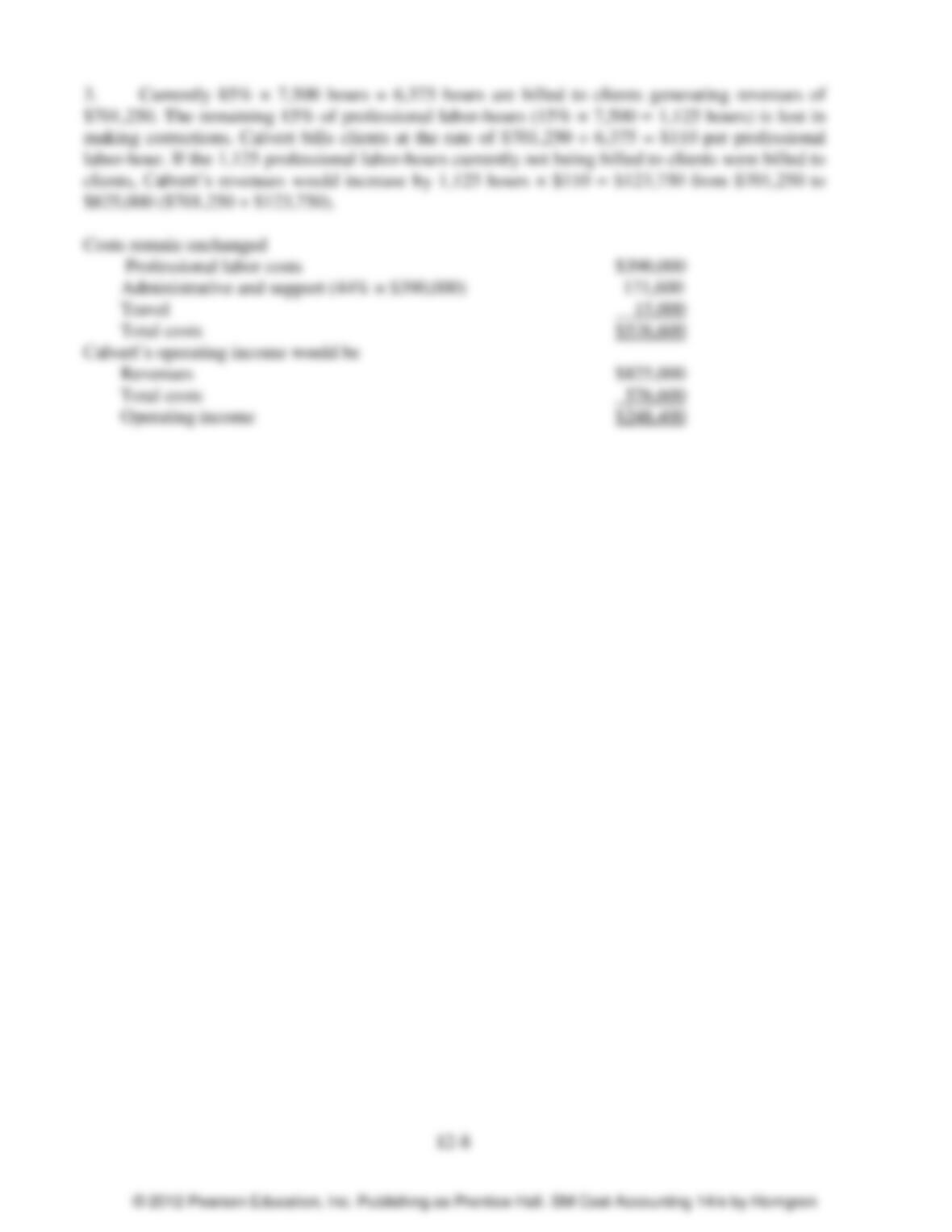
Total $475,512 $16,848 $84,240 $576,600