21–1
CHAPTER 21
CAPITAL BUDGETING AND COST ANALYSIS
21–1 No. Capital budgeting focuses on an individual investment project throughout its life, recognizing
the time value of money. The life of a project is often longer than a year. Accrual accounting focuses on
a particular accounting period, often a year, with an emphasis on income determination.
21–2 The five stages in capital budgeting are the following:
1. An identification stage to determine which types of capital investments are available to
accomplish organization objectives and strategies.
2. An information–acquisition stage to gather data from all parts of the value chain in order to
evaluate alternative capital investments.
3. A forecasting stage to project the future cash flows attributable to the various capital
projects.
4. An evaluation stage where capital budgeting methods are used to choose the best
alternative for the firm.
5. A financing, implementation and control stage to fund projects, get them under way and
monitor their performance.
21–3 In essence, the discounted cash–flow method calculates the expected cash inflows and outflows of
a project as if they occurred at a single point in time so that they can be aggregated (added, subtracted,
etc.) in an appropriate way. This enables comparison with cash flows from other projects that might
occur over different time periods.
21–4 No. Only quantitative outcomes are formally analyzed in capital budgeting decisions. Many
effects of capital budgeting decisions, however, are difficult to quantify in financial terms. These
nonfinancial or qualitative factors (for example, the number of accidents in a manufacturing plant or
employee morale) are important to consider in making capital budgeting decisions.
21–5 Sensitivity analysis can be incorporated into DCF analysis by examining how the DCF of each
project changes with changes in the inputs used. These could include changes in revenue assumptions,
cost assumptions, tax rate assumptions, and discount rates.
21–6 The payback method measures the time it will take to recoup, in the form of expected future net
cash inflows, the net initial investment in a project. The payback method is simple and easy to
understand. It is a handy method when screening many proposals and particularly when predicted cash
flows in later years are highly uncertain. The main weaknesses of the payback method are its neglect of
the time value of money and of the cash flows after the payback period. The first drawback, but not the
second, can be addressed by using the discounted payback method.
21–7 The accrual accounting rate–of–return (AARR) method divides an accrual accounting measure of
average annual income of a project by an accrual accounting measure of investment. The strengths of
the accrual accounting rate of return method are that it is simple, easy to understand, and considers
profitability. Its weaknesses are that it ignores the time value of money and does not consider the cash
flows for a project.
© 2012 Pearson Education, Inc. Publishing as Prentice Hall. SM Cost Accounting 14/e by Horngren
21–2
21–8 No. The discounted cash–flow techniques implicitly consider depreciation in rate of
return computations; the compound interest tables automatically allow for recovery of
investment. The net initial investment of an asset is usually regarded as a lump-sum outflow at
time zero. Where taxes are included in the DCF analysis, depreciation costs are included in the
computation of the taxable income number that is used to compute the tax payment cash flow.
21–9 A point of agreement is that an exclusive attachment to the mechanisms of any single
method examining only quantitative data is likely to result in overlooking important aspects of a
decision.
Two points of disagreement are (1) DCF can incorporate those strategic considerations that
can be expressed in financial terms, and (2) ―Practical considerations of strategy‖ not expressed
in financial terms can be incorporated into decisions after DCF analysis.
21–10 All overhead costs are not relevant in NPV analysis. Overhead costs are relevant only if
the capital investment results in a change in total overhead cash flows. Overhead costs are not
relevant if total overhead cash flows remain the same but the overhead allocated to the particular
capital investment changes.
21–11 The Division Y manager should consider why the Division X project was accepted and
the Division Y project rejected by the president. Possible explanations are:
a. The president considers qualitative factors not incorporated into the IRR computation
and this leads to the acceptance of the X project and rejection of the Y project.
b. The president believes that Division Y has a history of overstating cash inflows and
understating cash outflows.
c. The president has a preference for the manager of Division X over the manager of
Division Y—this is a corporate politics issue.
Factor a. means qualitative factors should be emphasized more in proposals. Factor b. means
Division Y needs to document whether its past projections have been relatively accurate. Factor
c. means the manager of Division Y has to play the corporate politics game better.
21–12 The categories of cash flow that should be considered in an equipment–replacement
decision are:
1a. Initial machine investment,
b. Initial working–capital investment,
c. After–tax cash flow from current disposal of old machine,
2a. Annual after–tax cash flow from operations (excluding the depreciation effect),
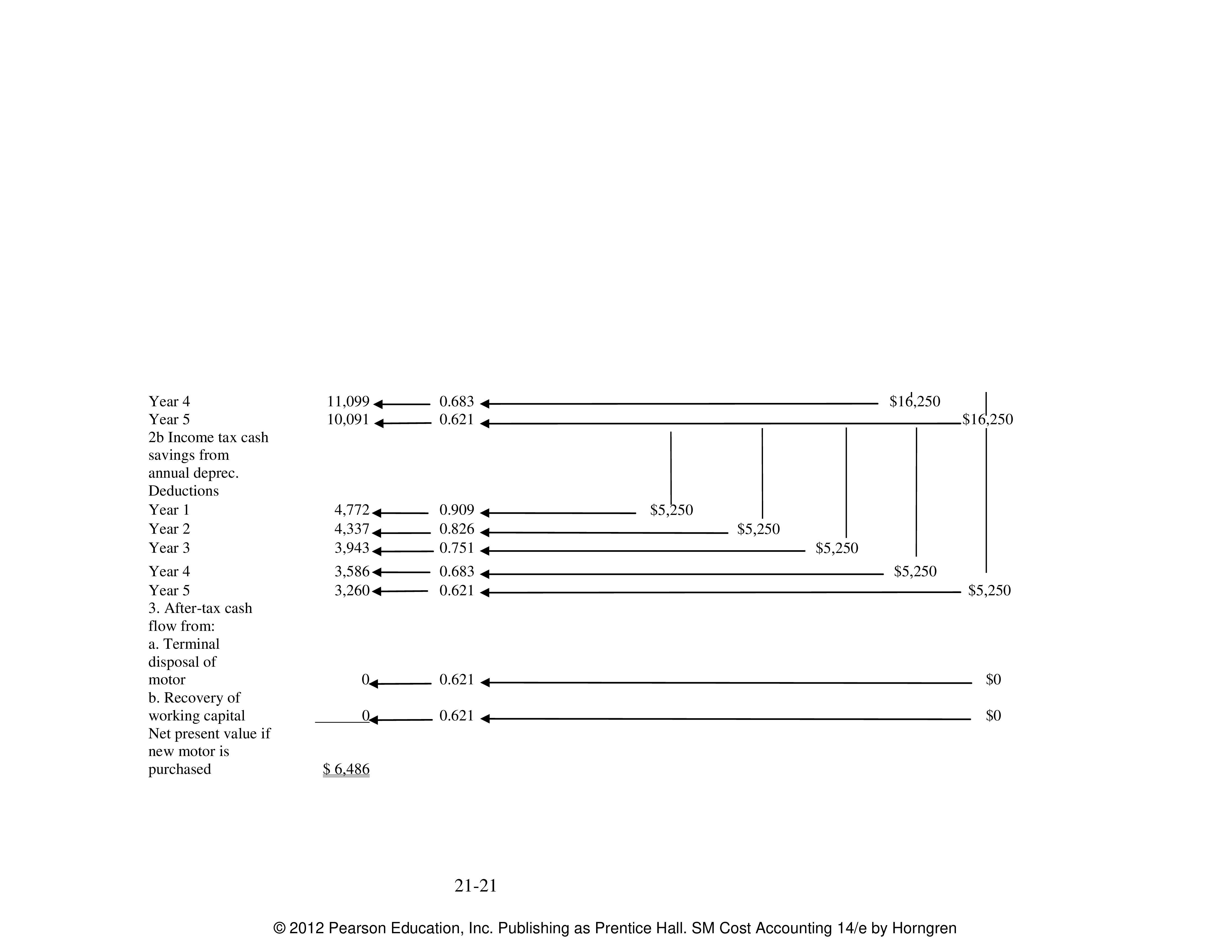
b. Income tax cash savings from annual depreciation deductions,
3a. After–tax cash flow from terminal disposal of machines, and
b. After–tax cash flow from terminal recovery of working–capital investment.
21–13 Income taxes can affect the cash inflows or outflows in a motor vehicle replacement
decision as follows:
a. Tax is payable on gain or loss on disposal of the existing motor vehicle,
b. Tax is payable on any change in the operating costs of the new vehicle vis–à–vis the
existing vehicle, and
c. Tax is payable on gain or loss on the sale of the new vehicle at the project termination
date.
d. Additional depreciation deductions for the new vehicle result in tax cash savings.
© 2012 Pearson Education, Inc. Publishing as Prentice Hall. SM Cost Accounting 14/e by Horngren

21–3
21–14 A cellular telephone company manager responsible for retaining customers needs to
consider the expected future revenues and the expected future costs of ―different investments‖ to
retain customers. One such investment could be a special price discount. An alternative
investment is offering loyalty club benefits to long–time customers.
21–15 These two rates of return differ in their elements:
Real-rate of return
Nominal rate of return
1. Risk-free element
1. Risk-free element
2. Business-risk element
2. Business-risk element
3. Inflation element
The inflation element is the premium above the real rate of return that is demanded for the
anticipated decline in the general purchasing power of the monetary unit.
21–16 Exercises in compound interest, no income taxes.
The answers to these exercises are printed after the last problem, at the end of the chapter.
(Please alert students that in some printed versions of the book there is a typographical
error in the solution to part 5. The interest rate is 8%, not 6%.)
21–17 (20–25 min.) Capital budget methods, no income taxes.
1a. The table for the present value of annuities (Appendix A, Table 4) shows:
8 periods at 8% = 5.747
Net present value = $67,000 (5.747) – $250,000
= $385,049 – $250,000 = $135,049
1b. Payback period = $250,000 ÷ $67,000 = 3.73 years
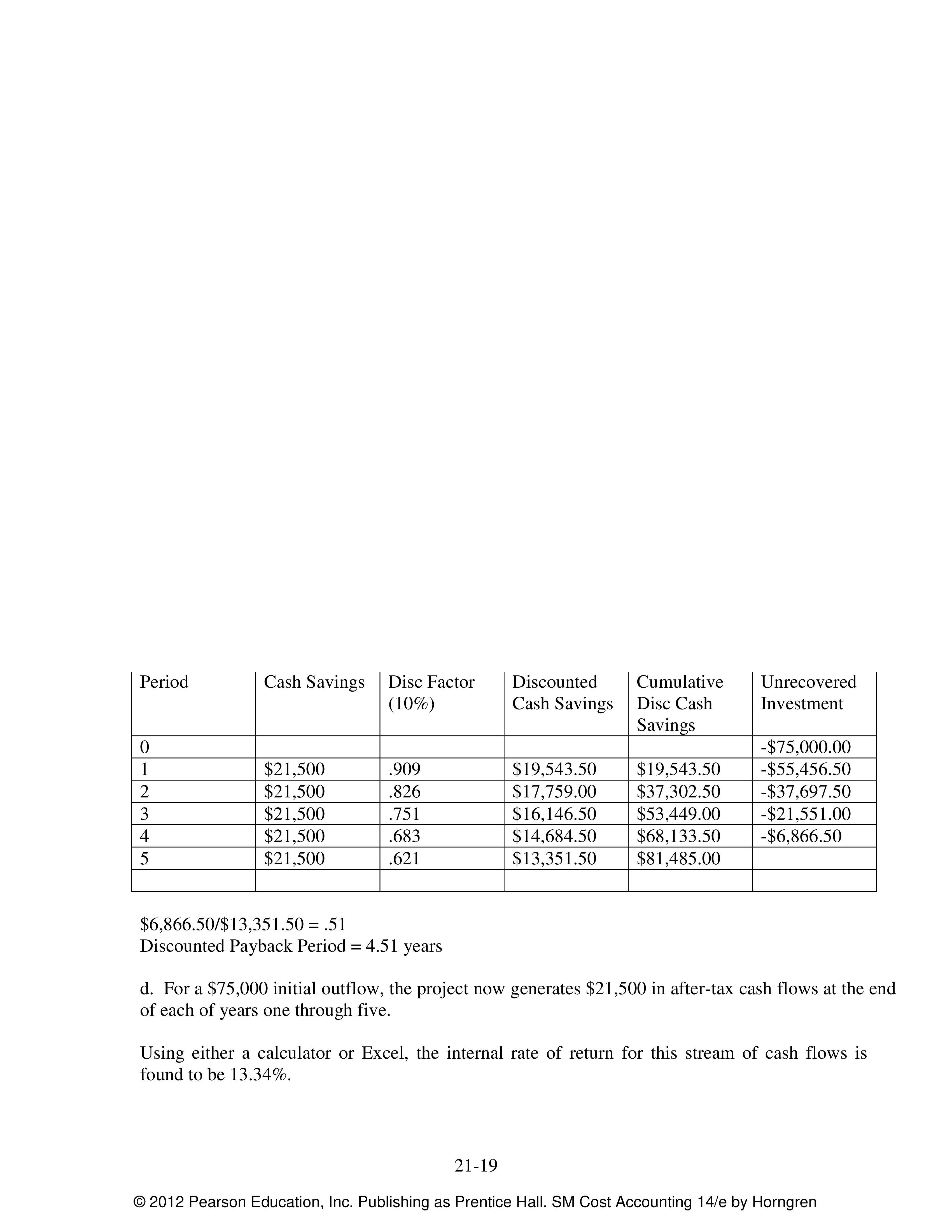
1c. Discounted Payback Period
Period
Cash Savings
Discount
Factor (8%)
Discounted
Cash Savings
Cumulative
Discounted
Cash Savings
Unrecovered
Investment
0
-$250,000
1
$67,000
.926
$62,042
$62,042
-$187,958
2
$67,000
.857
$57,419
$119,461
-$130,539
3
$67,000
.794
$53,198
$172,659
-$77,341
4
$67,000
.735
$49,245
$221,904
-$28,096
5
$67,000
.681
$45,627
$267,531
$28,096/$45,627 = .6158
Discounted Payback period = 4.62 years
© 2012 Pearson Education, Inc. Publishing as Prentice Hall. SM Cost Accounting 14/e by Horngren

21–4
1d. Internal rate of return:
$250,000 = Present value of annuity of $67,000 at R% for 8 years, or
what factor (F) in the table of present values of an annuity
(Appendix A, Table 4) will satisfy the following equation.
$250,000 = $67,000F
F = 250000/67000= 3.73
On the 8–year line in the table for the present value of annuities (Appendix A, Table 4), find the
column closest to 3.73; it is between a rate of return of 20% and 22%.
Interpolation is necessary:
Present Value Factors
20% 3.837 3.837
IRR rate – 3.730
22% 3.619 ––
Difference 0.218 0.107
Internal rate of return = 20% + (.107/.218) * (2%)
= 20% + .4908 (2%) = 20.98%
1d. Accrual accounting rate of return based on net initial investment:
Net initial investment = $250,000
Estimated useful life = 8 years
Annual straight–line depreciation = $250,000 ÷ 8 = $31,250
return of rate accounting Accrual
=
investment initialNet
income operating annual average expectedin Increase
= ($67,000 – $31,250) / $250,000 = $35,750 / $250,000 = 14.3%
Note how the accrual accounting rate of return can produce results that differ markedly from the
internal rate of return.
2. Other than the NPV, rate of return and the payback period on the new computer system,
factors that Riverbend should consider are:
Issues related to the financing the project, and the availability of capital to pay for the
system.
The effect of the system on employee morale, particularly those displaced by the
system. Salesperson expertise and real–time help from experienced employees is key
to the success of a hardware store.
The benefits of the new system for customers (faster checkout, fewer errors).
The upheaval of installing a new computer system. Its useful life is estimated to be 8
years. This means that Riverbend could face this upheaval again in 8 years. Also,
© 2012 Pearson Education, Inc. Publishing as Prentice Hall. SM Cost Accounting 14/e by Horngren
21–5
ensure that the costs of training and other ―hidden‖ start–up costs are included in the
estimated $250,000 cost of the new computer system.
© 2012 Pearson Education, Inc. Publishing as Prentice Hall. SM Cost Accounting 14/e by Horngren

21–6
21–18 (25 min.) Capital budgeting methods, no income taxes.
The table for the present value of annuities (Appendix A, Table 4) shows:
10 periods at 14% = 5.216
1a. Net present value = $28,000 (5.216) – $110,000
= $146,048 – $110,000 = $36,048
b. Payback period =
000,28$
000,110$
= 3.93 years
c. For a $110,000 initial outflow, the project generates $28,000 in cash flows at the end of
each of years one through ten.
Using either a calculator or Excel, the internal rate of return for this stream of cash flows is
found to be 21.96%.
d. Accrual accounting rate of return based on net initial investment:
Net initial investment = $110,000
Estimated useful life = 10 years
Annual straight–line depreciation = $110,000 ÷ 10 = $11,000
Accrual accounting rate of return =
000,110$
000,11$000,28$
=
000,110$
000,17$
= 15.45%
e. Accrual accounting rate of return based on average investment:
Average investment = ($110,000 + $0) / 2
= $55,000
Accrual accounting rate of return =
$28,000 $11,000
$55,000
= 30.91%.
2. Factors City Hospital should consider include:
a. Quantitative financial aspects.
b. Qualitative factors, such as the benefits to its customers of a better eye–testing machine
and the employee–morale advantages of having up–to–date equipment.
c. Financing factors, such as the availability of cash to purchase the new equipment.
© 2012 Pearson Education, Inc. Publishing as Prentice Hall. SM Cost Accounting 14/e by Horngren

21–19 (35 min.) Capital budgeting, income taxes.
1a. Net after–tax initial investment = $110,000
Annual after–tax cash flow from operations (excluding the depreciation effect):
Annual cash flow from operation with new machine
$28,000
Deduct income tax payments (30% of $28,000)
8,400
Annual after-tax cash flow from operations
$19,600
Income tax cash savings from annual depreciation deductions
30% $11,000
$3,300
These three amounts can be combined to determine the NPV:
Net initial investment;
$110,000 1.00
$(110,000)
10-year annuity of annual after-tax cash flows from operations;
102,234
$19,600 5.216
$3,300 5.216
Net present value