George Odisho, Dien Pham, Andrew Tong
Objective: To inform prospective employees in the management sector that Six Sigma can
not only be implemented in operations systems, but in financial systems as well.
TABLE OF CONTENTS
PAGE 2: OBJECTIVE
PAGE 3: INTRODUCTION
PAGE 4-8: CASE STUDY 1 – BANK OF AMERICA
PAGE 9-11: CASE STUDY 2 – JPMORGAN & CHASE CO.
PAGE 12: RECOMMENDATION
PAGE 13: CONCLUSION
PAGE 14: BIBLIOGRAPHY
OBJECTIVE
The objective of this report is to inform prospective employees/students that Six Sigma
level quality can be implemented, not only in manufacturing systems, but in business
practices (primarily financial systems) as well. The two case studies used during this report
are to demonstrate how large, top tier financial companies have implemented Six Sigma
quality and how both companies have used Six Sigma to varying degrees of success.
INTRODUCTION
Six Sigma is a set of techniques and tools for process improvement. It is often considered a
process that strives for near perfection. Six Sigma seeks to improve the quality of process
outputs by identifying and removing the causes of defects and minimizing variability in
manufacturing and business processes (which explains why only 3.4 defects per 1 million
units are bearable to a company practicing Six Sigma). The doctrine associated with Six
Sigma proclaims that continuous efforts to achieve stable and predictable process results
are of vital importance to business success. The doctrine also states that manufacturing and
business processes (where the emphasis of this report lies) have characteristics that can be
measured, analyzed, controlled and improved. The most important aspect of the Six Sigma
doctrine is the assertion that achieving sustained quality improvement requires
commitment from the entire organization, particularly from top-level management.
Although Six Sigma quality follows two types of methodologies inspired by Deming’s
Plan-Do-Check-Act Cycle, only one will be discussed in this report. The methodology
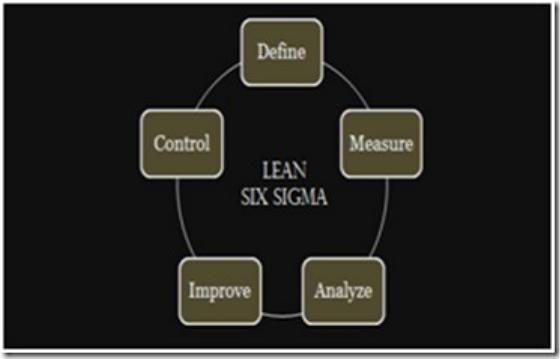
used in this report is the DMAIC, which is the most common used in business systems. D
stands for defining the system, M stands for measuring the key aspects of the current
process, A stands for analyzing the data to investigate and verify cause-and-effect
relationships, I stands for improve the current process based upon the data analysis, and C
stands for control. In this report, we will focus on how financial systems have
implemented Six Sigma and how successful these systems have become
post-implementation. This will further show that Six Sigma quality should be a goal for all
business systems due to its proven reliability.