Sexual Harassment in the Workplace
Yokeisha Hughes
Intro Business Research
ADCP360 D
Dr. Katherine Causey
February 28, 2017
2
ABSTRACT
Sexual Harassment is a developing issue in today’s work environment. This paper will
establish the causes of sexual harassment, types of sexual harassment, and federal laws against
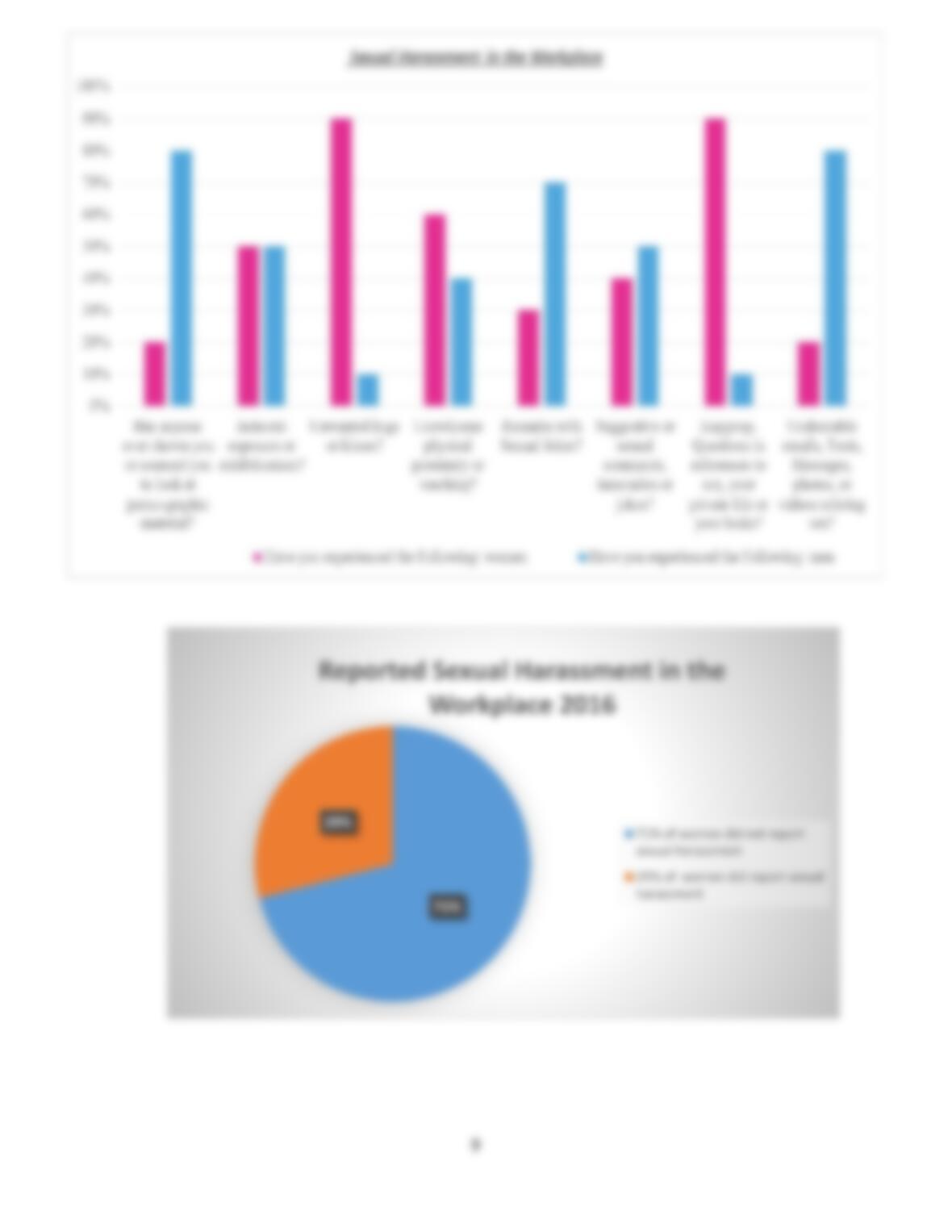
harassment. Attached with this paper is a survey regarding employees that were sexual harassed
at work that will initially show if their claims were reported to their employer. Another essential
viewpoint that it spreads will be on the most proficient method to manage the issue and how it
can be limited at working environments. The report demonstrates that lewd behavior is a
noteworthy challenge for employees. It is apparent from all wellsprings of study that lewd
behavior in the work environment is high. Employees are being subjected to perilous workplaces
that can influence their emotional and physical wellbeing.
3
Sexual Harassment in the Workplace
PROBLEM
Introduction
Sexual harassment is common in the workplace, but it’s not always reported. Two
decades after the federal courts first recognized sexual harassment as a form of sex
discrimination, debate still continues about what sexual harassment is, why it might be sex
discrimination, and what law can and should do about it. The practice of sexual harassment is
centuries old -at least, if we define sexual harassment as unwanted sexual relations imposed by
superiors on subordinates at work. For example, sexual coercion was an entrenched feature of
chattel slavery endured by African-American women without protection of law. While there
were crucial differences in the situation of free women employed in domestic service, they, too,
commonly faced sexual advances by men of the households in which they worked. Surviving
accounts of women employed in manufacturing and clerical positions in the late nineteenth and
early twentieth centuries also point to a variety of contexts in which men imposed sexual
relations- ranging from assault to all manner of unwanted physical or verbal advances-on women
who worked for them (Siegel, 2003, p.3)
Howard (2016) suggests many people believe that sexual harassment in the workplace is
a thing of the past; However, the reality is that sexual harassment in the employment setting is
still remarkably prevalent, and may even be more common than ever.
Sexual harassment is a gender-neutral offense, at least in theory: Men can sexually harass
women, and women can sexually harass men. People of the same sex can also sexually harass
each other, as long as the harassment is based on sex rather than sexual orientation, which is not
a protected characteristic under Title VII. For example, if a man’s coworkers constantly bombard
him with sexually explicit photos of women, and this makes him uncomfortable, he might have a
sexual harassment claim. If, however, a man’s coworkers tease and belittle him because he is
gay, that might not be illegal harassment under federal law as it is currently interpreted.
Nonetheless, such conduct may be illegal under laws enacted by certain states, or even cities.
The line between harassment based on sex and harassment based on sexual orientation
becomes blurred when gender-based stereotypes are at play. For example, courts have held that