Seven Transformations of Leadership
by David Rooke and William R. Torbert
Most developmental psychologists agree that what differentiates leaders is not so much their philosophy of leadership,
their personality, or their style of management. Rather, it’s their internal “action logic”—how they interpret their
surroundings and react when their power or safety is challenged. Relatively few leaders, however, try to understand their
own action logic, and fewer still have explored the possibility of changing it.
They should, because we’ve found that leaders who do undertake a voyage of personal understanding and development
can transform not only their own capabilities but also those of their companies. In our close collaboration with
psychologist Susanne Cook–Greuter—and our 25 years of extensive survey–based consulting at companies such as
Deutsche Bank, Harvard Pilgrim Health Care, Hewlett-Packard, NSA, Trillium Asset Management, Aviva, and Volvo—
we’ve worked with thousands of executives as they’ve tried to develop their leadership skills. The good news is that leaders
who make an effort to understand their own action logic can improve their ability to lead. But to do that, it’s important
first to understand what kind of leader you already are.
The Seven Action Logics
Our research is based on a sentence–completion survey tool called the Leadership Development Profile. Using this tool,
participants are asked to complete 36 sentences that begin with phrases such as “A good leader…,” to which responses vary
widely:
“…cracks the whip.”
“…realizes that it’s important to achieve good performance from subordinates.”
“…juggles competing forces and takes responsibility for her decisions.”
By asking participants to complete sentences of this type, it’s possible for highly trained evaluators to paint a picture of
how participants interpret their own actions and the world around them; these “pictures” show which one of seven
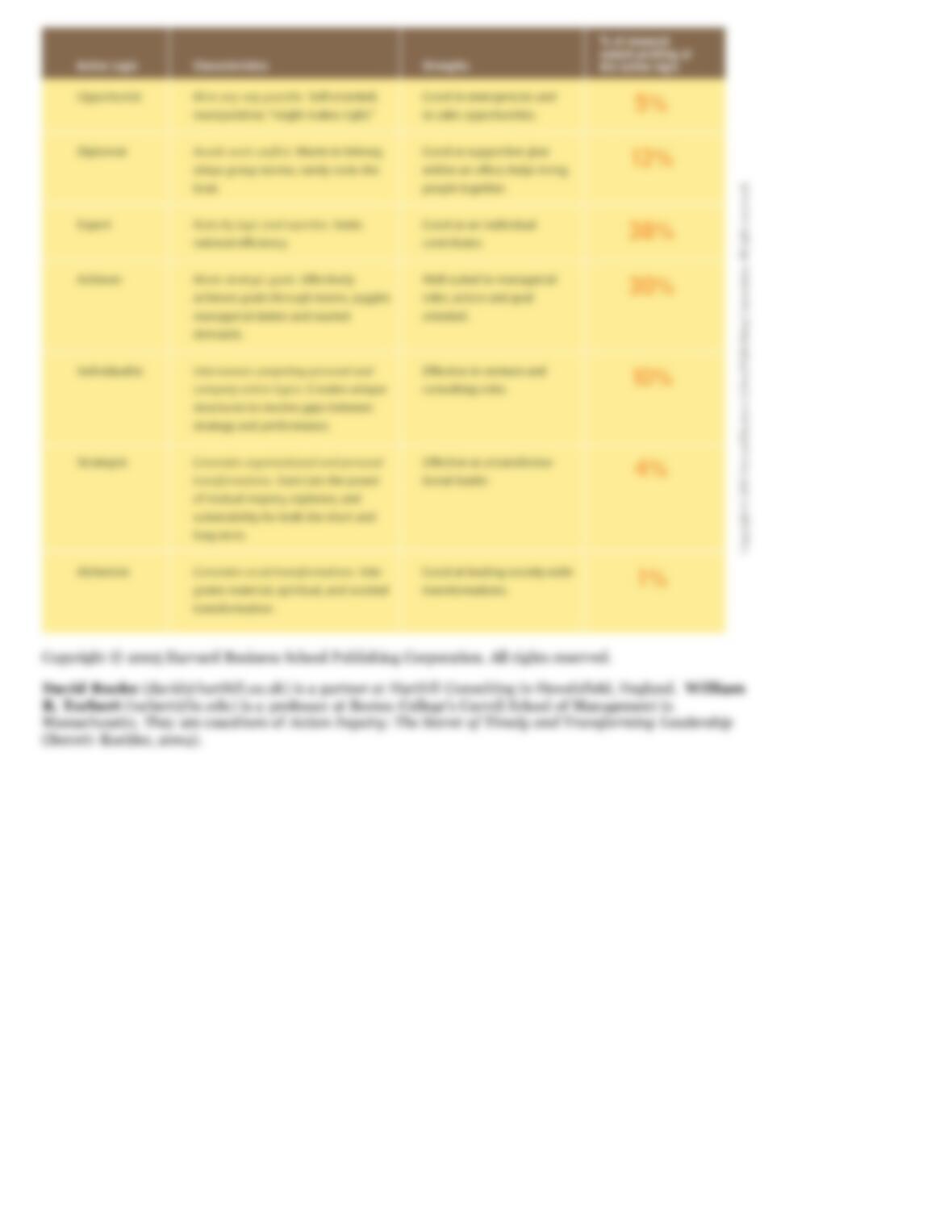
developmental action logics—Opportunist, Diplomat, Expert, Achiever, Individualist, Strategist, or Alchemist—currently
functions as a leader’s dominant way of thinking. Leaders can move through these categories as their abilities grow, so
taking the Leadership Development Profile again several years later can reveal whether a leader’s action logic has evolved.
Over the past 25 years, we and other researchers have administered the sentence–completion survey to thousands of
managers and professionals, most between the ages of 25 and 55, at hundreds of American and European companies (as
well as nonprofits and governmental agencies) in diverse industries. What we found is that the levels of corporate and
individual performance vary according to action logic. Notably, we found that the three types of leaders associated with
below–average corporate performance (Opportunists, Diplomats, and Experts) accounted for 55% of our sample. They
were significantly less effective at implementing organizational strategies than the 30% of the sample who measured as
Achievers. Moreover, only the final 15% of managers in the sample (Individualists, Strategists, and Alchemists) showed the
consistent capacity to innovate and to successfully transform their organizations.
Seven Ways of Leading (Located at the end of this article)
To understand how leaders fall into such distinct categories and corporate performance, let’s look in more detail at each
leadership style in turn, starting with the least productive (and least complex).
Leaders are made, not born, and how they develop is critical for organizational
change.

The Opportunist
Our most comforting finding was that only 5% of the leaders in our sample were characterized by mistrust, egocentrism,
and manipulativeness. We call these leaders Opportunists, a title that reflects their tendency to focus on personal wins and
see the world and other people as opportunities to be exploited. Their approach to the outside world is largely determined
by their perception of control—in other words, how they will react to an event depends primarily on whether or not they
think they can direct the outcome. They treat other people as objects or as competitors who are also out for themselves.
Opportunists tend to regard their bad behavior as legitimate in the cut and thrust of an eye–for–an–eye world. They reject
feedback, externalize blame, and retaliate harshly. One can see this action logic in the early work of Larry Ellison (now CEO
of Oracle). Ellison describes his managerial style at the start of his career as “management by ridicule.” “You’ve got to be
good at intellectual intimidation and rhetorical bullying,” he once told Matthew Symonds of the Economist. “I’d excuse my
behavior by telling myself I was just having ‘an open and honest debate.’ The fact is, I just didn’t know any better.”
Few Opportunists remain managers for long, unless they transform to more effective action logics (as Ellison has done).
Their constant firefighting, their style of self–aggrandizement, and their frequent rule breaking is the antithesis of the kind
of leader people want to work with for the long term. If you have worked for an Opportunist, you will almost certainly
remember it as a difficult time. By the same token, corporate environments that breed opportunism seldom endure,
although Opportunists often survive longer than they should because they provide an exciting environment in which
younger executives, especially, can take risks. As one ex-Enron senior staffer said, “Before the fall, those were such exciting
years. We felt we could do anything, pull off everything, write our own rules. The pace was wild, and we all just rode it.”
Of course, Enron’s shareholders and pensioners would reasonably feel that they were paying too heavily for that staffer’s
adventure.
The Diplomat
The Diplomat makes sense of the world around him in a more benign way than the Opportunist does, but this action logic
can also have extremely negative repercussions if the leader is a senior manager. Loyally serving the group, the Diplomat
seeks to please higher–status colleagues while avoiding conflict. This action logic is focused on gaining control of one’s own
behavior—more than on gaining control of external events or other people. According to the Diplomat’s action logic, a
leader gains more enduring acceptance and influence by cooperating with group norms and by performing his daily roles
well.
In a support role or a team context, this type of executive has much to offer. Diplomats provide social glue to their
colleagues and ensure that attention is paid to the needs of others, which is probably why the great majority of Diplomats
work at the most junior rungs of management, in jobs such as frontline supervisor, customer service representative, or
nurse practitioner. Indeed, research into 497 managers in different industries showed that 80% of all Diplomats were at
junior levels. By contrast, 80% of all Strategists were at senior levels, suggesting that managers who grow into more
effective action logics—like that of the Strategist—have a greater chance of being promoted.
Diplomats are much more problematic in top leadership roles because they try to ignore conflict. They tend to be overly
polite and friendly and find it virtually impossible to give challenging feedback to others. Initiating change, with its
inevitable conflicts, represents a grave threat to the Diplomat, and he will avoid it if at all possible, even to the point of
self–destruction.
Consider one Diplomat who became the interim CEO of an organization when his predecessor died suddenly from an
aneurysm. When the board split on the selection of a permanent successor, it asked the Diplomat to carry on. Our
Diplomat relished his role as a ceremonial figurehead and was a sought–after speaker at public events. Unfortunately, he
found the more conflictual requirements of the job less to his liking. He failed, for instance, to replace a number of senior
managers who had serious ongoing performance issues and were resisting the change program his predecessor had
initiated. Because the changes were controversial, the Diplomat avoided meetings, even planning business trips for the
times when the senior team would meet. The team members were so frustrated by the Diplomat’s attitude that they
eventually resigned en masse. He “resolved” this crisis by thanking the team publicly for its contribution and appointing
new team members. Eventually, in the face of mounting losses arising from this poor management, the board decided to
demote the Diplomat to his former role as vice president.
The Expert
The largest category of leader is that of Experts, who account for 38% of all professionals in our sample. In contrast to
Opportunists, who focus on trying to control the world around them, and Diplomats, who concentrate on controlling their
own behavior, Experts try to exercise control by perfecting their knowledge, both in their professional and personal lives.
Exercising watertight thinking is extremely important to Experts. Not surprisingly, many accountants, investment analysts,
marketing researchers, software engineers, and consultants operate from the Expert action logic. Secure in their expertise,
they present hard data and logic in their efforts to gain consensus and buy-in for their proposals.
Experts are great individual contributors because of their pursuit of continuous improvement, efficiency, and perfection.
But as managers, they can be problematic because they are so completely sure they are right. When subordinates talk about
a my–way-or–the–highway type of boss, they are probably talking about someone operating from an Expert action logic.
Experts tend to view collaboration as a waste of time (“Not all meetings are a waste of time—some are canceled!”), and
they will frequently treat the opinion of people less expert than themselves with contempt. Emotional intelligence is
neither desired nor appreciated. As Sun Microsystems’ CEO Scott McNealy put it: “I don’t do feelings; I’ll leave that to
Barry Manilow.”
It comes as no surprise, then, that after unsuccessfully pleading with him to scale back in the face of growing losses during
the dot–com debacle of 2001 and 2002, nearly a dozen members of McNealy’s senior management team left.
The Achiever
For those who hope someday to work for a manager who both challenges and supports them and creates a positive team
and interdepartmental atmosphere, the good news is that a large proportion, 30%, of the managers in our research
measured as Achievers. While these leaders create a positive work environment and focus their efforts on deliverables, the
downside is that their style often inhibits thinking outside the box.
Achievers have a more complex and integrated understanding of the world than do managers who display the three
previous action logics we’ve described. They’re open to feedback and realize that many of the ambiguities and conflicts of
everyday life are due to differences in interpretation and ways of relating. They know that creatively transforming or
resolving clashes requires sensitivity to relationships and the ability to influence others in positive ways. Achievers can also
reliably lead a team to implement new strategies over a one– to three-year period, balancing immediate and long–term
objectives. One study of ophthalmologists in private practice showed that those who scored as Achievers had lower staff
turnover, delegated more responsibility, and had practices that earned at least twice the gross annual revenues of those run
by Experts.
Achievers often find themselves clashing with Experts. The Expert subordinate, in particular, finds the Achiever leader
hard to take because he cannot deny the reality of the Achiever’s success even though he feels superior. Consider Hewlett-
Packard, where the research engineers tend to score as Experts and the lab managers as higher–level Achievers. At one
project meeting, a lab manager—a decided Achiever—slammed her coffee cup on the table and exclaimed, “I know we can
get 18 features into this, but the customers want delivery some time this century, and the main eight features will do.”
“Philistine!” snorted one engineer, an Expert. But this kind of conflict isn’t always destructive. In fact, it provides much of
the fuel that has ignited—and sustained—the competitiveness of many of the country’s most successful corporations.