Segmentation, Targeting, and Positioning
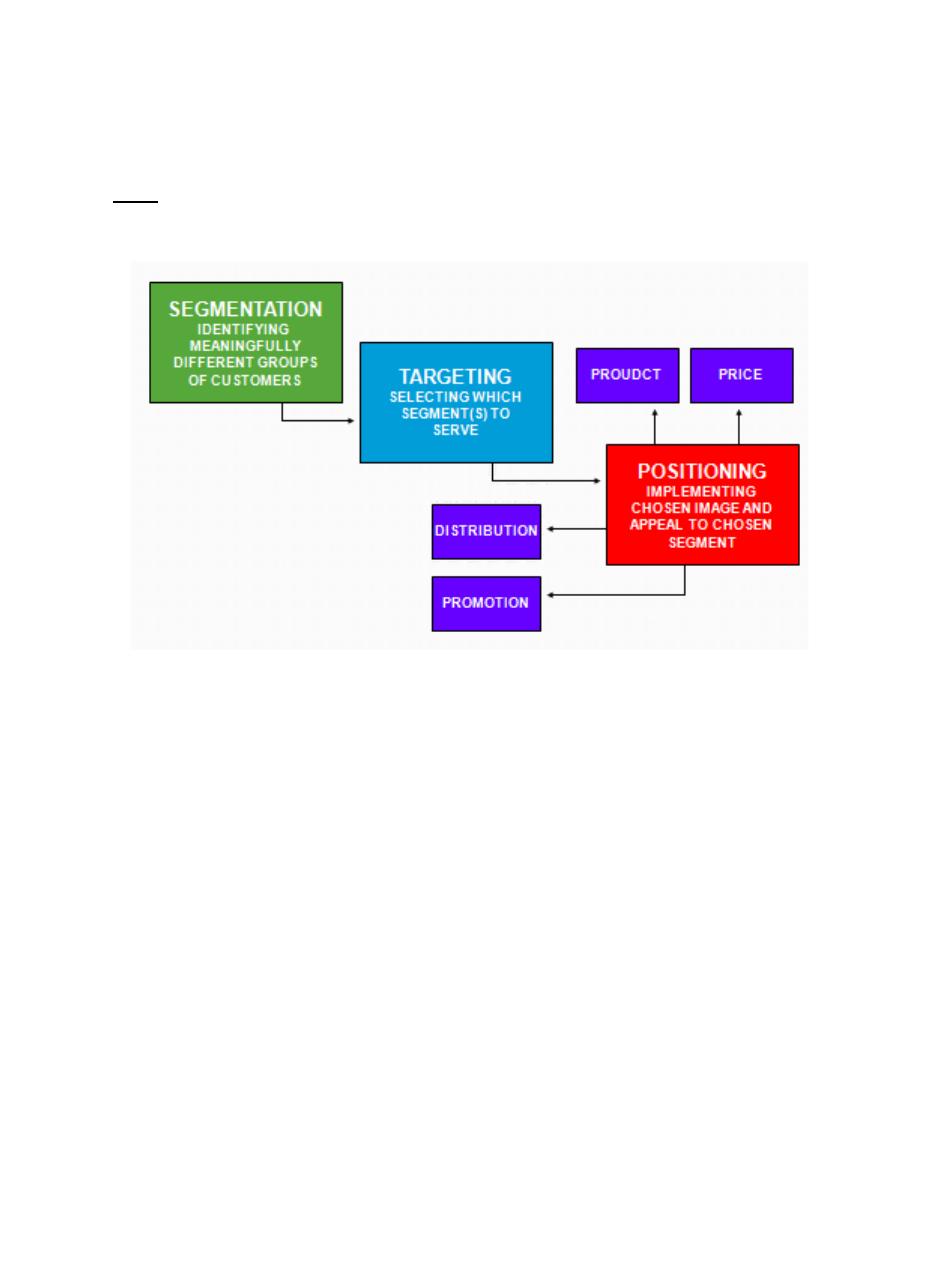
Segmentation, targeting, and positioning together comprise a three stage
process. We first (1) determine which kinds of customers exist, then (2)
select which ones we are best o trying to serve and, finally, (3) implement
our segmentation by optimizing our products/services for that
segment andcommunicating that we have made the choice to distinguish
ourselves that way.
Segmentation involves finding out what kinds of consumers with di erent
needs exist. In the auto market, for example, some consumers demand
speed and performance, while others are much more concerned about
roominess and safety. In general, it holds true that “You can’t be all things to
all people,” and experience has demonstrated that firms that specialize in
meeting the needs of one group of consumers over another tend to be more
profitable.
Generically, there are three approaches to marketing. In
the undifferentiatedstrategy, all consumers are treated as the same, with
firms not making any specific e orts to satisfy particular groups. This may
work when the product is a standard one where one competitor really can’t
o er much that another one can’t. Usually, this is the case only for
commodities. In the concentratedstrategy, one firm chooses to focus on one
of several segments that exist while leaving other segments to competitors.
For example, Southwest Airlines focuses on price sensitive consumers who
will forego meals and assigned seating for low prices. In contrast, most
airlines follow the differentiatedstrategy: They o er high priced tickets to
those who are in1exible in that they cannot tell in advance when they need
to 1y and find it impractical to stay over a Saturday. These travelers—
usually business travelers—pay high fares but can only fill the planes up
partially. The same airlines then sell some of the remaining seats to more
price sensitive customers who can buy two weeks in advance and stay over.
Note that segmentation calls for some tough choices. There may be a large
number of variables that can be used to di erentiate consumers of a given
product category; yet, in practice, it becomes impossibly cumbersome to
work with more than a few at a time. Thus, we need to determine which
variables will be most useful in distinguishing di erent groups of consumers.
We might thus decide, for example, that the variables that are most relevant
in separating di erent kinds of soft drink consumers are (1) preference for
taste vs. low calories, (2) preference for Cola vs. non-cola taste, (3) price
sensitivity—willingness to pay for brand names; and (4) heavy vs. light
consumers. We now put these variables together to arrive at various
combinations.
Several di erent kinds of variables can be used for segmentation.
Demographic variables essentially refer to personal statistics such as
income, gender, education, location (rural vs. urban, East vs. West),
ethnicity, and family size. Campbell’s soup, for instance, has found
that Western U.S. consumers on the average prefer spicier soups—
thus, you get a di erent product in the same cans at the East and West
coasts. Facing 1at sales of guns in the traditional male dominated