University of South Alabama
Department of Leadership and Teacher Education
K-6 Teacher Education Lesson Plan Format
Vital Information
Author: Caroline Short
Date: 3/17/21
Subject(s): Science
Central Focus: Matter is made up particles too small to be seen
Grade Level: 5th
Essential Literacy Strategy (Literacy Only)
Related Skills (Literacy only)
Standard(s)
List the full standard with its number for each content area addressed in lesson/learning segment.
For Math and Science also include the Standards for Mathematical Practice, Scientific and Engineering Practices, and Crosscutting Concepts.
5. 1. Plan and carry out investigations (e.g., adding air to expand a basketball, compressing air in a syringe, dissolving sugar in water, evaporating salt
water) to provide evidence that matter is made of particles too small to be seen.
Student Learning Objective(s)
List all objectives for the lesson/learning segment for each content area related to the content standards.
Objectives must be measurable, observable, based on lesson content, and must include actions, conditions, and criteria.
• While watching a video about particles in matter, students will write down what the particles do in each state, solid, liquid,
and gas.
• Students will demonstrate the fact that matter is made up of particles that are too small to be seen to the naked eye by
conducting the empty water bottle and balloon experiment.
• Students will learn the meaning of vocabulary words related to this lesson such as matter and particles by demonstrating their
understanding through whole group class discussions.
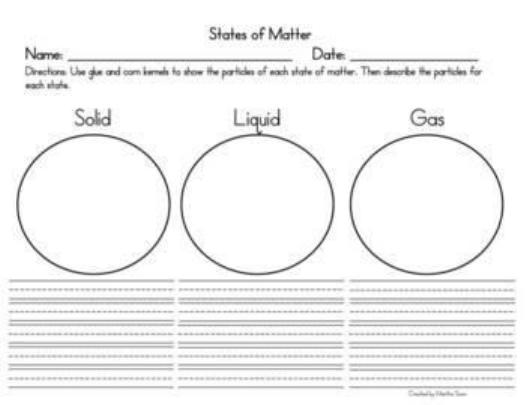
• Students will demonstrate their understanding of how particles act in each state of matter by drawing the particles in a solid,
liquid, and gas on their three states of matter worksheet.

Justification for Goals and Objectives
Description of what the students already know about the topics and their gaps in knowledge.
Prior Academic Knowledge and Conceptions
What prior knowledge, skills, and concepts must students already know within each content area to be successful with this lesson/learning segment?
• Students should already know or have heard of the term matter.
• Students are probably failure with the three states of matter.
• Students should know that matter can change states.
Common Errors
What are common errors or misunderstandings of students related to the central focus of this lesson/learning segment within each content area?
How will you address them for this group of students?
• Students may be confused by the term matter having multiple meanings.
• To address this, the definition of matter will be in the introduction video.
• Students might get sidetracked during the video. To prevent this, the students will write down three things that stood out to
them in the video. Instructional Strategies and Learning Tasks – Day 1
Description of what the teacher (you) will be doing and/or what the students will be doing.
Launch (Engage) __7__ Minutes
How will you assess prior knowledge?
How will you start the lesson to engage and motivate students in learning?
State the objectives in student terms.
Engage:
• “Today we are going to be talking about the fact that matter is made up of tiny particles that are too small to be seen. To start
off our lesson today we are going to be watching a video that better explains this concept. Please get out a piece of notebook paper and a
pencil so you can write down the description of how these particles act during each state of matter.”
• https://youtu.be/npv74D2MO6Q
• Once the video is over, I will collect select students to share with the class things that stood out to them in the video.
• My goal is that students will build off each other’s responses.
Instruction (Explore and Explain) __15__ Minutes
List (numbered steps or bullets are fine) the steps for your instruction, based on the student learning objectives and assessment.
How will you link the new content (skills and concepts) to students’ prior academic learning and their personal, cultural, and/or community assets?
What will you say and do to provide engaging learning opportunities based on concepts, theories, principles and research?
How will you incorporate problem solving and critical thinking?
How will you monitor students and provide feedback?
How will students engage with one another?
Will there be cross curricular connections?
For Math and Science:
How will students participate in inquiry-based (hands-on/minds-on) learning?
How will the students use math manipulatives to develop conceptual understanding?
How are students developing procedural fluency and mathematical reasoning/problem solving?
Explore:
• “I loved hearing all the things that stood out to everyone in the video. Let us revisit the video. What was the main idea of the
video? (I will allow students wait time and call on a student for the answer.) That is correct! There are three states of matter, solids, liquids,
and gas. The video explained how particles act in each state. Does anyone remember the characteristics of particles in a solid? “