Foreign Trade University
Group members
Nguyen Phuong Anh – 1113140060
Vu Ngoc Hoa – 1111140078
Pham Thi Khanh Linh – 1117140014
Nguyen T.Phuong Nga – 1114140058
Le Vu Thuy Trang –1111140131
Risks Hedging at DAKMAN – A
COFFEE EXORTER
Financial Risk Management
Instructor: Dr. Mai Thu Hien (Mrs)
1
Table of Contents
I. Overview of DAKMAN Company …………………………………………………………………………………………………………. 2
II. Current Situation of coffee production and consumption …………………………………………………………….. 3
1. Current situation of coffee production and consumption …………………………………………………… 3
a. The world ……………………………………………………………………………………………………………………. 3
b. Vietnam ………………………………………………………………………………………………………………………. 4
2. Fluctuations in coffee prices in the current period ……………………………………………………………. 5
3. Price fluctuation risks (Current fluctuation in the coffee price) …………………………………………….. 7
a. Hedging risks using Future Contracts ……………………………………………………………………………….. 7
b. Trading Robusta Coffee on LIFFE ……………………………………………………………………………………… 9
c. The process of coffee price risk’s hedging using futures contracts via TECHCOMBANK ……… 11
III. The process of hedging foreign exchange rate risks using forward contracts of DAKMAN
HCM via TECHCOMBANK ………………………………………………………………………………………………………………………………… 17
1. Source and impacts of foreign exchange risks on businesses……………………………………………. 17
2. Historical Exchange Rate and Future Forecast ………………………………………………………………… 18
Data on historical exchange rate from Nov 4, 2013 to Aug 31, 2014 …………………………………….. 18
Forecast for the last quarter of 2014 ………………………………………………………………………………….. 20
3. The process of carrying out forward contracts to hedge foreign exchange risks ……………….. 20
IV. Conclusion ……………………………………………………………………………………………………………………………………………… 21
1. Predictions on coffee demand and supply of Vietnam ………………………………………………….. 21
2. Challenges for DAKMAN when using coffee futures contracts ………………………………………. 22
3. Recommendations for DAKMAN …………………………………………………………………………………. 22
References ………………………………………………………………………………………………………………………………………………………….. 24
References

2
I. Overview of DAKMAN Company
Trade Name: DAKMAN COFFEE J.V, Processing & Export Factoory Buon Ma Thuot – Dak Lak
Address: KM 7, National Road 26, Buon Ma Thuot, Dak LAk, Vietnam
Telephone number: +84 500 3823 201
Fax: +84 500 3823 384
Registered No.: 4116000944
Type of Company: Foreign invested Joint venture company licensed by Vietnamese
government
Objects:
– Generating profits
– Stabilizing the circulation of goods in the market
– Creating jobs and improving working condition as well as living standards for employees
– Retrieving foreign currency through export-import activities
Business field:
– Main activities: Select and purchase Robusta coffee Directly from local farmers through to
the shipping container; process and export Robusta coffee from Vietnam
– Export-Import activities: exporting Robusta coffee
3
II. Current Situation of coffee production and consumption
Coffee is one of the key agricultural export products of Vietnam. In 2013, exporting coffee reached
$ 1.2 billion (decreased 13.7% in volume and 15.6% in value compared to 2012). The volatility of
coffee prices in 2013 was due to the oversupply of coffee. Rising coffee price encouraged producers
to invest and increase coffee production.
Although the drought led to lower productivity yields, it is not the disadvantage for farmers. It can
help the coffee price increase. In contrast, the suitable climate can help to increase yields; farmers
can fail because the market price may be reduced. It is the sensitivity and difficulty to predict the
coffee market. Not only farmers but also the coffee exporters in Vietnam are affected by the price
reducing. Especially, Vietnamese coffee prices in the world market depend largely on coffee
production in Brazil.
The factors affect the volatility of prices including climatic condition, production of the major
exporting countries such as Brazil, Vietnam, Indonesia, Colombia; consumption in some major
markets; fluctuations in currency exchange rate; speculative, donors, non-commercial state on the
commodity market, and the politic field.
1. Current situation of coffee production and consumption
a. The world
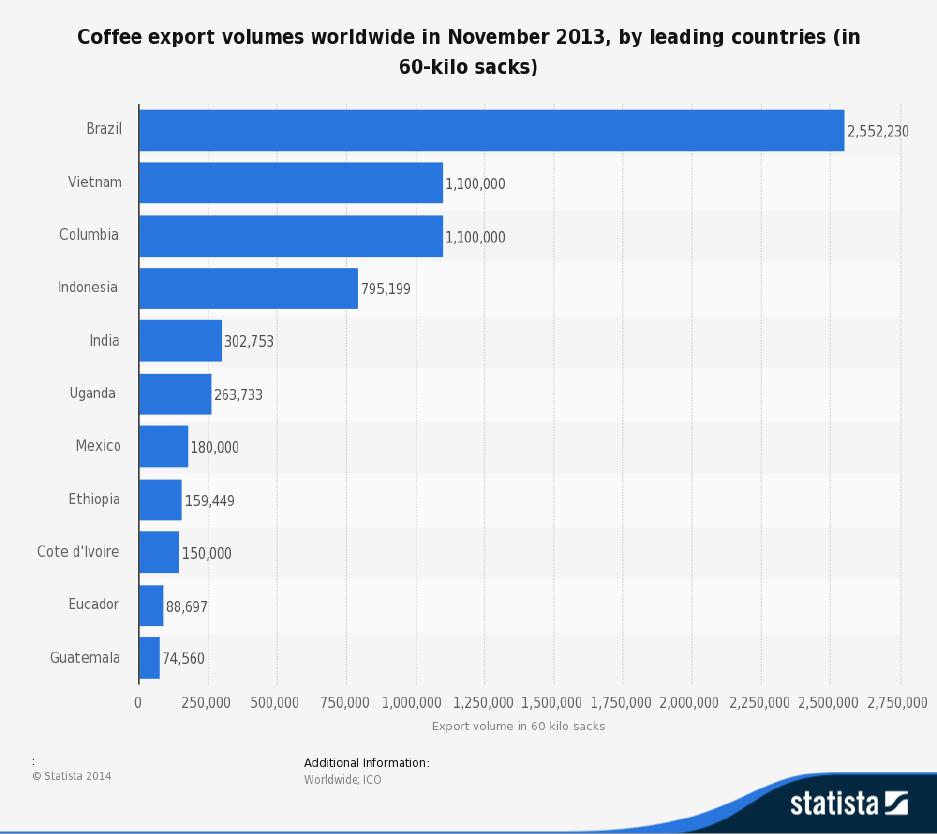
Nowadays, there are 86 countries exporting coffee, focusing on four main areas: South America,
Central America, Africa and Asia. The world total output was 145,194,000 bags in 2013. In
particular, South America produced 47%, Africa 17%, North and Central America 16%, Asia 17% of
the world coffee production.
Brazil is the largest coffee producing countries in the world with over 1.7 million tons of production
annually, achieved approximately 25% of the international market. The other major exporting
countries are Vietnam, Colombia, Indonesia, Ivory Coast, Mexico, India, Guatemala, Ethiopia,
Uganda, Costa Rica, Peru and El Salvador.
In 2013, the export of the world coffee in the period 2012/2013 still rose 2.3%, which exports
mainly to the United States. Besides that, Japan, Italy, France and Germany are the countries import
large amount of coffee (over $ 1 billion).
4
b. Vietnam
Vietnam has exported coffee to 74 countries and territories all over the world. And after 25 years of
development in the early 21st century Vietnam has occupied the No. 2 spot in the world in volume
of coffee exports, and the first of Robusta output.
– In 2013: The area of 616,000 hectares (nearly 1.49 million tons), (1 in 5 export items with the
value over $ 1 billion)
– Gravity interpretation of 6 coffee growing regions: Northeast and South Central Coast 0%, North
West 1%, North Central 2%, South East 8%, West Central 89%.
5
– The percentage of area under tree age: over 25 years : 5%, 20-25 years: 17%, 12-20 years: 28%
less than 12 years: 50%.
– Production capacity: 21.9 tons / ha, yield of 1167.9 thousand tons, exports reached 2.69 billion
dollars.
– Status of tree: the proportion of Arabica coffee production is still modest compared with Robusta
coffee (respectively 2.56% and 97.44%).
Coffee exports from Vietnam in 2013 reached 1.3 million tons with an export turnover reached 2.72
billion, reduced 24.8% in volume and 25.9% in turnover. Compared with the previous year, 2013
was the year that the coffee industry has been a significant decline in export volume and export
value. Reviewed within the past five years, exports of Vietnam coffee increased the growth in the
first 4 years (from 2009 to 2012) with an average growth rate of about 17.7% / year. This suggests
that the main markets of importing Vietnamese coffee are increasingly interested in Vietnamese
coffee and the number of export markets in coffee has been expanded (in 2008, Vietnam’s coffee is
exported to 74 market, by the end of 2013 had reached 86 markets). However, the world economic
situation faced many difficulties; demand for commodities in the export market is significantly
reduced due to the economic downturn, natural disasters disease (such as rain ice, water shortages,
rust). That made a serious impact on productivity and quality of coffee products …, which lead to
the decline in the country’s coffee exports both in volume and value in 2013.
2. Fluctuations in coffee prices in the current period
The global market for coffee has experienced the price instability for the recent 5 years. Because
International Coffee Organization (ICO) cannot maintain the import-export quotas and impacts
form Financial Crisis, there have been periods that the coffee price went down unprecedentedly
compared with past decades.
The crisis in coffee market not only pulled the coffee price down but also caused negative
consequences: farmers with low income could not afford the expenditure for daily life and
investment for reproduction; coffee fields were left fallow or being utilized for other crops.
Due to impacts from Financial Crisis, the price of agricultural products in general and coffee in
specific fell significantly. The FOB price of coffee in HCM City decreased from USD 2,520 per ton in
February 2008 to USD 2000 in September 2008. The price dropped continuously and reached USD
1,480 per ton in November that year.
Besides, pressure from USD currency recovery and simultaneous capital withdrawal of investors’
contribute to the decrease in demand in futures market, which reduces the coffee price
unexpectedly.
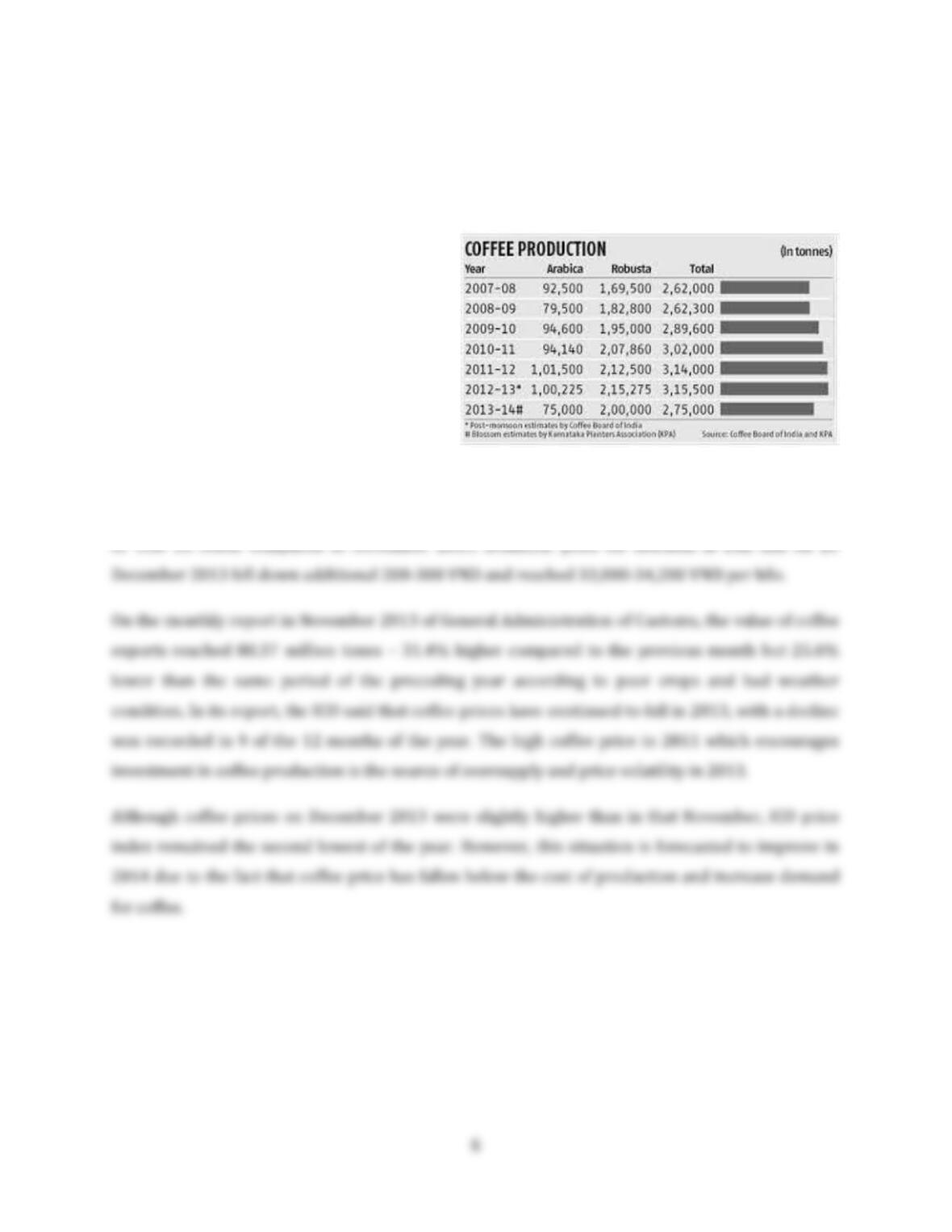
Since the early of 2010, the global market for
coffee has witnessed recovery with the price
outburst happened at the end of 2011: the
Robusta price in December 2011reached
almost USD 2,600 per ton, a little bit higher
than before Financial Crisis. However, after 2–
year of recovery, the world market for coffee
faces the trend of gradual decrease in both
price and production output.
The Robusta price on LIFFE, London on 20 December 2013 equals USD 1,690 per ton, which is 0.89%