Chapter 05 Risk and Return: Past and Prologue
1. You put up $50 at the beginning of the year for an investment. The value of the
investment grows 4% and you earn a dividend of $3.50. Your HPR was ____.
A. 4.00%
B. 3.50%
C. 7.00%
D. 11.00%
Bodie – Chapter 05 #1
Difficulty: Medium
2. The ______ measure of returns ignores compounding.
A. geometric average
B. arithmetic average
C. IRR
D. dollar weighted
Bodie – Chapter 05 #2
Difficulty: Easy
3. If you want to measure the performance of your investment in a fund, including the
timing of your purchases and redemptions you should calculate the __________.
A. geometric average return
B. arithmetic average return
C. dollar weighted return
D. index return
Bodie – Chapter 05 #3
Difficulty: Medium
4. Which one of the following measure time weighted returns?
I. Geometric average return
II. Arithmetic average return
III. Dollar weighted return
A. I only
B. II only

C. I and II only
D. I and III only
Bodie – Chapter 05 #4
Difficulty: Medium
5. Rank the following from highest average historical return to lowest average historical
return from 1926-2008.
I. Small stocks
II. Long term bonds
III. Large stocks
IV. T-bills
A. I, II, III, IV
B. III, IV, II, I
C. I, III, II, IV
D. III, I, II, IV
Bodie – Chapter 05 #5
Difficulty: Medium
6. Rank the following from highest average historical standard deviation to lowest average
historical standard deviation from 1926-2008.
I. Small stocks
II. Long term bonds
III. Large stocks
IV. T-bills
A. I, II, III, IV
B. III, IV, II, I
C. I, III, II, IV
D. III, I, II, IV
Bodie – Chapter 05 #6
Difficulty: Medium
7. You have calculated the historical dollar weighted return, annual geometric average
return and annual arithmetic average return. If you desire to forecast performance for next
year, the best forecast will be given by the ________.
A. dollar weighted return
B. geometric average return
C. arithmetic average return

D. index return
Bodie – Chapter 05 #7
Difficulty: Medium
8. The complete portfolio refers to the investment in _________.
A. the risk-free asset
B. the risky portfolio
C. the risk-free asset and the risky portfolio combined
D. the risky portfolio and the index
Bodie – Chapter 05 #8
Difficulty: Easy
9. You have calculated the historical dollar weighted return, annual geometric average
return and annual arithmetic average return. You always reinvest your dividends and
interest earned on the portfolio. Which method provides the best measure of the actual
average historical performance of the investments you have chosen?
A. Dollar weighted return
B. Geometric average return
C. Arithmetic average return
D. Index return
Bodie – Chapter 05 #9
Difficulty: Medium
10. The holding period return on a stock is equal to _________.
A. the capital gain yield over the period plus the inflation rate
B. the capital gain yield over the period plus the dividend yield
C. the current yield plus the dividend yield
D. the dividend yield plus the risk premium
Bodie – Chapter 05 #10
Difficulty: Easy
11. Your timing was good last year. You invested more in your portfolio right before prices
went up and you sold right before prices went down. In calculating historical performance
measures which one of the following will be the largest?
A. Dollar weighted return
B. Geometric average return
C. Arithmetic average return
D. Mean holding period return
Bodie – Chapter 05 #11
Difficulty: Medium
12. Published data on past returns earned by mutual funds are required to be ______.
A. dollar weighted returns
B. geometric returns
C. excess returns
D. index returns
Bodie – Chapter 05 #12
Difficulty: Medium
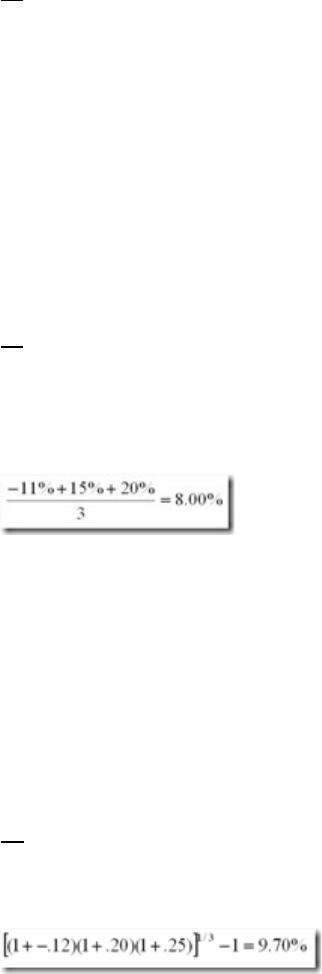
13. The arithmetic average of -11%, 15% and 20% is ________.
A. 15.67%
B. 8.00%
C. 11.22%
D. 6.45%
Bodie – Chapter 05 #13
Difficulty: Easy
14. The geometric average of -12%, 20% and 25% is _________.
A. 8.42%
B. 11.00%
C. 9.70%
D. 18.88%
Bodie – Chapter 05 #14
Difficulty: Medium
15. The dollar weighted return is the _________.
A. difference between cash inflows and cash outflows

B. arithmetic average return
C. geometric average return
D. internal rate of return
Bodie – Chapter 05 #15
Difficulty: Easy
16. An investment earns 10% the first year, 15% the second year and loses 12% the third
year. Your total compound return over the three years was ______.
A. 41.68%
B. 11.32%
C. 3.64%
D. 13.00%
(1.10)(1.15)(1 – .12) = 11.32%
Bodie – Chapter 05 #16
Difficulty: Medium
17. Annual percentage rates can be converted to effective annual rates by means of the
following formula:
A. (1 + (APR/n))n – 1
B. (APR)(n)
C. (APR/n)
D. (periodic rate)(n)
Bodie – Chapter 05 #17
Difficulty: Easy
18. Suppose you pay $9,700 for a $10,000 par Treasury bill maturing in three months.
What is the holding period return for this investment?
A. 3.01%
B. 3.09%
C. 12.42%
D. 16.71%
Bodie – Chapter 05 #18
Difficulty: Easy
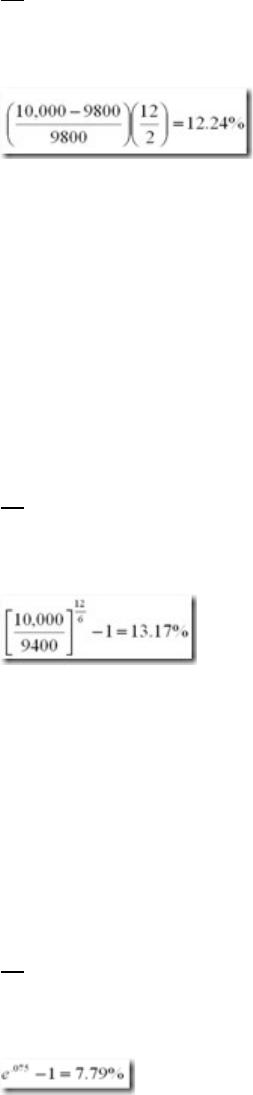
19. Suppose you pay $9,800 for a $10,000 par Treasury bill maturing in two months. What
is the annual percentage rate of return for this investment?
A. 2.04%
B. 12.00 %
C. 12.24%
D. 12.89%
Bodie – Chapter 05 #19
Difficulty: Medium
20. Suppose you pay $9,400 for a $10,000 par Treasury bill maturing in six months. What
is the effective annual rate of return for this investment?
A. 6.38%
B. 12.77%
C. 13.17%
D. 14.25%
Bodie – Chapter 05 #20
Difficulty: Medium
21. You have an APR of 7.5% with continuous compounding. The EAR is _____.
A. 7.50%
B. 7.65%
C. 7.79 %
D. 8.25%
Bodie – Chapter 05 #21
Difficulty: Medium
22. You have an EAR of 9%. The equivalent APR with continuous compounding is _____.
A. 8.47%
B. 8.62%
C. 8.88%
D. 9.42%
LN[1 + .09] = 8.62%
Bodie – Chapter 05 #22
Difficulty: Medium
23. The market risk premium is defined as __________.
A. the difference between the return on an index fund and the return on Treasury bills
B. the difference between the return on a small firm mutual fund and the return on the
Standard and Poor’s 500 index
C. the difference between the return on the risky asset with the lowest returns and the
return on Treasury bills
D. the difference between the return on the highest yielding asset and the lowest yielding