The Rise and Fall of Jet Airways
Jet Airways: Background
Jet Airways (India) Private Limited was a reputed private airline in India with an average fleet age of 4.45
years. Jet flew to 63 destinations spanning the length and breadth of India and beyond, including New York
(both JFK and Newark), Toronto, Brussels, London (Heathrow), Hong Kong, Singapore, Kuala Lumpur,
Colombo, Bangkok, Kathmandu, Dhaka, Kuwait, Bahrain, Muscat, Doha, Riyadh, Jeddah, Abu Dhabi and
Dubai. The Airline carried 1.28 million passengers out of 4.08 million passengers carried by the whole airlines
industry. It enjoyed a reputation for punctuality and outstanding service and consequently attracted a large
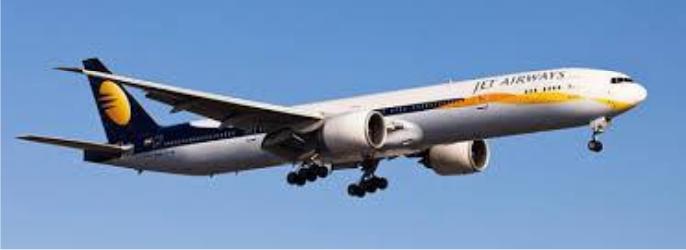
proportion of business travellers. Currently it operates a fleet of 97 aircrafts, which includes 12 Airbus 330-200;
20 ATR 72-500 aircraft;11 Boeing 737-700;42 Boeing 737-800; 2 Boeing 737-900 and 10 Boeing 777-300 ER.
The management had ambitious plans to develop its own maintenance hangers and pilot training centers
Jet Airways: Origins
Recipient of several business and leadership awards, Company founder Naresh Goyal completed his
graduation in Commerce in 1967 and joined the travel business at the age of 18 as a general sales agent (GSA)
for the Lebanese International Airlines. From 1967 to 1974 he learnt the intricacies of the travel business
through his association with several foreign airlines.
In May 1974, he formed his own company, Jet air (Private) Limited, to market other foreign airlines in India.
Naresh Goyal was involved in developing studies of traffic patterns, route structures, operational economics,
and flight scheduling. Jet air eventually grew to a network of 60 branch offices. After three and a half decades
of monopoly by Air India and Indian Airlines, the Indian government reopened the domestic aviation market to
private carriers in April 1989. This provided an opportunity to Goyal who established Jet Airways (India)
Private Limited in 1991. It commenced commercial operations on May 5, 1993. At that time, Jet Airways
claimed to be the only profitable privately owned airline in India. Indeed, by 1997, five of the seven airlines
that had been launched since 1992 were grounded. By another count, more than 20 start-up airlines had been
launched in India since deregulation, reported Airline Business; Jet Airways was one of the very few survivors.
On March 22, 2004 Jet Airways and rival private airlines in India were free to begin flying outside the country.
Jet had borrowed about $800 million to finance new aircrafts. Jet was poised to profit from an expected
extension of flying rights throughout Asia. Colombo, Sri Lanka, was the first such international destination.
Flights to Bangladesh and Nepal followed soon after. An initial public offering of 25 percent of shares,
discussed since 1995, was also in the works. Over the next few years Jet established itself as a leading Indian
player, becoming a case study for in-flight excellence. Possibly excited by this euphoria, industry insiders say,
the management made its first big gamble by eying Air Sahara in 2006.
Apart from Jet and Air India, Air Sahara was among the only three Indian carriers that flew abroad during that
period. Naresh Goyal moved in to buy Sahara a year later for Rs 1,450 crores. Jet Airways fulfilled its desire to
be the only private Indian carrier to fly abroad in 2006. Acquiring Sahara meant a huge drain on Jet’s resources,
both on financial and management fronts. All this happened at a time when the concept of low-cost carriers was
completing two years in India. The domestic aviation market was growing at 30-40% and players like Air
Deccan were challenging the might of full-service carriers.
Fall from Grace:
When Goyal and his wife, Anita, started Jet in 1993, state-run Air India was the only formidable opponent, and
the country’s aviation market was just taking off. Goyal’s pitch was ensuring the country’s biggest private carrier
had impeccable service – a world-class product built in India.
Jet’s problems began when it embarked on an aggressive international expansion plan, said an industry executive
who has been associated with the airline.
The carrier ordered 22 wide-body aircraft for delivery over about 18 months, starting in 2006, depleting cash.
Then Jet bought a struggling Indian airline called Sahara for 14.5 billion rupees ($209 million) in 2007 that had
an ageing fleet and did not fit Jet’s corporate culture.
Meanwhile, a newcomer, low-cost carrier IndiGo, had begun chipping away at Jet’s market share with cheap
fares.
In 2013, Jet was close to running out of cash, but survived collapse when Abu Dhabi’s Etihad Airways bought a
24 percent stake in the Indian airline. As part of the deal, Etihad also bought three pairs of Jet’s landing slots at
London’s Heathrow airport and 51 percent stake in its frequent flyer program.
To compete with low-cost carriers, Jet has lowered prices without reducing its expensive services. High fuel
prices and hefty taxes have compounded the spending issues.
Motive of the Acquisition
The merger of Jet and Sahara gave Jet Airways access to the entire leased fleet of 27 aircrafts of Air Sahara along
with its infrastructure and logistics. It also gave Jet Airways presence in those areas in India where they were not
there, but Air Sahara was. Air Sahara proved to be complementary to Jet even in the international arena. While
Jet was operating on long haul routes such as US and Europe, Air Sahara operated to neighbouring countries
such as Sri Lanka, Nepal and Thailand. Jet had about 62 aircrafts and operated 320 flights to 44 domestic
destinations and 6 foreign destinations at the time of the deal.
One major gain for Jet in the deal was that it could gain access to Sahara’s parking slots in London’s Heathrow
airport as well as in Delhi and Mumbai. Another factor was that there was a huge shortage of airline pilots.
Hence, it could utilize Air Sahara’s pilots. The maintenance facilities of the smaller carrier would also be
available within the country.
Since Air Sahara had leased all of its 27 aircrafts, Jet would not own them and hence there was not much gain in
terms of tangible assets especially since Air Sahara was not transferring its real estate and helicopters. However,
when the deal was announced in January 2006, the plan was to take over all of Air Sahara’s assets for $545
million.
Jet Airways was also looking at capturing more market share post the deal. It used to have a 40 percent market
share which fell down to 27 percent at the time of the deal. The major reason was Jet’s intention of becoming the
king of Indian skies by becoming the number 1 private airlines in the industry.
Summarizing the reasons of merger
Buyout to make merged entity largest domestic private carrier with market share of 42% and fleet of 88 aircraft,
27 operated by Air Sahara
Jet – Sahara was expected to turn into the only privately owned airlines which was permitted to fly international
routes
The deal is commercially viable since Jet would get a lot of infrastructure and manpower – areas where India is
facing a lot of pressure now
Jet to gain access to Sahara’s parking slots in London, Delhi, and Mumbai
Low costs through economies of scale would enhance the capability of Jet to compete with the low-cost carriers
in terms of price
Air Sahara was proving to be a very good buy as its financial status was better than most of its competitors. The
debt equity breakup of Air Sahara was about Rs. 500 Crore funded by promoters which comprised of Rs. 236
Crore of equity, Rs. 50 Crore in preferential shares and loans taken by the group amounting to Rs. 250 Crore.
The remaining promoters contributed around Rs. 40 to 50 Crore.
What went wrong?