175
iiSouthern African Business Review Volume 18 Number 3 2014
A comparative analysis of returns of various fi nancial
asset classes in South Africa: a triumph of bonds?
C. Auret & R. Vivian
8ABSTRACT
17There is a popular view that equities always outperform other fi nancial
asset classes; especially bonds. This study investigates the performance
of three common asset classes to determine whether or not this view is
validated in South Africa. Conceptually, the popular view is irrational. If
one class consistently and materially outperforms other asset classes, in
the absence of other reasons, the other asset classes would disappear.
Accordingly, rationally, in the long run and on a risk-adjusted basis,
returns on all asset classes should conceptually more or less converge.
The results from this study, which concentrates on equities, bonds and
cash, show that in South Africa, even before adjusting for risk, there
was no material difference between the returns of equities over long
bonds over the 27-year period covered by this study (1986–2013). This
is equally true for other shorter fi xed periods with the end–date (28
February 2013) being the focal point. It is even more evident that bonds
outperform equities when a system of rolling periods is used. On a
nominal basis (before adjusting for risk), over any randomly selected
rolling period, bonds outperform equities in six of the seven categories.
This study does not take tax into consideration. After adjusting for risk
using the Sharpe ratio or other risk measures, bonds outperformed
equities.
18Key words: equities, bonds, cash, performance, asset classes, risk-adjusted basis,
outperformance
Introduction
1A popular view that is also prevalent in South Africa is that equities, although risky,
outperform other asset classes, but this view is irrational. Investors are presumed to
Prof. C. Auret is Professor of Finance and Prof. R. Vivian is Professor of Finance & Insurance in the School of Economic and
Business Sciences, University of the Witwatersrand. Email: christo.auret@wits.ac.za
Sabus_Review_18_3.indd 175Sabus_Review_18_3.indd 175 2014/12/09 06:10:152014/12/09 06:10:15

C. Auret & R. Vivian
176
be rational, even if only bounded rational, and if any class outperforms other classes,
there is little reason for investors to invest in underperforming assets. Rational
investors would invest only in equities, and other classes of assets would disappear
unless there are other reasons for the existence of that asset class, as in the case of
money. Since various asset classes do exist, it is logical to believe that over the long
run all asset classes, especially once adjusted for risk, perform roughly the same,
which is empirically validated in this article. This comparative study of total returns
examines the relative performance of three South African asset classes. This is
achieved by providing a history of the returns of the three major investment classes
over an extended period and highlighting the differing levels of risk associated with
each asset class. Once this has been done, a comparative analysis is carried out.
Some investment managers such as Bridgewater Associates, an American
investment management firm with US$120 billion assets under management serving
institutional clients, have been very successful in adopting the concept of risk–
parity as their investment mantra. Bridgewater Associates began as an institutional
investment advisory service, graduated to institutional investing and pioneered the
risk-parity investment approach in 1996.1
Literature review
1Considerable research has been done on the relative performance of various asset
classes, especially equities versus bonds (Barsky 1986; Grauer & Hakonsson 1987;
Leibowitz & Krasker 1988; Fama & French 1989; Fama & French 1993; Lucas
1994; Benartzi & Thaler 1995; Asness 2000; Ilmanen 2003). The findings were
that no single asset class continuously outperforms other classes in all economic
environments. This suggests that a dual strategy for investments is called for – firstly
diversification, and secondly changing the balance of an investment portfolio (i.e.
asset allocation). This can reduce risk while at the same time improving returns.
Correct asset allocation is critical for portfolio performance, and diversification for
the control of risk. Assets perform differently over varying time periods, and these
differences may well reflect structural changes in the economy. In South Africa, for
example, there was a structural decline in inflation that began in the mid-1990s
and coincided with the prolonged outperformance of bonds relative to equities that
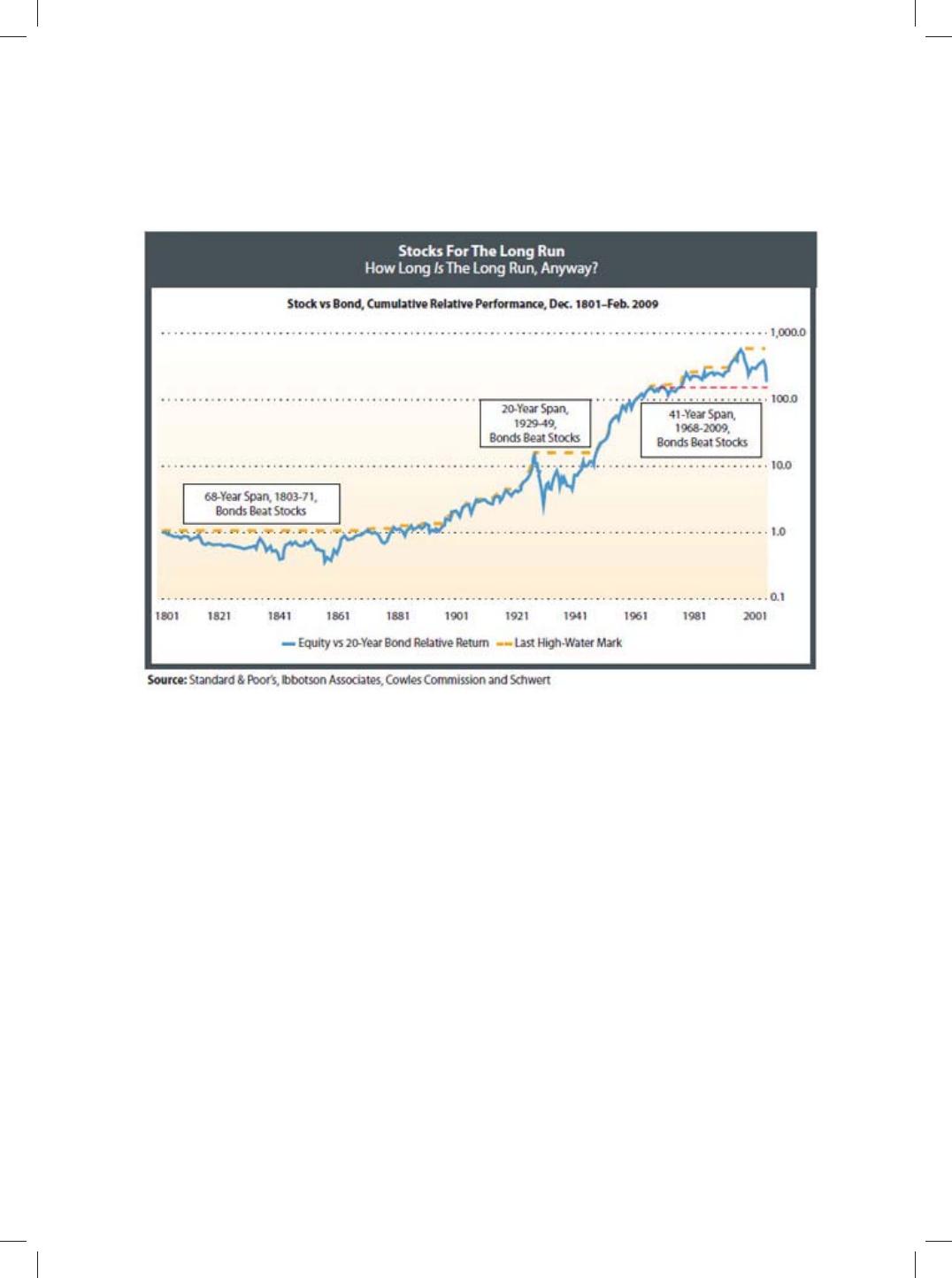
lasted until 2009 (see Figure 1). Although historical performance is not a guarantee
of future performance, it serves as a useful input for investors when making asset
allocation decisions.
Arnott (2011), citing the Ibbotson 2011 Classic Yearbook, notes that in the USA
over the 84-year period from January 1926 to December 2010, the Standard & Poor’s
Sabus_Review_18_3.indd 176Sabus_Review_18_3.indd 176 2014/12/09 06:10:152014/12/09 06:10:15

177
A comparative analysis of returns of various fi nancial asset classes in South Africa
500 (S&P 500) index generated a compound return of 9.9% p.a. compared with 5.5%
p.a. for long-term government bonds, an excess of 4.4%. A quick calculation shows
that through the power of compound interest, US$1 000 invested in equities in
January 1926 would have grown to US$2.778 million in December 2010 compared
with a mere US$89 778 for bonds, an outperformance of 31 times. On this basis,
equities should be preferred over bonds as an investment class over the long run. This
appears to provide overwhelming evidence that investors should prefer equities to
bonds as an asset class. According to Kopcke and Muldoon (2009), the relatively high
long–term return on equities makes investments in equities seem both an attractive
and suitable means of accumulating wealth. The authors warn, however, that the
50% drop in the S&P 500 from May 2008 to March 2009 is a reminder that equities
pose considerable risk for investors, especially over the short term.
Arnott (2011), however, continues by pointing out that equities should produce
higher returns than bonds in order for the capital markets to work. Otherwise,
stockholders, as the equity investors, would not be paid for the additional risk they
take for being lower down the capital structure, namely the capital default risk. This
is thus even before market risk is taken into consideration. Kopcke and Muldoon
(2009) show that in the USA, the average annual real rate of return on equities was
7.2% between 1949 and 2008. The standard deviation of annual returns was 18.2
percentage points. The authors state that stockholders expect adequate compensation
for bearing this higher market risk. Accordingly, the gap between the annual return
on equities and bonds has averaged 3.8 percentage points since 1872, and 5 percentage
points since 1949. In an article entitled ‘Bonds: why bother?’, Arnott (2009) says that
bond sceptics generally point out that equities have beaten bonds by 5 percentage
points a year for many decades, and that stock returns mean–revert, so that the true
long–term investor enjoys that higher return with little additional risk in 20–year
and longer annualised returns. The author says that most investors use bonds not
to generate higher returns but rather to provide asset class diversification and thus
to reduce portfolio risk. Most investors expect their stock holdings to outpace their
bonds holdings over any reasonably long span of time.
Similar views are found in South Africa. Firer and McLeod (1999) compared the
performance of equities, bonds and cash in South African markets between 1925 and
1998 and concluded that over this period, equities far outperformed the other two
asset classes. Similar results for South Africa were also found by Winston Floquet
(1998), senior partner of Fleming Martin Securities Ltd., a leading stockbroking firm
in South Africa that was subsequently taken over by JP Morgan Chase & Co.
Despite these findings, other views are found, namely that bonds can outperform
equities over substantial periods. Arnott (2009) challenges two core beliefs of modern
Sabus_Review_18_3.indd 177Sabus_Review_18_3.indd 177 2014/12/09 06:10:152014/12/09 06:10:15
C. Auret & R. Vivian
178
investing, namely the reliability of equities as the higher-return asset class and the
efficacy of bonds in portfolio diversification and in risk reduction.
1
Source: Arnott (2009)
Figure 1: Stocks compared with bonds: cumulative relative performance in the USA, December
1801–February 2009
1Arnott (2009) shows in Figure 1 that in the USA, bonds outperformed equities for
a 68-year span from 1803–1871, for a 20-year span from 1929–1949, and again for a
41-year span from 1968–2009. The author also points out that it is a fact that equities
produced negative returns for just over a decade. Real returns for the S&P 500 index
were negative over any time span starting in 1997 or later, which the author calls the
lost decade for equities. The author shows that starting any time from 1979 until
2008, the investor in 20–year Treasury bonds would have beaten the S&P 500 investor.
He found, in fact, that from the end of February 1969 until February 2009, bonds
outperformed stocks by a small margin.
A study by Bloomberg (2011) entitled ‘Bonds: the better investment’ points out
that the generations-long beliefs, firstly that equities outperformed bonds in the
past and will continue to do so in the future, and secondly that equities, because
Sabus_Review_18_3.indd 178Sabus_Review_18_3.indd 178 2014/12/09 06:10:152014/12/09 06:10:15

179
A comparative analysis of returns of various fi nancial asset classes in South Africa
of mean reversion that damps out short-run fluctuations, are not risky if held for
ten years or more, are myths. The study continues by saying that in the ‘holy name
of diversification’, investors are told to maintain a balance on the bulk of their
investment portfolio between equities and bonds, which, the authors maintain, is
a mistake. For individual investors, the study takes the position that bonds are a
better investment than equities. That is because after paying taxes, fees, expenses
and factoring in the risk, the return on equities is not likely to exceed the return
on bonds. These risks are clearly demonstrated as a result of the two stock market
crashes that occurred between 2000 and 2009. The study found that over the previous
20 years, the performance between equities and bonds had been about the same. For
the previous 25 and 30 years, it was found that equities had nominally outperformed
bonds. However, when risk expressed as volatility is taken into account, it is clear that
bonds outperformed equities for the previous 25 and 30 years as well.
The study makes the important point that 30 years is as long as most of us invest.
It is clear from their analysis that over the previous 25 to 30 years, investors were not
rewarded for taking substantial risks in the stock market when compared to Treasury
bonds. Equities are risky; the study points out that over certain periods of time, stock
markets declined and even crashed. The crash of 1929, for example, is infamous. On
19 October 1987, the Dow Jones Industrial Average declined 508 points in one day,
a 22.6% loss. More recently there was the dot-com crash of 2000–2002, when the
Nasdaq lost 77.9% of its value. The next crash occurred in 2008 when equities lost
37%.
Returning to South Africa, Hassan and Van Biljon (2010) conducted a detailed
empirical examination of the South African equity premium over a 105-year period.
The authors concluded that over the long run, the South African equity market
produced average returns six to eight percentage points above bonds and cash.
Furthermore, they found that looking at a 20-year horizon, an investor would not
have experienced a single negative realised equity premium over the entire 105-year
period. The results presented in this article, however, do not confirm the findings of
Hassan and Van Biljon (2010).
It is also important to realise that South Africa is an emerging economy and ranks
fifth on the list of emerging financial markets that international investors focus on.
As such it is anticipated worldwide that many pension funds and other institutional
investors invest in the South African equities to track the worldwide emerging
market index. This study analyses the performance of equities compared with bonds
and cash in the South African financial markets as a proxy for emerging markets
over various fixed and rolling periods, both on a nominal and a risk-adjusted basis.
In a previous study on historical performance in South Africa, Firer and McLeod
Sabus_Review_18_3.indd 179Sabus_Review_18_3.indd 179 2014/12/09 06:10:152014/12/09 06:10:15
C. Auret & R. Vivian
180
(1999) looked at a 74-year period from 1925 to 1998, using the same methodology as
the Ibbotson and Sinquefield (1989) study, making their results comparable to those
of the US study. The results of Firer and McLeod’s study indicated that, in South
Africa, on a nominal basis equities outperformed bonds and cash over the 74-year
period 1925 to 1998 by a considerable margin.
This study examined the performance of three common asset classes in South
Africa, namely equities, bonds and cash, using monthly total return data for the
period April 1986 to February 2013. Over this period of the study, bonds outperformed
equities on a risk-adjusted basis. Even looking at nominal returns, bonds fare well
against equities over the medium to long term (three years or more). This study
utilises total monthly return data covering the period April 1986 to February 2013
and reaches different conclusions from those of Firer and McLeod (1999). The
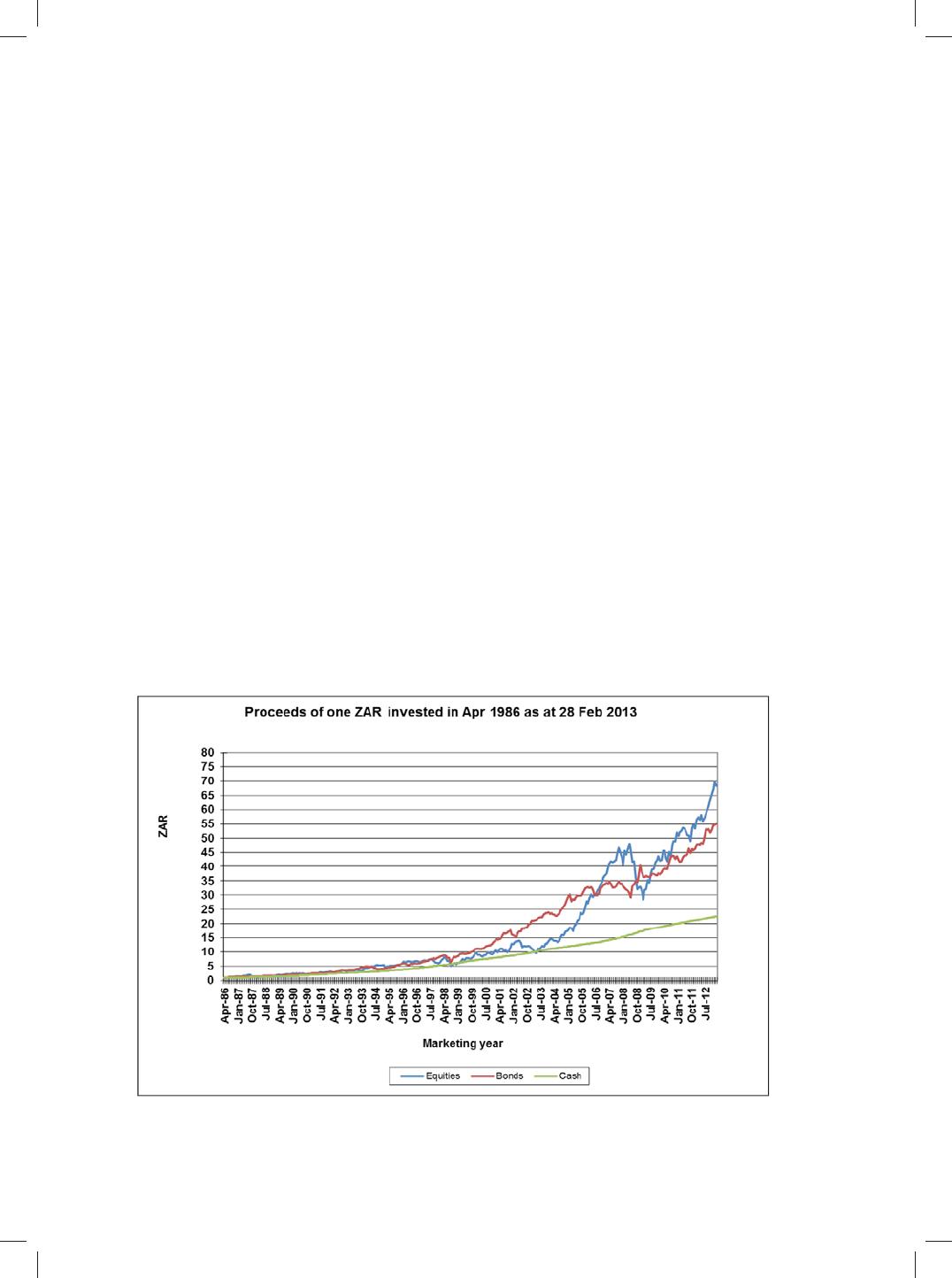
performance of equities and bonds is generally comparable on a nominal basis. Figure
1 illustrates the value to which one South African Rand (ZAR) invested in April 1986
would appreciate up to February 2013 in the three asset classes. In nominal terms,
ignoring tax and transaction costs, one Rand would appreciate to R68.32 if invested
in equities, R55.03 if invested in bonds and R22.50 if invested in cash in South Africa.
For comparative purposes, as a matter of interest, one dollar invested in the S&P 500
index over the same period would be worth US$11 today. One Rand invested in the
S&P 500 index in April 1986 would be worth R51.61 today (28 February 2013) after
taking exchange rate movements into account.
1
Figure 2: Value of one Rand invested in equities, bonds and cash in South Africa in April 1986
Sabus_Review_18_3.indd 180Sabus_Review_18_3.indd 180 2014/12/09 06:10:152014/12/09 06:10:15

A comparative analysis of returns of various fi nancial asset classes in South Africa
It is clear from Figure 2 that between 1996 and 2006, bonds outperformed equities
on a nominal basis and then again from October 2008 onwards for a few months.
Since then, equities have been the better-performing asset class on a nominal basis.
Once adjusted for risk, bonds consistently outperformed equities over the 27-year
period in South Africa.
Data
Data for the three asset classes
Equities
1It is common cause that the South African financial stock market history commenced
in 1960 (Firer & McLeod 1999: 7). Attempts have been made to reconstruct financial
data before this date, but since this study starts in 1986, this reconstruction is of no
further interest for the purposes of this study. The Johannesburg Stock Exchange
(JSE) is South Africa’s only stock exchange. The different sectorial indices were
reconstructed in March 1995 when a new and more-inclusive method of determining
the constituents of the indices was established (Firer & McLeod 1999: 8).