MODULE 1: Introduction to Applied Economics
Lesson 1: Revisiting Economics as a Social Science
Economics
– it comes from the greek word “oikonomia” meaning
“household management”
– is a social science that deals with the efficient use of
available resources for maximum satisfaction of unlimited
human wants.
– is the social science that studies how people interact with
things of value; in particular, the production, distribution,
and consumption of goods and services.
Importance of Economics
➢ It is important in order to understand problems facing the
citizen and the family;
➢ To help government promote growth and improve the
quality of life while avoiding depression and inflation
and to analyze fascinating patterns of social behavior.
➢ Economic analysis can be applied throughout society,
in real estate, business,finance, health
care, and government. Economic analysis is sometimes
also applied to such diverse subjects
ascrime, education, the family, law, politics, religion, soc
ial institutions, war, science, and the environment.
The Nature of Economics
Economics is the scientific study of the ownership, use, and
exchange of scarce resources – often shortened to
the science of scarcity. Economics is regarded as a social
science because it uses scientific methods to build theories
that can help explain the behaviour of individuals, groups
and organisations. Economics attempts to
explain economic behaviour, which arises when scarce
resources are exchanged.
In terms of methodology, economists, like other social
scientists, are not able to undertake controlled experiments
in the way that chemists and biologists are. Hence,
economists have to employ different methods, based
primarily on observation and deduction and the construction
of abstract models.
The Study of Economics
3 Related Investigations.
1. Why scarce resources are exchanged?
2. How consumers and producers behave as they interact
with each other in markets, in their attempt to achieve
mutually beneficial exchange?
3. The role of government in compensating for the
limitations of markets in achieving mutually beneficial
exchange?
The Methods used by Economists
Economists use scientific observation and deduction in their
investigations. To achieve this they:
Describe and measure the exchanges they observe
Economists describe changes in economic variables, and
measure these changes over time. For example, economists
describe and measure how interaction in markets determines
the prices of such diverse products as motor cars, houses,
haircuts, and computer software. Measurement in economics
can take many forms, including measuring absolute and
relative quantities and values. When measuring relative
values it is common to use index numbers.
Explain how interactions arise and create costs and
benefits
Economists try to explain the effects, or results, of economic
transactions. For example, economists can explain why,
despite bubbles and crashes, the long-run trend in house
prices in the UK has been upwards over the last 30 years,
and can identify those who have been affected positively
and negatively by this increase. Of course, economists also
try to explain the short-term movements in prices, and how
they also have costs and benefits.
Propose hypotheses, construct, and apply ‘models’ to test
these hypotheses.
Economists develop hypotheses to explain why economic
behavior takes place, and then construct models to test these
hypotheses. For example, economists may propose that price
rises are caused by excess demand, and then attempt to
construct a model of price that explains how excess demand
can raise price. Economists frequently use versions of
the demand and supply model to help explain events such as
house price trends and movements. Economic models
usually employ graphical and mathematical analysis to help
explain and illustrate such economic processes.
Gather data to put into the model
Models must be tested against the real world, which means
gathering statistical data about real events. In this way, a
model can be improved and revised when necessary.
Predict behaviour based on these models.
The ultimate goal of the economist is to predict future
behavior. For example, by using a demand and supply
model and by inputting real data about the housing market,
economists can show that even a small fall in bank lending
can trigger behavior that leads to a significant fall in house
prices in the short run.
Statistical analysis of actual economic data can provide a
flow of information from which to build models and test
hypotheses. For example, by gathering data about changes
in house prices it is possible to deduce factors that cause
house prices to go up or down, and by how much.
Economists use index numbers to help make comparisons
between countries and over time.
Correlation analysis can help determine the strength of
particular causal relationships so
that strong and weak relationships can be identified.
The Role of the Professional Economist
Professional economists apply their skills of description,
analysis, model building, and prediction to generate
knowledge and, from this, provide advice to private firms, to
governments and other organizations.

Providing knowledge
1. The first function of the economist is to provide
information, called economic intelligence, from
which decisions can be made. The professional
economist can help reduce such risks by gathering
and analyzing economic intelligence. This
economic intelligence is only useful when it can
be put into an economic model, and then applied
to the decisions that need to be taken.
2. The second function of the professional economist
is to interpret the data that has been gathered and
provide informed advice to firms, organizations,
and governments about the likely costs and benefits
of the decisions they make.
In providing advice, the economist will always make an
assessment of the other options that could have been chosen.
Positive and Normative Economics
As a social science, economics attempts to use the principles
and methods of science to explain economic behavior. This
involves making positive statements about the economic
world.
Positive statements are those that can be verified, and are
factual, such as:
‘.. House prices have fallen by 15% over the last year…’
In contrast, normative statements are based on opinion
and value judgment. Statements suggesting that something
‘ought to’ happen, or that something is ‘unfair’, are
normative because they are matters of opinion.
‘..the recent fall in house prices is unfair to the rich..’.
The Ceteris Paribus Rule
❖ Economics is a social science, and, unlike the physical
sciences, cannot engage in controlled experimentation to
demonstrate how variables are connected.
❖ In the real world, economic variables such
as price and income, are constantly changing, and this
creates a problem in demonstrating the relationship
between variables.
❖ Of course, for independent reasons, income could also
fall while demand does not rise. The fall in price could
have been counteracted by a fall in income. The ceteris
paribus rule, that all other things remain the same, is
used whenever attempting to demonstrate the link
between economic variables. Without this assumption,
positive economics is impossible.
The Evolving Role of the Economist
➢ In recent years much interest has been shown in the
interconnections between economics and psychology, and there
has been a considerable increase in the popularity
of behaviouraleconomics. This is both in terms of the number
of Universities offering courses in behavioral economics, and
in terms of how public policy makers have turned to this branch
of economics, especially in the wake of the financial crisis.
➢ Similarly, the emergence of crypto currenciessuch as Bitcoin,
have forced economists to reassess the nature of money in a
globalised world. Trading relationships between countries,
and theories to explain them, have also been put under the
spotlight as a result of Brexit.
Macroeconomics and Microeconomics
Microeconomics analyzes basic elements in the economy,
including individual agents and markets, their interactions,
and the outcomes of interactions. Individual agents may
include, example, households, firms, buyers, and sellers.
❖ Microeconomics examines how entities, forming
a market structure, interact within a market to create
a market system. These entities include private and
public players with various classifications, typically
operating under scarcity of tradable units and
light government regulation.The item traded may be a
tangible product such as apples or a service such as
repair services, legal counsel, or entertainment.
Macroeconomics analyzes the economy as a system where
production, consumption, saving, and investment interact,
and factors affecting it: employment of the resources of
labor, capital, and land, currency inflation, economic
growth, and public policies that have impact on these
elements.
❖ Macroeconomics examines the economy as a whole to
explain broad aggregates and their interactions “top
down”, that is, using a simplified form of general-
equilibrium theory. Such aggregates include national
income and output, the unemployment rate, and
price inflation and sub aggregates like total consumption
and investment spending and their components. It also
studies effects of monetary policy and fiscal policy.
❖ Since at least the 1960s, macroeconomics has been
characterized by further integration as to micro–
based modeling of sectors, including rationality of
players, efficient use of market information,
and imperfect competition.This has addressed a long–
standing concern about inconsistent developments of the
same subject.
❖ Macroeconomic analysis also considers factors affecting
the long-term level and growth of national income. Such
factors include capital accumulation, technological
change and labor force growth.
Division of Economics
Five major divisions:
1. Production – is a process of combining various material
inputs and immaterial inputs (plans, know-how) in order to
make something for consumption (output). It is the act of
creating an output, a good or service which has value and
contributes to the utility of individuals. The area of
economics that focuses on production is referred to as
production theory, which in many respects is similar to the
consumption (or consumer) theory in economics.
2. Distribution – marketing of goods and services to
different economic outlets for allocation and individual
consumers. It is the way total output, income, or wealth is
distributed among individuals or among the factors of
production (such as labor, land, and capital).
3. Exchange – transferring goods and services to a person or
persons in return for something. At present, the medium of
exchange used in the market is money. This means, we can
exchange our money with goods and services.

4. Consumption – proper utilization of economic goods.
5. Public Finance – the activities of the government
regarding taxation, borrowings and expenditures. It deals
with the efficient use and fair distribution of public
resources in order to achieve maximum social benefits. This
means, government programs and projects which are funded
by taxes and loans are properly implemented and managed
to generate maximum and optimum benefits for all members
of society.
Tools of Economics
1. Logic – It is a science that deals with sound thinking and
reasoning, In the process of reasoning, facts and proofs
should be presented; otherwise, such reasoning will be
clouded by an iota of doubt.
2. Mathematics – It is a science that deals with numbers and
their operations. Actually, economics is the most
quantifiable discipline among social sciences. It can
quantify population, income, national product, aggregate
number of firms, etc. Besides, mathematical operations and
equations are used in economics in arriving at a conclusion.
Mathematics comes hand in hand with economics.
Mathematics helps economists solve concrete problems
involving numbers. Mathematical tools used in economics
include matrix algebra, linear equations, econometric
models, optimization and differential equations.
The simplest application of mathematics for economic
analysis is found in the field of Geometry, a science that
explains relationships.
3. Statistics – It is a branch of mathematics engages with the
analysis and interpretation of numerical data. It deals with
the process of collecting, tabulating and analyzing data to
test the validity of a certain hypothesis. These are facts
collected and arranged in an orderly way for study. Through
statistics, one may be able to reject or accept an assumption
made on a certain phenomenon. Statistical tools include
regression and correlation analysis and calculation of
probabilities
The Economic Resources
-also known as factors of production or inputs.
1. Land – free gifts of nature which includes all natural
resources above, on, and below the ground such as soil,
rivers, lakes, oceans, forests, mountains, mineral resources
and climate.
❖ Land is considered economic resources because it has a
price attached to it. One cannot utilize this natural
resource without paying for it usually in the form of rent
or lease.
❖ Land is usually a limited resource for many economies,
the physical land is usually a fixed resource. Nations
must carefully use their land resource by creating a mix
of natural and industrial uses. Using land for industrial
purposes allows nations to improve the production
processes for turning natural resources into consumer
goods.
2. Labor – This is also termed as human resources, refers to
all human efforts, be it mental or physical, that help to
produce want satisfying goods and services. Labor is an
indispensable factor in the production of goods and services.
❖ Labor represents the human capital available to transform raw or
national resources into consumer goods. Human capital includes
all able-bodied individuals capable of working in the nation’s
economy and providing various services to other individuals or
businesses. This factor of production is a flexible resource as
workers can be allocated to different areas of the economy for
producing consumer goods or services. Human capital can also
be improved through training or educating workers to complete
technical functions or business tasks when working with other
economic resources.
3. Capital –2 economic definitions as a factorof production.
➢ Capital can represent the monetary resources companies
use to purchase natural resources, land and other capital
goods. Monetary resourcesflows through a nation’s
economy as individuals buy and sell resources to
individuals and businesses.
➢ Capital also represents the major physical assets
individuals and companies use when producing goods or
services. These assets include buildings, production
facilities, equipment, vehicles and other similar items.
Individuals may create their own capital production
resources, purchase them from another individual or
business or lease them for a specific amount of time from
individuals or other businesses. Income derived from
capital is called interest.
4. Entrepreneur – French word meaning enterpriser.
An entrepreneur is the organizer and coordinator of the other
factors of production: land, labor, and capital. An
entrepreneur is one who is engaged in economic
undertakings and provides society with goods and services it
needs. He utilizes his initiative, talent and resourcefulness in
the creation of economic goods. He is able to compensate
himself through the acquisition of profits.
5. Foreign Exchange – This refers to the dollar and dollar
reserves that the economy has. Foreign exchange is part of
economic resources because we need foreign currency,
particularly dollars for international trading and buying of
raw materials from other countries. Dollar is the
international medium of currency used in engaging business
with foreign countries.
MODULE 2: Economics as an Applied Science
What Is Applied Economics?
➢ Applied economics applies the conclusions drawn from
economic theories and empirical studies to real-world
situations with the desired aim of informing economic
decisions and predicting possible outcomes. The purpose
of applied economics is to improve the quality of practice
in business, public policy, and daily life by thinking
rigorously about costs and benefits, incentives, and human
behavior.
➢ Applied economics can involve the use of case studies
and econometrics, which is the application of real-world
data to statistical models and comparing the results
against the theories being tested.

KEYTAKEAWAYS
• Applied economics is the use of the insights gained from
economic theory and research to make better decisions
and solve real-world problems.
• Applied economics is a popular tool in business planning
and for public policy analysis and evaluation.
• Individuals can also benefit from applying economic
thinking and insights to personal and financial decisions.
Understanding Applied Economics
➢ Applied economics is the application of economic
theory to determine the likely outcomes associated with
various possible courses of action in the real world.
Applied economics is the tool to help choose the best
means to reach those ends. As a result, applied
economics can lead to “to do” lists for steps that can be
taken to increase the probability of positive outcomes in
real-world events.
➢ The use of applied economics may first involve
exploring economic theories to develop questions about
a circumstance or situation and then draw upon data
resources and other frames of reference to form a
plausible answer to that question. The idea is to establish
a hypothetical outcome based on the specific ongoing
circumstances
Applied Economics Relevance in the Real World
➢ Applied economics can illustrate the potential outcomes of
financial choices made by individuals.Beyond finances,
understanding the meaning of the economic theories of rational
choice, game theory, or the findings of behavioral
economics and evolutionary economics can help a person make
better decisions and plan for success in their personal life and
even relationships.
➢ Applied economics can also help businesses make better
decisions. Understanding the implications of economic laws of
supply and demand combined with past sales data and
marketing research regarding their target market can help a
business with pricing and production decisions. Awareness of
economic leadingindicators and their relationship to a firm’s
industry and markets can help with operational planning and
business strategy. Understanding economic ideas such
as principal-agent problems, transaction costs, and the theory of
the firm can help businesses design better compensation
schemes, contracts, and corporate strategies.
➢ Applied economics is an invaluable tool for public policy
makers. Many economists are employed to predict both
the macro- and microeconomic consequences of various policy
proposals or to evaluate the effects of ongoing policy.
➢ Applied macroeconomic modeling is routinely used to project
changes in unemployment, economic growth, and inflation at
the national, regional, and state level. Understanding the way
the economic incentives and compensating behaviors created
by public policy impact real-world trends in things like job
growth, migration, and crime rates is critical to implementing
effective policy and avoiding unintendedconsequences.
What is Econometrics?
Econometrics is the application of statistical methods to
economic data in order to give empirical content to
economic relationships. More precisely, it is “the
quantitativeanalysis of actual economic phenomena based
on the concurrent development of theory and observation,
related by appropriate methods of inference“.
➢ An introductory economics textbook describes
econometrics as allowing economists “to sift through
mountains of data to extract simple relationships”.
➢ The first known use of the term “econometrics”
(in cognate form) was by Polish economist
PawełCiompa in 1910.
➢ Jan Tinbergen is considered by many to be one of the
founding fathers of econometrics.
➢ Ragnar Frisch is credited with coining the term in the
sense in which it is used today.
➢ A basic tool for econometrics is the multiple linear
regression model.
➢ Econometric theory uses statistical
theory and mathematical statistics to evaluate and
develop econometric methods.
➢ Econometricians try to find estimators that have
desirable statistical properties including un–
biased, efficiency, and consistency.
➢ Applied econometrics uses theoretical econometrics and
real-world data for assessing economic theories,
developing econometric models, analysing economic
models, analysing economic history, and forecasting.
Basic Economic Problems
The economic problem
❖ All societies face the economic problem, which is the
problem of how to make the best use of limited, or
scarce, resources. The economic problem exists because,
although the needs and wants of people are endless, the
resources available to satisfy needs and wants are
limited.
Limited resources
Resources are limited in two essential ways:
1. Limited in physical quantity, as in the case of land,
which has a finite quantity.
2. Limited in use, as in the case of labor and
machinery, which can only be used for one purpose
at any one time.
Choice and opportunity cost
➢ Choice and opportunitycost are two fundamental
concepts in economics. Given that resources are
limited, producers and consumers have to make choices
between competing alternatives. Individuals must
choose how best to use their skill and effort, firms must
choose how best to use their workers and machinery,
and governments must choose how best to use
taxpayer’s money.
➢ Making an economic choice creates a sacrifice
because alternatives must be given up. For example,
land and other resources, which have been used to build
a school, could have been used to build a factory. The
loss of the next best option represents the real sacrifice
and is referred to as opportunity cost. The opportunity
cost of choosing the school is the loss of the factory,
and what could have been produced.
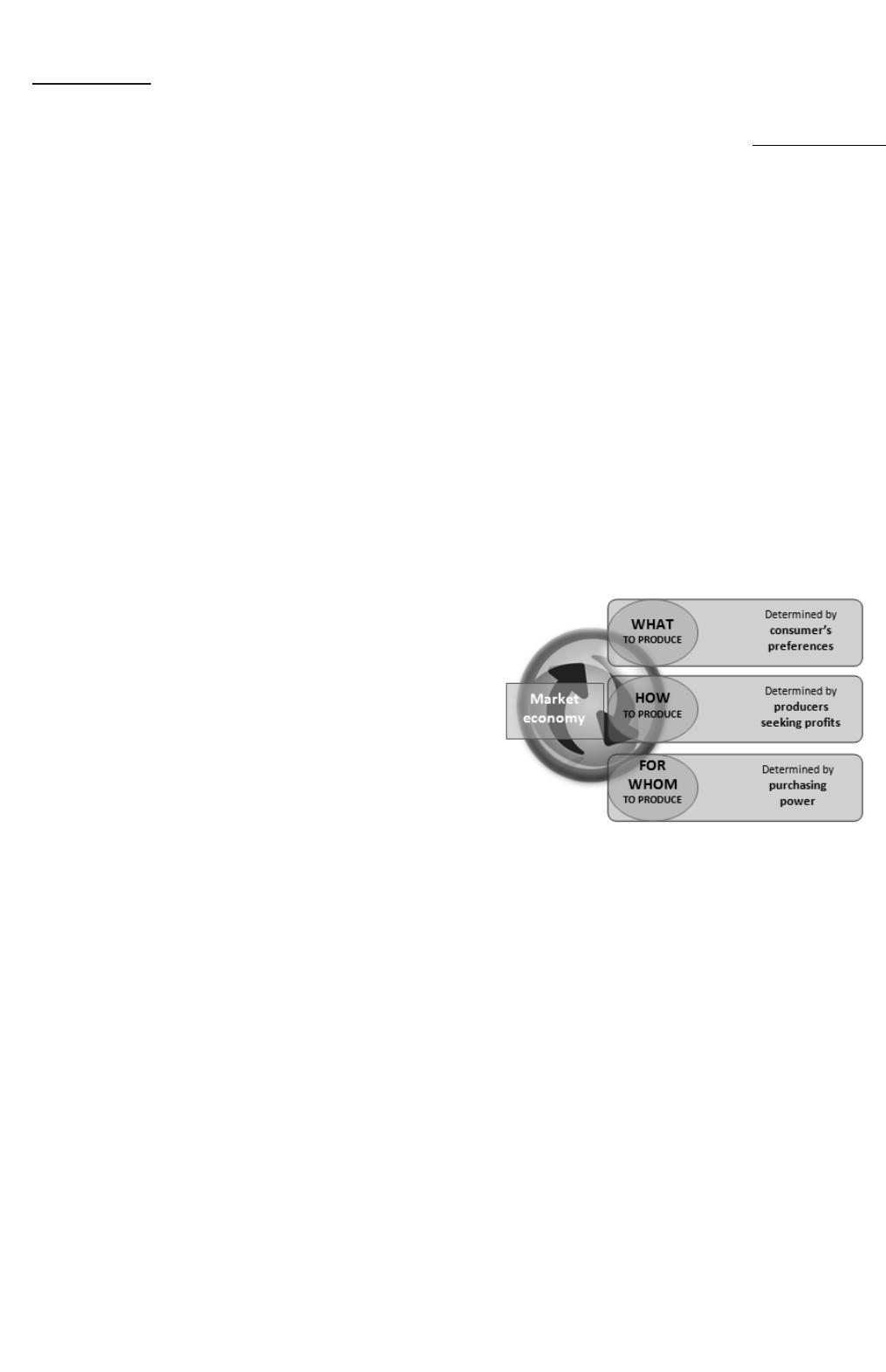
Samuelson’s 3 Questions
America’s first Nobel Prize winner for economics, the
late Paul Samuelson, is often credited with providing the
first clear and simple explanation of the economic problem –
namely, that in order to solve the economic problem
societies must endeavor to answer three basic questions –
What to produce?
Societies have to decide the best combination of goods and
services to meet their varied wants and needs. Societies
must decide what quantities of different resources should be
allocated to these goods and services.
How to produce?
Societies also have to decide the best combination of factors
to create the desired output of goods and services. For
example, precisely how much land, labor, and capital should
be used to produce consumer goods such as computers and
motor cars?
For whom to produce?
Finally, all societies need to decide who will benefit from
the output from its economic activity, and how much they
will get. This is often called the problem of distribution.
Different societies may develop different ways to answer
these questions.
Free goods- one that is so abundant that its consumption
does not deny anyone else the benefit of consuming the
good. In this case, there is no opportunity cost associated
with consumption or production, and the good does not
command a price. Air is often cited as a free good, as
breathing it does not reduce the amount available to
someone else.
MODULE 3
Lesson 3: The Economic System
Economic systems
There are two basic solutions to the economic problem as
described by Paul Samuelson, namely those based on free
markets and those based on central panning.
Free market economies
Markets enable mutually beneficial exchange between
producers and consumers, and systems that rely on
markets to solve the economic problem are called market
economies.
In a free market economy, resources are allocated through
the interaction of free and self-directed market forces.
This means that what to produce is determined consumers,
how to produce is determined by producers, and who gets
the products depends upon the purchasing power of
consumers. Market economies work by allowing the direct
interaction of consumers and producers who are
pursuing their own self-interest. The pursuit of self-
interest is at the heart of free market economics.
Command economies
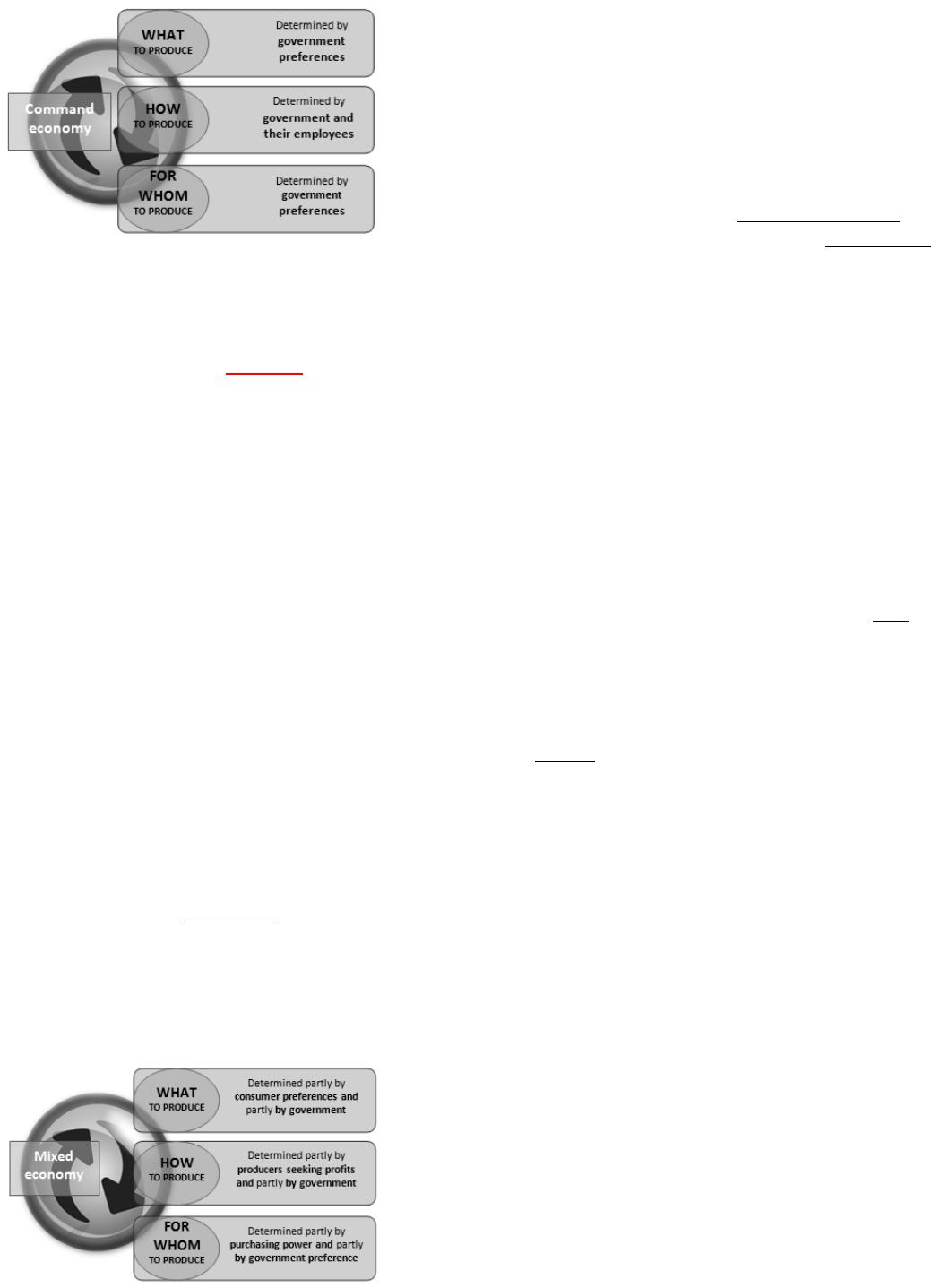
The second solution to the economic problem is the
allocation of scarce resources by government, or an
agency appointed by the government. This method is
referred to as central planning, and economies that
exclusively use central planning are called command
economies. In other words governments direct or
command resources to be used in particular ways. For
example, governments can force citizens to pay taxes and
decide how many roads or hospitals are built.
Command economies have certain advantages over free
market economies, especially in terms of the coordination
of scarce resources at times of crisis, such as a war or
following a natural disaster. Free markets also fail at times
to allocate resources efficiently, so remedies often involve
the allocation of resources by government to compensate
for these failures.
Communism
The benefits of command economies over free market
capitalism became the central economic idea of German
philosopher and economist, Karl Marx, who advocated
state ownership of the means of production – namely, land
and capital. He also predicted the eventual collapse of
capitalism. The real value of an economic activity, Marx
argued, could always be traced back to labour rather than
capital, and hence capitalism’s pursuit of higher profits
though the accumulation of capital was always at the
expense of labour, who would increasingly have to produce
more and more output to satisfy the needs of capitalists.
According to Marx, when the ‘reality’ of this sets in, labour
would realize it was being exploited and would rise up and
overthrow their capitalist ‘masters’. While the ideas of Marx
seem out of touch with the reality of history, Marx’s
economic theories are widely studied and still influential.
Mixed economies
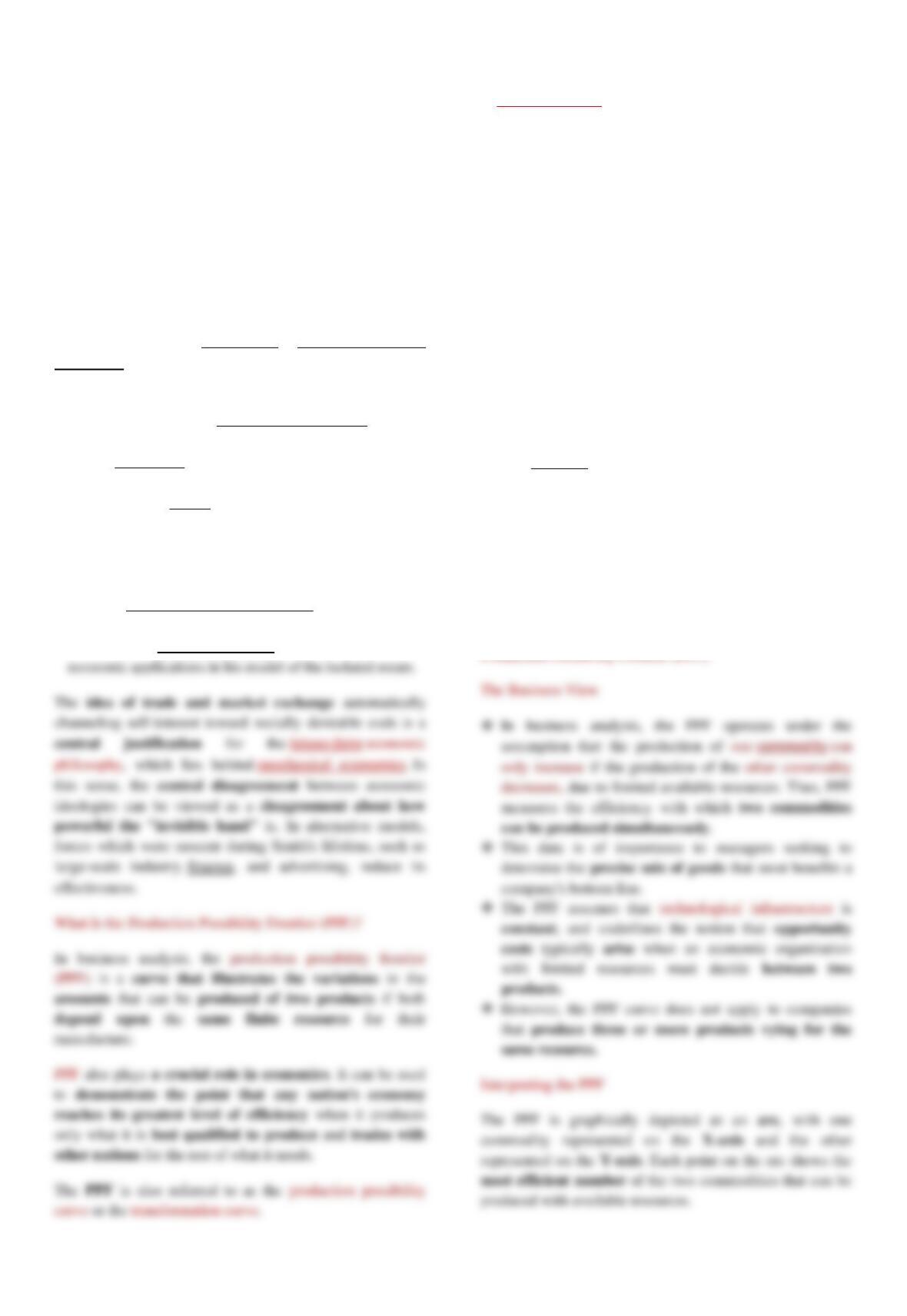
There is a third type of economy involving a combination
of market forces and central planning.
Mixed economies may have a distinct private sector, where
resources are allocated primarily by market forces, such
as the grocery sector of the UK economy. Mixed economies
may also have a distinct public sector, where resources are
allocated mainly by government, such as defense, police,
and fire services. In many sectors, resources are allocated
by a combination of markets and planning, such
as healthcare and, which have both public and private
provision.
Interventionist economists
In contrast to the unregulated free market approach, and that
of centrally planned command economies, the majority of
economists favour comes in the form of government
intervention to make capitalism work better, rather than to
prevent it working at all.
These include Keynesian economists, whose name is
derived from British economist, John Maynard Keynes, and
modern Libertarian Paternalists, including Richard Thaler,
who are influenced by behavioural economics.
➢ Keynes laid down the basic ground rules for state
intervention in markets, and was, perhaps, the most
influential economist of the 20th Century.
➢ Thaler has been instrumental in the emergence of
behavioural economics, and the use of experimentation
to show how behaviour can be nudged towards more
effective actions and outcomes.
❖ These groups are pragmatic in that while accepting that
capitalism is the most effective system on which to base a
modern economy, it requires considerable intervention
at significant times.
❖ In reality, all economies are mixed, though there are wide
variations in the amount of mix and the balance between
public and private sectors. For example, in Cuba the
government allocates the vast majority of resources,
while in Europe most economies have an even mix
between markets and planning.
Economic systems can be evaluated in terms of
how efficient they are in achieving economic objectives.
Adam Smith and the Invisible Hand
Adam Smith FRSA (c. 16 June [O.S. c. 5 June] 1723– 17
July 1790) was a Scottish economist, philosopher,
and author as well as a moral philosopher, a pioneer
of political economy, and a key figure during the Scottish
Enlightenment, also known as ”The Father of
Economics”[7] or ”The Father of Capitalism”. Smith
wrote two classic works, The Theory of Moral
Sentiments (1759) and An Inquiry into the Nature and
Causes of the Wealth of Nations (1776). The latter, often
abbreviated as The Wealth of Nations, is considered
his magnum opus and the first modern work of
economics. In his work, Adam Smith introduced his theory
of absolute advantage.
❖ Smith studied social philosophy at the University of
Glasgow and at Balliol College, Oxford, where he was
one of the first students to benefit from scholarships set up
by fellow Scot John Snell. After graduating, he delivered
a successful series of public lectures at the University of
Edinburgh, leading him to collaborate with David
Hume during the Scottish Enlightenment. Smith obtained
a professorship at Glasgow, teaching moral philosophy
and during this time, wrote and published The Theory of
Moral Sentiments. In his later life, he took a tutoring
position that allowed him to travel throughout Europe,
where he met other intellectual leaders of his day.
❖ Smith laid the foundations of classical free
market economic theory. The Wealth of Nations was a
precursor to the modern academic discipline of
economics. In this and other works, he developed the
concept of division of labour and expounded upon how
rational self-interest and competition can lead to
economic prosperity. Smith was controversial in his own
day and his general approach and writing style were often
satirized by writers such as Horace Walpole.
The invisible hand describes the unintended social benefits
of an individual’s self-interested actions, a concept that
was first introduced by Adam Smith in The Theory of Moral
Sentiments, written in 1759, invoking it in reference to
income distribution.
❖ By the time he wrote The Wealth of Nations in 1776,
Smith had studied the economic models of the
French Physiocrats for many years, and in this work the
invisible hand is more directly linked to production, to the
employment of capital in support of domestic industry.
The only use of “invisible hand” found in The Wealth of
Nations is in Book IV, Chapter II, and “Of Restraints
upon the Importation from foreign Countries of such
Goods as can be produced at Home.” The exact phrase is
used just three times in Smith’s writings.
❖ Smith may have come up with the two meanings of the
phrase from Richard Cantillon who developed both
Understanding the PPF
In macroeconomics, the PPF is the point at which a
country’s economy is most efficiently producing its
various goods and services and, therefore, allocating its
resources in the best way possible.
KEY TAKEAWAYS
• In business analysis, the production possibility frontier
(PPF) is a curve illustrating the varying amounts of two
products that can be produced when both depend on
the same finite resources.
• The PPF demonstrates that the production of one
commodity may increase only if the production of the
other commodity decreases.
• The PPF is a decision-making tool for managers deciding
on the optimum product mix for the company.
✓ If the economy is producing more or less of the quantities
indicated by the PPF, resources are being managed
inefficiently and the nation’s economic stability will
deteriorate.
The production possibility frontier demonstrates that there
are, or should be, limits on production. An economy, to
achieve efficiency, must decide what combination of goods
and services can and should be produced.