BUSI 293
Solutions to Problem Set “A”
Revenue Recognition and the Statement of Income
AP4-1A
1. a. The performance obligation is one year of coverage under the insurance
policy starting February 1, 2020.
b. The transaction price is $1,800, the price of the policy.
c. When the performance obligation (s) would be satisfied: The $1,800
collected on January 28 should be recorded initially as unearned revenue
by the insurance company, and then, beginning in February, 1/12 of this
amount will be recorded as a reduction of unearned revenue and an
increase in revenue at the end of each month, as the performance
obligation for the month has been satisfied.
2. a. The performance obligation is that Porter Airlines will provide you with a
one-way flight home for Christmas.
b. The transaction price is $398, the price of the ticket.
c. When the performance obligation (s) would be satisfied: Porter Airlines
should record the $398 as unearned revenue when they receive the cash
in October. When the flight is provided by Porter at Christmas time,
unearned revenue would be reduced and revenue increased by $398.
Even though the ticket is non-refundable, Porter has not satisfied the
performance obligation until they provide the flight.
3. a. The performance obligation is providing the dental check up on April 5,
2020.
b. The transaction price is $125, the cost of the dental checkup.
c. When the performance obligations would be satisfied: When the dental
checkup is performed on April 5, 2020. The dentist should record $125 as
revenue on April 5, 2016 and an account receivable for the payment that is
due within 30 days.
AP4-1A (Continued)
4. a. The performance obligation is allowing the ticket holder to watch the 41
Winnipeg Jets games in their assigned seat.
b. The transaction price is $6,087.
c. When the performance obligation(s) would be satisfied: After each game
is completed, the performance obligation for that game is satisfied. The
Winnipeg Jets should recognize the collection of $6,087 as unearned
revenue when they receive the cash in July, 2020. As each of the 41
games is played during the season, the Jets would recognize part of the
revenue (i.e. 1/41) and so reduce unearned revenue and increase
revenue. This is the case whether or not you attend all of the games. The
onus is on the Jets to provide games, and their performance obligation is
satisfied as each game is played.
LO 2 BT: AP Difficulty: M Time: 35 min. AACSB: None CPA: cpa-t001 CM: Reporting

AP4-2A
a.
Question
Analysis
Step 1: Is there a
contract?
Yes, both parties have agreed to enter a contract. The
goods and services to be provided, price, and payment
terms have been agreed to and each party’s rights under
the contract are clear. The contract is consistent with
both parties’ lines of business, meaning it has
commercial substance. There are no indications of any
concerns regarding collectability.
Step 2: What
performance
obligations are
included in the
contract?
The contract includes two performance obligations: the
design of machines and the construction of the
machines. The assurance warranty is not considered to
be a separate performance obligation.
Step 3: What is
the transaction
price?
The transaction price is $4.1 million.
Step 4: How
should the
transaction price
be allocated to
the performance
obligations?
Performance
obligation
Stand-Alone
(SA) Selling
Price
% of
Total SA
Selling
Price
Contract
Price
Allocation of
Contract
Price
Design of
machines
$510,000
11.3%
X $4.1 M
$463,300
Construction
of machines
$4,000,000
88.7%
X $4.1 M
$3,636,700
$4,510,000
100 %
$4,100,000
Step 5: Has a
performance
obligation been
satisfied?
The first performance, the design of machines is
satisfied on March 28, 2020 when the design is
approved by Coastal. The revenue related to this
performance obligation would be recognized at this
point.
The second performance obligation, the construction of
the machines is satisfied on May 20, 2020, when the
harvesters are delivered to Coastal. The revenue related
to this performance obligation would be recognized at
this point.
Revenue recognized for the year ended May 31, 2020 – the full contract of
$4,100,000
AP4-2A (Continued)
b. TreeHold would record the following journal entries and adjusting journal
entries in relation to these transactions:
Feb 18 DR No entry 0
CR No entry 0
No entry because neither party has performed any obligations
under the contract.
Feb 25 DR Cash 1,250,000
CR Unearned Revenue 1,250,000
To record the receipt of the deposit, but as TreeHold has not
satisfied any performance obligations, no revenue can be
recorded.
Mar 28 DR Unearned Revenue 463,300
CR Service Revenue 463,300
To record the revenue related to the design of the machines, as
the performance obligation for the machines has been satisfied
May 18 DR No entry 0
CR No entry 0
No entry as the performance obligation has not been satisfied.
May 20 DR Accounts Receivable 2,850,000
DR Unearned Revenue1 786,700
CR Sales Revenue 3,636,700
1($1,250,000 – $463,300)
To record the revenue related to the construction of the machines
as the performance obligation for the machines has been satisfied
less the estimated warranty liability. The related costs of
construction would be recorded to Cost of Goods Sold.
AP4-2A (Continued)
May 20 DR Warranty Expense 230,000
CR Warranty Liability 230,000
To accrue warranty liability
June 2 DR Cash 2,850,000
CR Accounts Receivable 2,850,000
To record the collection on account from Coastal.
LO 2,3 BT: AP Difficulty: M Time: 40 min. AACSB: None CPA: cpa-t001 CM: Reporting

AP4-3A a.
Question
Analysis
Step 1: Is there a
contract?
Yes, both parties have agreed to enter into a
contract. The quantity, price, and payment
terms have been agreed to and each party’s
rights under the contract are clear. The
contract is consistent with both parties’ lines
of business, meaning it has commercial
substance. There are no indications of any
concerns regarding collectability as
subscriptions are paid in advance and single
copies are also sold in cash transactions.
Step 2: What
performance
obligations are included
in the contract?
There is a single distinct good (a magazine)
being provided under the contract: 115,000
monthly subscriptions 115,000 x 12 months
= 1,380,000 magazines and 25,000 monthly
magazines 25,000 x 12 = 300,000
magazines
Step 3: What is the
transaction price?
The transaction prices are:
Monthly paper magazines: $4.167 ($50/12
months)
Monthly digital magazines: $3.333 ($40/12
months)
Monthly newsstand magazines: $5
Step 4: How should the
transaction price be
allocated to the
performance
obligations?
There is no need to allocate the transaction
price because there is a single performance
obligation.
Step 5: Has a
performance obligation
been satisfied?
Revenue would be recognized once the
magazines are delivered to the subscription
customers and the newsstands, net of any
refund liability.
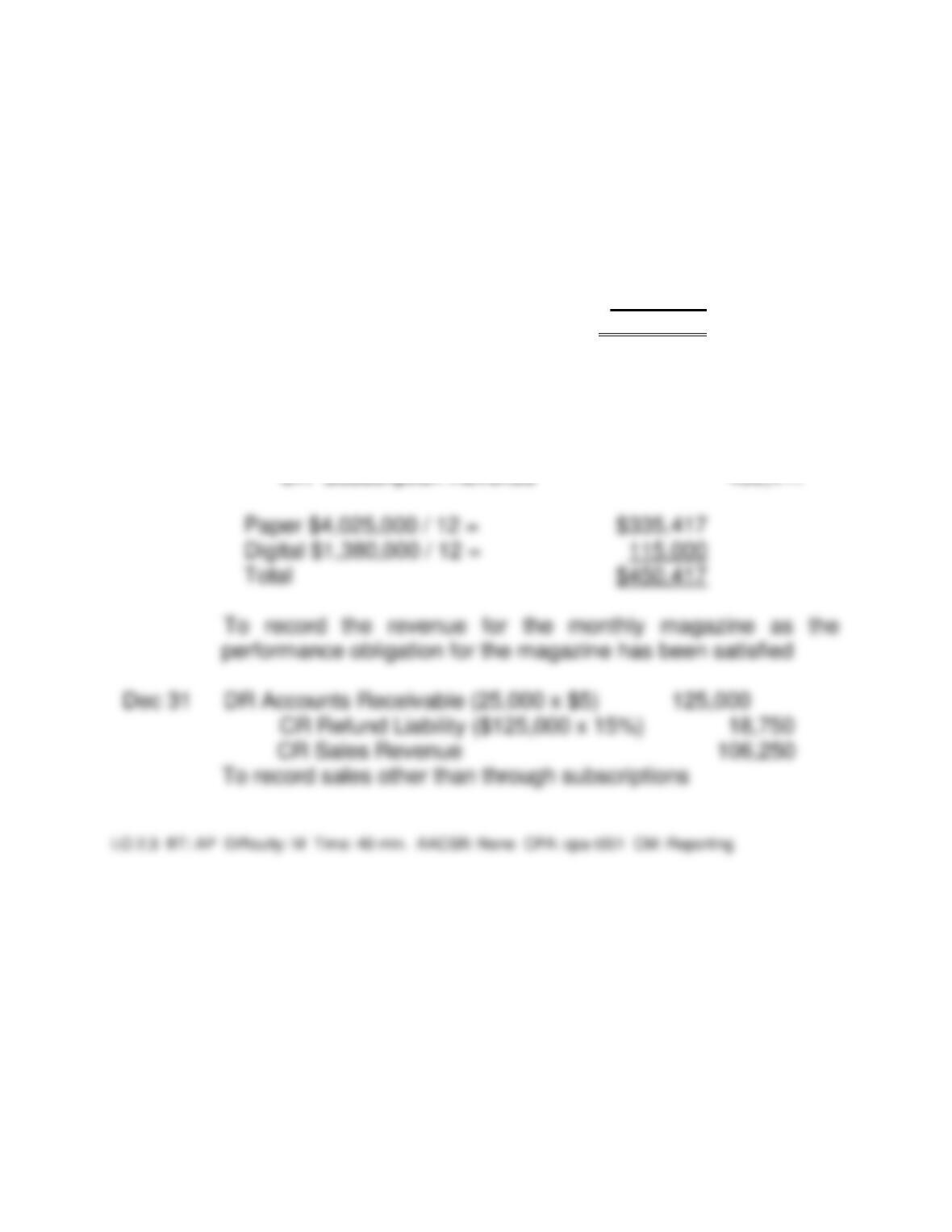
Revenue recognized in 2020 – December’s revenue
AP4-3A (Continued)
b.
Dec 1 DR Cash 5,405,000
CR Unearned Revenue 5,405,000
Paper 115,000 x 70% x $50 = $4,025,000
Digital 115,000 x 30% x $40 = 1,380,000
Total $5,405,000
Chow has not satisfied any performance obligations. No revenue
can be recognized.
Dec 31 DR Unearned Revenue 450,417