RETAIL ANALYSIS: MARKS
& SPENCER
Analysis on the Macroenvironment, Positioning, Merchandise, Retail Image & Future Trends

Contents
1.0 Introduction………………………………………………………………………………………………………………..2
2.0 Body of Report…………………………………………………………………………………………………………..4
2.1 Marks & Spencer in the Macroenvironment and its Competition…………………………..………….4
2.1.1 The Economy and Marks & Spencer……………………………………………………………………..……4
2.1.2 Law & Order: Marks & Spencer and the Political- Legal Environment………….……………….5
2.1.3 Technology and Marks & Spencer………………………………………………………………………………5
2.1.4 Is It Healthy, Is It Green?: Marks & Spencer & the Socioculture Environment.………….......6
2.1.5 The Analysis of Competition: Zara and H & M……………………………………….…………………..7
2.2 How Marks & Spencer Positions Itself in the Market…………………………………………….………..9
2.2.1 The Target Market…………………………………………………………………………………………………….9
2.2.2 The Retail Strategy………………………………………………………………………………..……………….10
2.2.3 General Merchandise………………………………………………………………………………………………11
2.2.4 The Emerging Trend………………………………………………………………………………..……………..14
2.3 The Retail Image of Marks & Spencer…………………………………………………………….…………..15
2.3.1 Atmosphere of Marks & Spencer Store………………………………………………………….………….16
References……………………………………………………………………………………………………………………..23
Appendix……………………………………………………………………………………………………………………….25
1

1.0 Introduction
Marks & Spencer first began with Michael Marks selling penny goods from a market stall in
Leeds in 1884. In 1894, Michael asked Tom Spencer to join him and the famous partnership of
Marks & Spencer was born. Over the years, Marks & Spencer has grown from a single market
stall to become an international multi-channel retailer which has over 760 UK stores and
420 international stores in over 50 markets across Europe, the Middle East and Asia (Marks and
Spencer plc, 2014). It has around 76,000 employees internationally with over 2000 suppliers to
work with. Marks & Spencer specializes in the retail sale of a range of men’s and women’s
fashion, food, beauty products, and toiletries. Although perhaps not the most fashionable place to
shop, Marks & Spencer is well known for both its quantity and quality- basic clothing comes in
most colours, sizes and styles.
M&S profitability was at its peak in the year of 1997-1998 but the company was found to
be in deep financial troubles in later years solely due to the increasing levels of profit margin, the
disapproval of company to accept payment by using credit cards, out of touch clothing ranges
and the principle of the company to only be involve with British suppliers (BBC News, 1999).
Eventually, the company went through massive changes that includes the introduction of more
new variety of clothing brands, acceptance of payment through credit cards and prioritizing more
on customer services and so, the company was able to regain its position and recover some of its
market share. Since the downfall, M&S has portrayed a good image to its customers by certain
various means which will be discussed in the session later (Hawkins, 2007). They have traded in
Malaysia since 1993 and currently have five stores located at Suria KLCC, Paradigm Mall,
2

Bandar Utama, The Gardens Mall, and Sunway Pyramid. These 5 stores share a certain
similarities which are all located in Kuala Lumpur, mainly because of the higher population and
living standards. Their stores are aim to provide customer a spacious and modern shopping
experience.
This report aims to explore the retail strategies which includes positioning and retail
image of Marks & Spencer. A survey with a sample size of 12 was also performed to allow and
in-depth analysis on this retail firm.
3

2.0 Body of Report
2.1 Marks & Spencer in the Macroenvironment and its Competition
The macroenvironment consists of external forces that a retailer has little control over.
The economy, the culture of society, technology, politics as well as legal issues are part of the
macroenvironment that significantly influences decision making within the firm (Gupta, 2013).
An international retailer such as Marks & Spencer must understand its’ macroenvironment and
its’ competitors in order to maintain its strategic position and retain profits (Pallapothu & Krause,
2013).
2.1.1 The Economy and Marks & Spencer
The changes in the economic environment will affect both the consumers and the retail
firm. Inflation, economic growth, changes in income and unemployment rate are some of the
factors that contributes to the change in the economy. On the consumers end, these factors will
affect their ability as well as their willingness to purchase a product (Gupta & Randhawana,
2008). Since Marks & Spencer sell high quality merchandise from the UK, taxes on the products
are incurred as they are imported products which increases the price of the products, not to
mention the difference in exchange rate as well as delivery costs. The retailer on the other hand
is affected by such costs as part of the many costs that comes with running an international retail
firm.
4

2.1.2 Law & Order: Marks & Spencer and the Political- Legal Environment
The legal environment sets the basic rules for how a business can operate in society. It is
crucial for a company to adhere to government policies and regulations when constructing a
marketing plan. Governments establish policies and organizations to monitor organizations and
their offerings. Due to increasing government regulations on health and safety and environmental
concern, in 2002 Marks and Spencer launched a new campaign that emphasized on health,
quality and environmental sustainability. They introduced products that had lower sodium
chloride and advertised their health benefits aggressively (Marks and Spencer, 2006).
2.1.3 Technology and Marks & Spencer
The rapid change in technology presents both opportunities and difficulties for marketers.
Retailing has shifted to a more technologically driven industry. Companies have constructed
their own online shops, databases and websites that assist them in increasing the online profit
generated. Therefore, Marks and Spencer have invested heavily on information technology. They
purchased an Electronic point of sale systems that were used to increase customer service, drive
sales and improve its efficiency. However, M&S did not effectively manage it EPOS system and
online shop efficiently. Customers who shop online still feel inconvenient.
5
2.1.4 Is It Healthy, Is It Green?: Marks & Spencer & the Socioculture Environment
Demographics, attitudes, lifestyle and cultural changes may present an opportunity at the
same time a threat to a retailer (Gupta & Randhawa, 2008). Marks & Spencer is a brand from
the United Kingdom and through cultural change brought by globalization, Marks & Spencer can
be found in major cities through the world. The gradual adoption of western ideals, values and
lifestyle by peoples of other cultures enabled Marks & Spencer it to be a distinctive retailer
specializing in goods from the UK as without this change in culture, Marks & Spencer will not
be here in Malaysia today. Moreover, the society around the world are embracing sustainability
advocating for fair trade as well preferring environmentally friendly products. Marks & Spencer
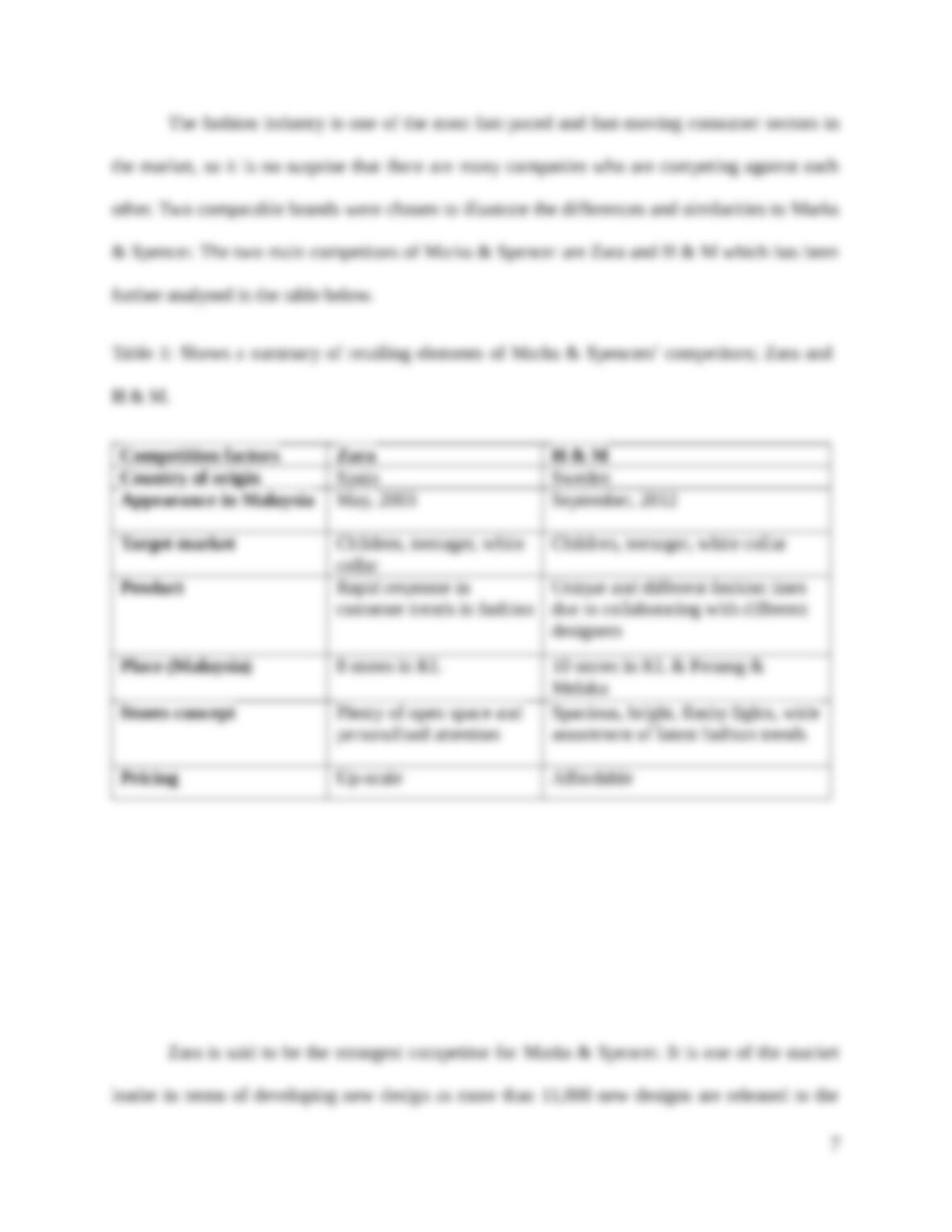
takes this opportunity to deliver such products especially in its food products. They produced