ENG502M
Second Trimester, AY 2010-2011
RESEARCH PAPER ON THE ATTRITION RATE
IN FINANCIAL SHARED
SERVICES ORGANIZATION
Submitted To:
Prof. Maria Cequena
Submitted By:
Rachel Reyes
Title: Attrition Rate in Financial Shared Services Organization
1. What are the factors affecting the high attrition rate in shared services organization
(SSO)?
2. What are the impacts of the increasing attrition rate in SSO?
3. How should shared services organization address the high attrition rate common
in the industry to maintain employee retention?
Attrition rate has been a common problem faced by the shared services industry. The
increase in attrition rate among these companies could be alarming with the sustainability
of offshore services in the Philippines. This research paper will identify the factors that
cause the rise in attrition rate of shared services industry. Factors determined such as
management/superior, compensation and benefits, career and personal growth are some
common causes of attrition rate in a certain organization. These aspects shall be proven if
are deemed applicable in Philippine shared services industry in the course of the study.
This comprehensive study will focus only on the attrition of Philippine shared services
particularly of the financial services such as Citibank, Deutsche and JP Morgan. Its
purpose is to evaluate the factors that may hinder employee retention and its impact on
management and the company as well. Lastly, after determining and testing the common
causes of attrition rate, suggested ways on improving employee retention will be presented
in order to help address the problem.
CHAPTER 1: THE PROBLEM AND BACKGROUND OF THE STUDY
I. Introduction
The 21st century highlights the growth of technology. Development of technology paved
the way for the different inventions of cellphone, ipod, ipad, among others. Technology
also opened opportunities for the rise of outsourcing companies. Multinational companies
outsource parts of their operations in other countries to minimize costs and focus on their
competencies. Philippines is known for the various outsourcing services provided
worldwide, second to India.
Over the past years, the BPO industry has expanded amongst the different industries in
the world. Based from McKinsey & Co. reports, around $180 billion outsourcing services
is needed by the end of 2010 (2005). This will strengthen the growing offshore services not
only of the leading call centers but also of knowledge process outsourcing (KPO) based
services such as legal, accounting, web design, medical transcription, and software
development in the Philippines.
The growth of these shared services operations in the country give rise to different
companies as such providing competition within industry and job opportunities for people.
Despite the growth of the industry, these shared services organizations still face problems
with its people just like any other organization. Employee retention has been one of the
primary human resource problems in the industry. The rigid competition of these
companies in hiring the best people may affect the attrition rate of these firms. Given the
dependency on workers, companies should minimize its employee turnover. Otherwise,
this will affect the operations of the firm and will also incur several costs to the company.
In fact the attrition rate of BPO in India, the leader in this industry is 7.8% higher than
any other industry according to a report released by Hay Group (2008). Given the threat of
attrition in the BPO industry of India, this would likely be a similar challenge other
offshore service destinations.
For instance, the shared services industry in the country has now been experiencing the
same dilemma of Indias BPO sector. A number of companies such as Deutsche, JP Morgan
and Citibank face and need to solve the increasing turnover of its employees. This research
will determine the factors causing the high attrition in these companies. This issue on
attrition without given proper attention may create negative impact on the growing shared
services industry in the country. Sustainability of these companies to continue providing
quality service could be at stake as perceived by the investors or the regional offices
abroad. Thus, in light of providing resolution to the matter, retention programs are
presented to help the companies resolve this matter.
II. Statement of the Problem
Facing the challenge of sustainability of the shared services industry in the midst of the
high attrition rate, this comprehensive study will focus on the attrition rate of different
financial shared services in the Philippines. Its purpose is to provide the management a
better understanding of the employees”€™ sentiments contributing to employee turnover.
Specifically, this research will try to address:
“€¢ What are the different factors affecting the high attrition rate in shared services
organization (SSO)?
Moreover, the following are the underlying issues:
“€¢ What are the impacts of the increasing attrition rate in SSO?
“€¢ How should shared services organization address the high attrition rate
common in the industry to maintain employee retention?
III. Objectives
This paper intends to achieve the following purposes:
“€¢ To review common causes of employee turnover
“€¢ To identify the causes of attrition rate applicable to the subjects of the study
“€¢ To determine the impacts attrition rate in shared services organization
“€¢ To recommend ways to increase retention of employees in shared services
organization
IV. Theoretical and Conceptual Framework
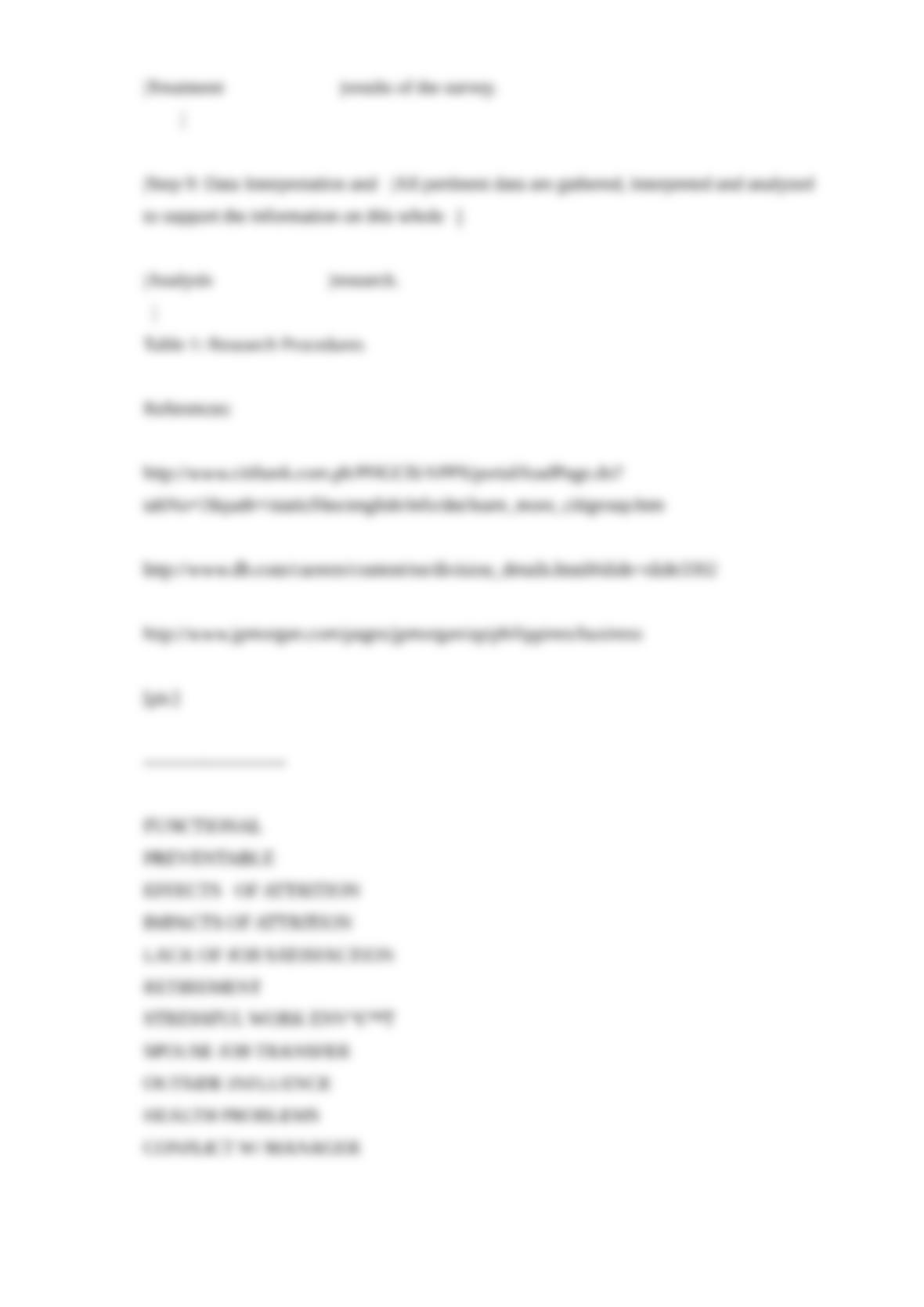
[pic]
Figure 1. RESEARCH PARADIGM
Source: http://www.themanagementskills.com/business/attrition-rate
Attrition rate is defined as the term used for the voluntary or involuntary loss of employees
due to a variety of reasons over a specific period of time.
(http://www.themanagementskills.com/business/attrition-rate) It has now caused a lot in
terms of the cost for the firms. There are two identified categories of attrition rate:
Functional and Preventable Attrition.
The only difference between the two categories is that functional attrition is due to
uncontrollable circumstances while preventable is due to controllable reasons and can be
given solutions. Functional attrition includes retirement, spouse job transfer or migration
and health problems. All people get old and tired of working. Thus, the maximum age of
working people would only be 60 years old. As for the job transfer of spouse, this has also
been common these past years due to the increase in number of migrations to other
country. This has been triggered by the poor economy in the country. Lastly, health
problems have been issue for most people especially for stressful work that affects the
health of the employee. This could be seen among call center agents wherein they change
shifts often causing their health to suffer. These reasons for attrition are not preventable
and mostly personal to address with any solutions.
On the other hand, preventable attrition is mostly work-related and should be address to
minimize attrition because of these causes. Lack of job satisfaction would be one of the
common reasons which is provoked by lack of career advancement. Next is stressful
environment wherein employees feel they work long enough but paid less. This is related
also with outside influence. Employees may opt to choose companies that could pay them
higher than what can their current employers can offer. Most people consider
compensation and benefits as one of the essential factors they look for in a job. Lastly,
working environment is important as this also motivates people to work. Having a conflict
with your manager or superior may affect how you work. This affects the emotions of the
employees and may cause him not to fulfill his responsibilities well.
The above reasons are few causes of attrition that needs to be address by the companies as
this will have an impact within the organization and affect retention of employees.
V. Research Hypothesis
The main factors contributing to attrition rate in shared services organization are

compensation and benefits, superior or the bosses and career growth and development.
VI. Significance of the Study
This study aims to address the problem on employee retention which will be valuable for
management as well as for the employees of shared services organization.
Human Resource department faces the challenge of reducing attrition rate because of
several reasons. HRs training and hiring of new people incurs a lot of costs compared to
retaining an employee and improving his skills. Dr. Sullivans study (2000) showed losing a
talented person already cost US$200-250. In the long run, talent development gives value
to the firm. Knowledge and skills of an old employee will not be part of his turnover to the
new employee. As such, there will be no assurance that the new one could provide the
same quality of work.
This research hopes to help management minimize attrition rate through understanding the
causes of attrition among employees. Hence, it will provide the management a wider
perspective of the employees”€™ side in terms of work. Furthermore, the suggested
retention programs may eventually improve the turnover rate of employees. Hence, the
firm could incur lesser costs of rehiring and could cultivate the knowledge and skills of its
employees better.
On the other hand, minimizing the turnover rate would also help the employees build their
career. Given that employees could now stay longer with their job, this does not only
provide job security to employees. But it also helps them to develop their career path and
hone their skills in order to do better on their responsibilities at work.
Given the significance of this research to both employees and management, this study
would also eventually help the shared services industry as a result. Improving the attrition