In an ever changing market culture such as the business world, people are required to
adapt to the situation in which they are given. Within this change, many people tend to struggle
with communicating between their companies, employees, coworkers, and customers. Many
companies would begin going above and beyond for their customers if they were implementing
better decision making programs. A vast majority of these have already begun implementing
these and have shown signs of great improvement. They are able to gain a slight advantage
above the rest of their selective field simply by being able to decide what choice is best in
handling the situations at hand.
Decision making is a crucial part of life and has become a core issue in organizational
analysis within the past 40 years (Halvorsen, 2013). This streams from being able to find the
right answer, also known as problem solving. Problem solving finds the right cause of the
problem you have at hand (Saaty, 2013). There are four different dynamics of decision making
business tend to focus on. These dynamics are decision-making styles, intuition, decision tree
for making ethical decisions, and creativity. Each of these play a key role in the way a company
runs its every day operations (Kinicki, Fugate, 2012).
Decision-making styles reflect the combination of how someone perceives and
comprehends stimuli and how he or she chooses to respond to such. These are influenced by the
extent in which the person focuses on either the task and technical concerns or people and social
concerns and the degree in which the person needs control in his or her life. These two
dimensions make up the four styles that make up the decision making tree (Kinicki, Fugate,
2012).
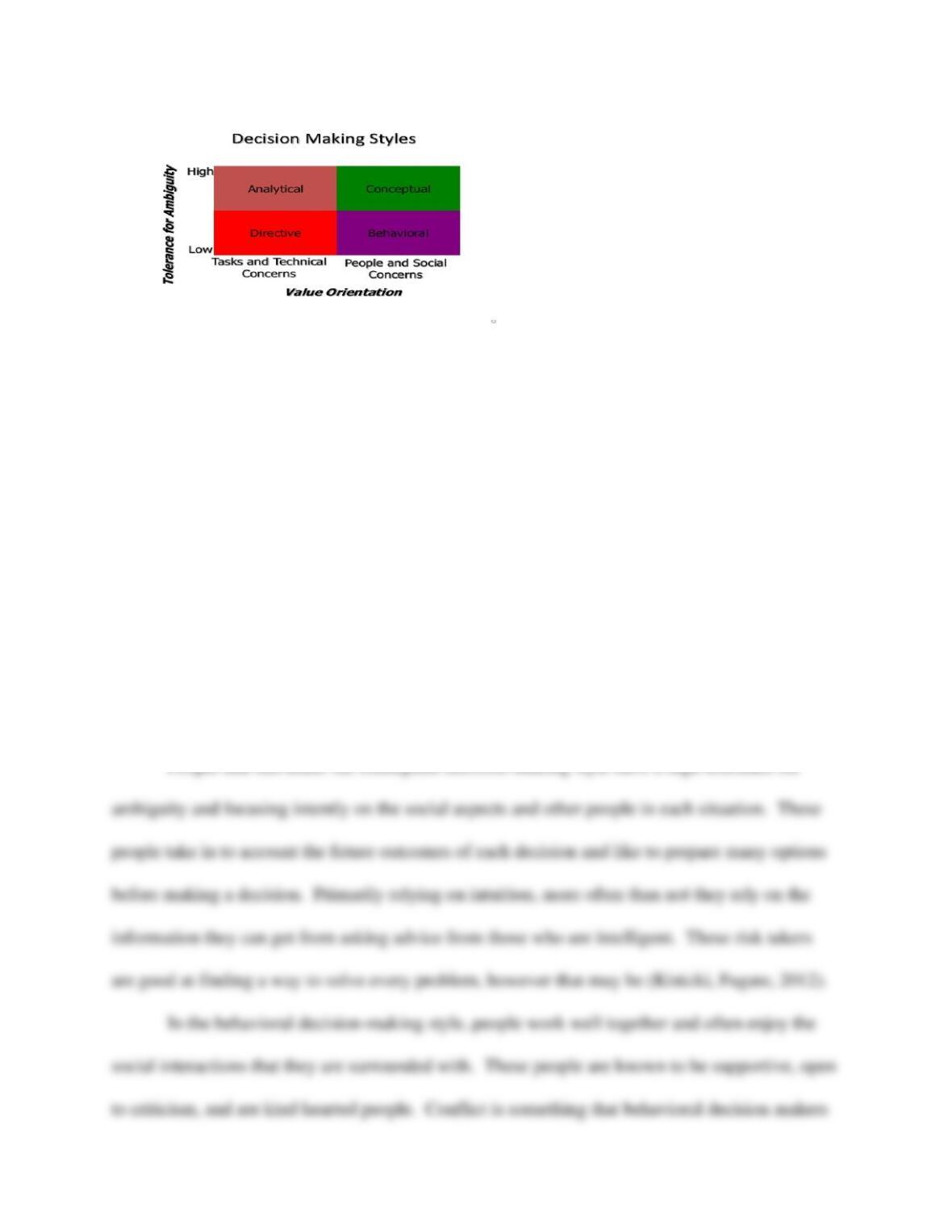
A directive decision-making style lays claim to the people who have a low tolerance for
ambiguity and are oriented toward task and technical concerns in decision making. They tend
to be very efficient people with logical decision making skills. These decisive people tend to
stick to the facts and stay focused on the short run (Kinicki, Fugate, 2012).
Analytical people have a lot higher level of tolerance towards ambiguity and are
primarily people who overanalyze situations. They like to have options in making decisions and
to consider all of the information they can lay claim to. These people are ones who make
decisions carefully and thoroughly while being able to adapt well to new or arising situations
(Kinicki, Fugate, 2012).