Research on the Rural Tourism Development in Hubei
Province from the Perspective of New Urbanization
Li Yudi Li Yingli
(School of Business Administration of ZhongNan University of Economics and Law,WuHan 430073,china)
Abstract: With the rapid process of urbanization in China, an increasing number of people
wish to return to the countryside to enjoy the casual living. In the recent years, the Central
First Document also proposed to construct the beautiful countryside. Besides, the Several
Opinions of the State Council on Promoting the Reform and Development of the Tourism Industry
also proposed to develop the rural tourism. This paper conducted statistics, classification
and evaluation on the rural tourism resource unit in Hubei Province, adopted the Fuzzy
Synthesis Evaluation Model to take the resource endowment, tourism location, economic
development level, policy measure and customer market as the evaluation factors, establish
the weighted apportionment fuzzy subset to carry out quantitative analysis on the development
potential of rural tourism in Hubei Province and then combined the SWOT model to obtain the
direct of improvement of rural tourism development in Hubei Province.
Key words:new urbanization, rural tourism, fuzzy synthesis evaluation
1. Introduction
Rural tourism is a kind of tourism consumption behavior and sum of all phenomenon and
relationship takes characteristic rural scenery, agricultural activities and folk custom
in countryside for attracts and takes urban residents for target market, which meets
all kinds of traveling requirements such as tourists’ touring, relaxation, recreation,
vacation, curiosity and returning to nature(Xiangjun Xiao,2009).The development of
rural tourism in Hubei Province plays a guiding role for new rural construction and the
development of urban and rural areas. According to the statistic released by Tourism
Administration of Hubei Province, the total operating income of rural tourism in Hubei
has achieved 26.4 billion Yuan last year. The acceleration of the development of leisure
agriculture and rural tourism in Hubei Province not only conforms to the needs of urban
residents’ leisure tourism, but also becomes the pushing effort of urban and rural
integration.
2. Status and Significance
2.1 Research status
Researches about Rural Tourism are mainly discussed the sustainable development
of rural tourism and the relationship between new urbanization and rural tourism.
In beforehand developed regions of China, there are typical problems in the process of
urbanization, such as semi-urbanization, reduced farmland and disorder and unlimited
expansion of urban space, which is not conducive to continuous advanced and healthy
development of urbanization. Faced with profound farming culture, practical constraints
such as tightening environmental and land pressures, rural tourism should develop through
scientific planning of urban system, constant improvement of urban functions to enhance
urban capacity, taking the road of new urbanization to integrate industrialization and
urbanization by the establishment and design of smooth channels connecting farmers and cites
based on systems.
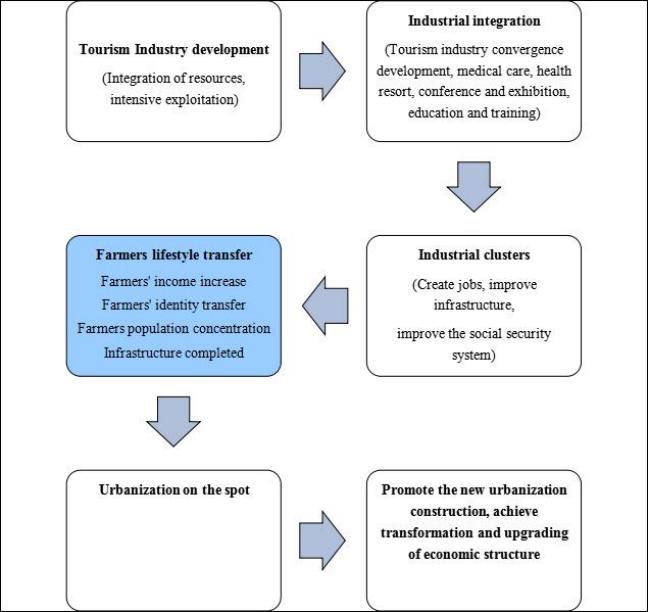
Julin Jiang (2012) in the paper “development of tourism and the construction of
new urbanization” describes the development of tourism should take the”new road of
urbanization under the guidance of the tourism industry” and depicts the basic framework
(Figure 2-1)
Figure 2-1 New urbanization under the guidance of the tourism industry
Therefore, overall planning and combing urban and rural areas to realize coordinated
development is the keys of “Promote the New Urbanization, and Realize the Transformation
and Upgrading of Economic Structure”
2.2 Research significance
Rural tourism is a product of urbanization process (Qiuhua Qu, 2012).With the
acceleration of urbanization process in China, returning to the countryside and enjoying
a leisure life will become universal aspirations of people, which give birth to the
production, development and growth of rural tourism. However, with the pace of urbanization
in Hubei Province, urban culture and lifestyle strongly expand to rural areas, and negative
impact of its development on rural tourism is gradually revealed. There are problems in the
development of rural tourism including similar products, simple and backward development
model, flying-land, ecological and environmental costs, leading to difficulties in the
coupling between them. Under the strong impact and phagocytosis of urbanization, resources,
markets and culture gradually deviate from rural to urban areas, leaving the development of
rural tourism troubled.
The so-called new urbanization takes people’s livelihood, sustainable development
and quality as its contents, in order to achieve regional integration and coordination,
industrial upgrading and low-carbon transformation, ecological civilization and intensive
and efficient new process of urbanization. The development of rural tourism from the view of
new urbanization needs both rural and urban regions to be functional and retain their own
characteristics on the basis of their development, making the city more like a city, the
countryside more like countryside, to achieve sustainable and coordinated development of
urban and rural areas.
Rural tourism and the development of new rural construction are closely related, which
provides an exciting opportunity for rural economic development, promotes rural employment,
reasonable land use and the integration of urban and rural areas. Especially, rural tourism
and new rural construction impacts each other and develops with each other seen from
possible opportunities for development, resource allocation, development efficiency.(Shufang
Wang, 2009) But in reality, there are cases that the process of rural tourism planning
violates the development path. Therefore, this article requires new eco-concept to see and
avoid its shortcomings, and think about how to develop rural tourism in Hubei Province in a
systematic and ecological way. In addition, it teases out rural tourism resources in Hubei
Province, in close connection with the reality of economic development of rural tourism
in Hubei Province. On the basis of spatial characteristics and evolution, it provides
targeted measures for industrial optimization, serving as a direct reference to the economic
development and transition of rural tourism in Hubei.
3. Hubei Province Rural Tourism Resources Research
3.1 Basic endowment of rural tourism resources in Hubei Province
3.1.1 Rural tourism resource classification
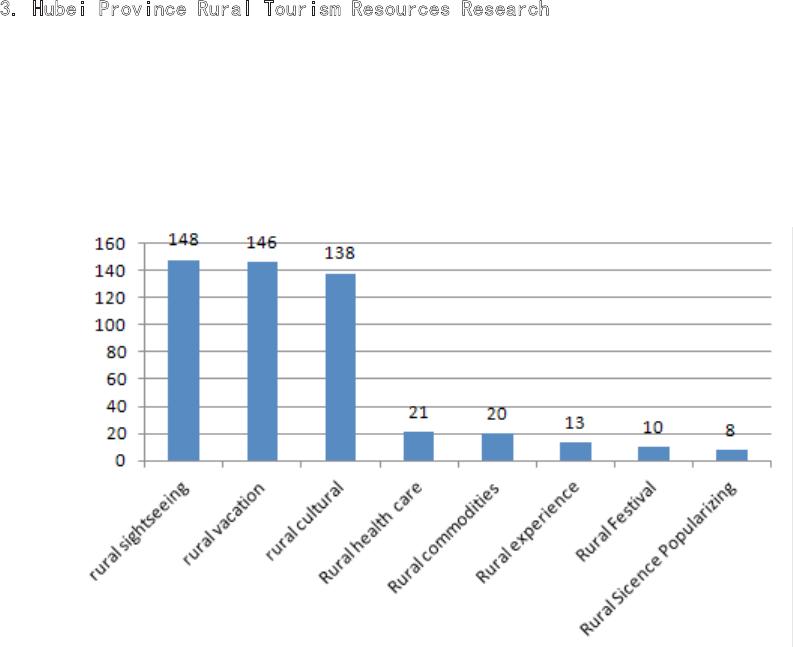
The resources of rural tourism in Hubei province distribute wide; and there are 504
resource monomers. According to the resource classification table of rural tourism in Hubei
province, eight tourism resources are counted. The result is shown in figure 3-1.
Figure 3-1 Hubei rural tourism resources monomers chart

Figure 3-1 shows that the tourism resource types are rich in the countryside in Hubei
province; Especially rural sightseeing, rural vacation as well as rural cultural resources
are the main types. From the result of rank, the distribution of four-star and three-star
tourism resources is relatively centralized and features are outstanding. Rural tourism
takes famous flowers, lakes, high mountains, tea garden as well as rural culture for
main features. From the development conditions, rural tourism resources get support from
government, traffic, demand as well as investment.
3.1.2 Rural tourism rank evaluation
(1) Evaluation index
According to the rural tourism resource features, evaluation index and methods of rural
tourism resource in Hubei province are constructed; In addition, rural tourism resources are
dependent on the value of resources, development conditions and development value. The grade
of resource value, development conditions and development value are relatively 60, 30 and 10
scores (score by experts). Rural topic sightseeing is the main factor of its value. Whether
the tourism environment and ecologic environment quality is good or not in the tourism
resource place is the important standard to attract tourists. Therefore, tourism environment
is the important factor of development conditions. Rural tourism is equipped with the
functions of pro-poor tourism and industry drive. It comprehensive development value and
drive effects are the main factors to evalue the development value of tourism resources.
Table 3-1 Rural tourism rank evaluation
Target layer Comprehensive evaluation
layer Project Evaluation level Evaluation factor layer
Rural Tourism
Resources (100)
Resource Value (60)
Rural property (30)
Typical (15)
Ornamental (8)
Cultural property (4)
Popular science (3)
Rare and unusual nature
(8)
Size and capacity (4)
Awareness (3)
Development conditions
(30)
Environmental Quality
(10)
Tourism Environment (7)
Village appearance (3)
Market potential (7)
Location and
transportation (5)
Infrastructure (4)
Policy factors (2)
Tourism Talented person
(2)
Development value (10)
Tourism will effect (6)
Tourism Integrated Value
(4)
(2) Evaluation results
Five-star tourism resources are called advanced tourism resources, equipped with the
character of representation and influence in the nation, which reflects some rural features
in countryside of Hubei province. In a long term, rural tourism resources are the important
resources attracting international tourists. Four-star tourism resources are senor tourism
resources which are the rural tourism resources in the province. Three-star tourism
resources are favorable resources, attracting tourists from cities.
According to the evaluation results, there are 17 fifth tourism resources. The fifth
tourism resources are equipped with sightseeing value, development conditions as well as
development effects from the aspects of representation and advancement. There are 41 four-
star tourism resources and 82 three-star tourism resources.
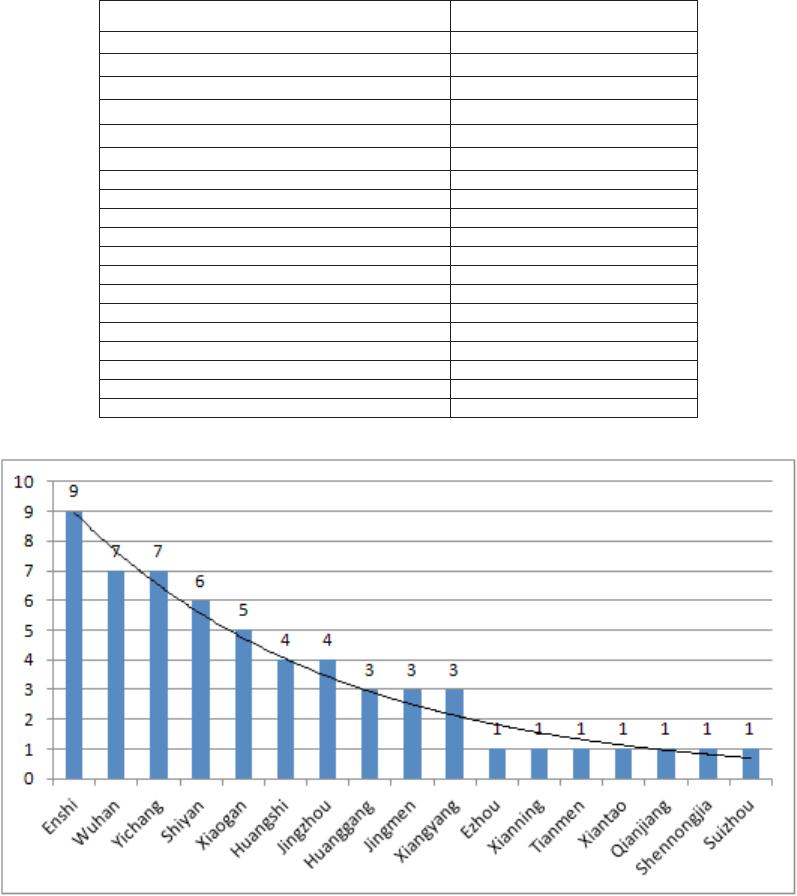
3.2 Rural tourism resource spatial distribution of Hubei Province
To master the spatial distribution characteristics of senior rural tourism resources,
we make spatial distribution statistics of provincial four-grade and five-grade tourism
resources, and come to the conclusions as Table 2.
Table 3-2 Hubei Province spatial distribution characteristics of senior rural tourism resources
Sample source Number of recovery
Wuhan 23
Yellowstone 15
Shiyan 15
Jingzhou 15
Yichang 15
Xiangyang 14
Ezhou 12
Jingmen 15
Huanggang 15
Xiaogan 11
Xianning 15
Xiantao 7
Qianjiang 7
Shennongjia 16
Enshi 15
Tianmen 8
Suizhou 11
Online questionnaire (Other provinces) 38
Total 268
Figure 3-2 Hebei Province spatial distribution characteristics of senior rural tourism resources
Thus it can be seen that senior tourism resources are distributed in 17 cities, states
and forest districts across the province, which mainly concentrate upon Enshi, Yichang,
Wuhan, Shiyan, Xiaogan and other areas. In spatial distribution, the concentration