FOREIGN TRADE UNIVERSITY
HO CHI MINH CITY CAMPUS
———***———
Subject: International Economics
TERM PAPER
ANALYSIS OF VIETNAM’S EXPORTING HS 9403
INDUSTRY IN THE PERIOD OF 2001– 2018
Lecturer: Dr. Trần Nguyên Chất
Class: K57CLC3
Student: Vũ Đăng Hưng – 1801015328
Ho Chi Minh City, May 2020

Table of Contents
I) Introduction: ……………………………………………………………………………………………………………………….. 1
II) Main body: ………………………………………………………………………………………………………………………….. 2
1. Export revenues and growth: …………………………..………………………………………………………………… 2
2. Import revenues and growth: …………………………………………………………………………………………….. 6
3. Market structure: ……………………………………………………………………………………………………………… 8
4. RCA analysis: ………………………………………………………………………………………………………………….. 11
5. IIT analysis: …………………………………………………………………………………………………………………….. 13
III) Conclusion: …………………………………………………………………………………………………………………….. 15
1. Implication: ………………………………………………………………………………………………………………... 15
2. Summary: …………………………………………………………………………………………………………………… 16
IV) Reference: ………………………………………………………………………………………………………………..……. 17
Table of graphs
Graph 1………………………………………………………………………………………………………………………………………. 2
Graph 2………………………………………………………………………………………………………………………………………. 4
Graph 3………………………………………………………………………………………………………………………………………. 5
Graph 4………………………………………………………………………………………………………………………………………. 6
Graph 5………………………………………………………………………………………………………………………………………. 8
Graph 6…………………………………………………………………………………………………………………………………….. 11
Graph 7…………………………………………………………………………………………………………………………………….. 13
1
I) Introduction:
As one of the top 10 export products of Vietnam, for nearly a decade, with impressive
export growth, Vietnam’s furniture export industry is one of the most dynamic and
successful industries in the process of international economic integration. Along with the
impressive development of the timber industry not only brings direct benefits to the
producers, processors and traders of export timber, but also makes an important
contribution to the improvement of income sources and living standards. Millions of
workers participate in various stages of the supply chain, including many afforestation
households, providing materials for the furniture industry, as wood furniture alone
accounts for about 70%. Vietnam’s participation in a series of free trade agreements has
brought Vietnam a big step forward in the process of integration and globalization. This
also gives the furniture industry the opportunity to access the largest and most potential
markets with priority terms. This paper focuses on identifying and analyzing the reasons
for the import and export activities of this industry in Vietnam.
2
II) Main body:
1. Export revenues and growth:
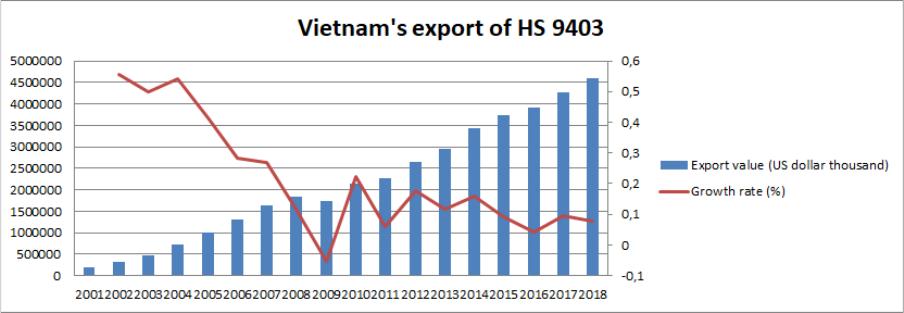
Graph 1
Vietnam’s total export of furniture and parts thereof, n.e.s. (excluding seats and
medical, surgical, dental or veterinary …) has steadily and rapidly increased over the time
from 2001 to 2018, except for the year 2009. This slight downturn could be explained by
the economy crisis back in 2007 and 2008. The crisis had caused a direct influence on
Vietnamese exports to the US, Japan and Europe markets, which were the main exporting
markets of Vietnam. As the import activities of these countries decreased, thus affecting
Vietnam’s exports and back in those years, Vietnam exported up to 60% of GDP so it was
certainly that the crisis would affect the export of furniture and parts thereof, n.e.s.
(excluding seats and medical, surgical, dental or veterinary …). However, because
Vietnam’s financial system didn’t integrate with the global financial system, Vietnam had
only opened the capital account but almost no outflow, so insignificant and indirect
capital inflow was not much so Vietnam’s financial system was not much affected by this
crisis compared to other countries with deep financial integration level at that time. Along
with the guidance of the government and administration, the amount of export only
decreased a little then quickly increased again in 2010. Especially, with the signing of
free trade agreements with many countries around the world such as the US, Japan,
Korea… as well as the entry into force of those agreements since 2007. These FTAs
3
created a chance for Vietnam to open the domestic market and also enter the international
one as they cut tariffs on goods, opened markets for services, intellectual property,
technically barriers related to trade… Moreover, the international integration has created
opportunities to improve the national investment environment. the foreign investors could
make their enter in Vietnam market faster in the process of establishment, acquisition,
expansion, administration, deployment, operation, business.
In the trade war between the United States and China which began in 2018, the
export of furniture and parts thereof in Vietnam also gained a lot of benefits. This is
considered the result of a trade war between the US and China. The process of trade
negotiations between the two largest economies in the world continues to have many
positive signals, but no agreement has been reached yet. Therefore, the tax on goods of
the two countries is maintained up to the present time. An increase in import tariffs has
led to a rise in the retail price of wooden furniture in the US, at a popular rate of 3%.
Therefore, retailers were forced to find supplies from countries not subject to import tax
increase, such as Vietnam, Indonesia, and India… so the export of furniture of Vietnam
in this period went up quite fast. Furniture exporters of Vietnam had the opportunities to
boost the export of goods to the United States since the United States was the main
import market for Vietnam’s bedroom furniture items. And in order to avoid the damage
from the trade war, many furniture producers also shifted their production line away from
China and seek for other countries such as Vietnam so Vietnam’s export also gained
benefits from this movement.
In addition, Vietnam has the area of forested land nationwide about 14,491,295 ha,
which includes 10,255,525 ha of natural forest and 4,235,770 ha of planted forest. The
area of forest land eligible for national coverage is 13,785,642 ha and the coverage rate is
41.65% and there are around 19357 plant species. Vietnam’s natural endowment also
contributed a lot in the export of furniture as a great portion of the amount of furniture
exported is the one made from wood. This opened up a chance for both domestic and
even foreign companies to take advantage of the natural resources to increase their
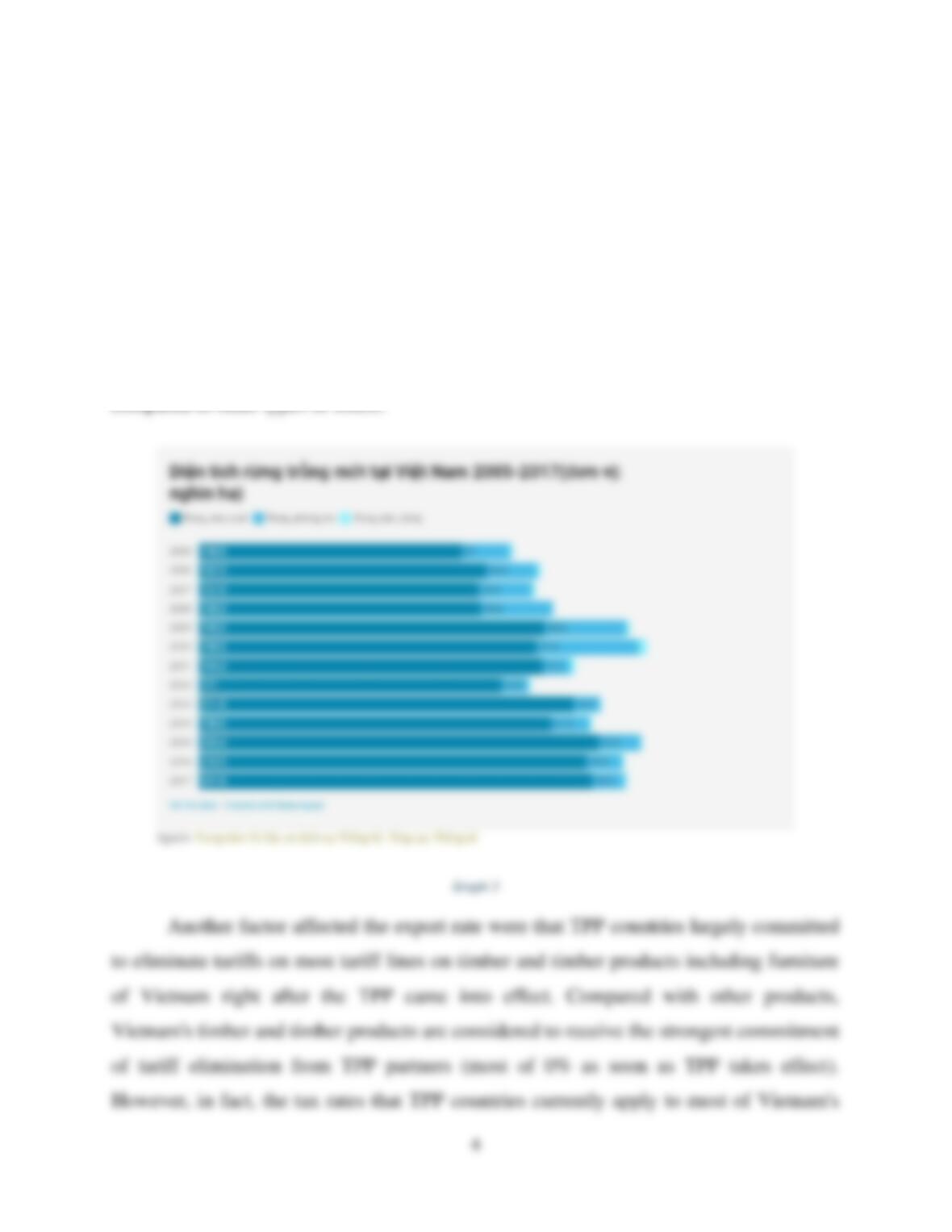
production. With the steady development in international integration over the years from
2001 to 2018, along with many FTAs, Vietnam’s furniture and parts thereof industry has
an easier access to the international market and its demand over the world. Natural
endowment gives Vietnam a huge advantage over other countries as it supplies the
producer the materials to produce furniture made from woods. Moreover, as the more and
more increasing usage of wood, the government and administration of Vietnam also
enacted some policies to protect and increase the usable production forest. As we can see
from the graph below, the proportion of new planted forest area was very big when