Research in Daily Life 2
❖ Human history abounds with problems. To be able to achieve that,
solutions must be based on knowledge, not on mere beliefs, guesses, or
theories. To acquire this knowledge it requires a well-
planned and systematic procedure and should be continuously
evaluated on its accuracy and usefulness. RESEARCH has been
devised to meet this need.
Research is a systematic and unbiased way of solving a
problem (Shone, 2015). It is a natural day-to-day activity of
gathering information to solve some day–to–day problems. It
may in the form of qualitative or quantitative.
➢ Qualitative researches are those studies in which the data
concerned can be described without the use of numerical
data
➢ Quantitativeresearch suggests that the data concerned can be
analyzed in terms of numbers.
Quantitative research designs use numbers in stating
generalizations about a given problem or inquiry in contrast to
qualitative research that hardly uses statistical treatment in stating
generalizations. The numbers in quantitative research are the
results of objective scales of measurements of the units of
analysis called variables.
Lesson 1: The Nature of Inquiry
➢ One goal of education is knowledge acquisition.
However, education is not just stocking your brain with
knowledge, but it also encourages you to use
acquired knowledge for a deeper understanding of the
world—an understanding that inspires you to create,
construct or produce things for the betterment of not only
your own life but of the whole world as well.
➢ Inquiry, a term that is synonymous with the word
‘investigation’. When you inquire or investigate, you tend to
ask questions to probe or examine something. You do this
kind of examination through your HOTS or higher-order
thinking strategies of inferential, analytical, critical,
creative, and appreciative thinking to discover more
understandable or meaningful things beyond such object of
your inquiry. Thinking in this manner makes you ask open-
ended questions to elicit views, opinions, and beliefs of
others in relation to your research. (Small 2012)
➢ Furthermore, according to Badke cited by Baraceros,
solving a problem, especially social issues, does not only
involves yourself but other members of the society
too. Whatever knowledge you have about the world
bears the influence of your cultural, sociological,
institutional, or ideological understanding of the world.
(Badke 2012)
Lesson 2: Research: An Overview
❖ Research can be a way of life; it is the basis for many
of the important decisions in our lives. Without it, we are
deluged with information, subjected to the claims of
advertisers, or influenced by hearsay in making sense of
the world around us. This informal, experiential research
helps us decipher the flood of information we encounter
daily.
❖ Formal academic research differs from experiential
research and can be more investigative in nature. For
example, it may require us to learn about an area in
which we have little knowledge or inclination to learn. It
may be library-oriented or field-oriented, depending on
the nature of the research.
❖ Research is a systematic process of collecting,
analyzing, and interpreting information to increase
our understanding of a phenomenon about which we are
interested or concerned (Leedy&Ormrod, 2013).
Why DO research?
1. Produce new knowledge of information
2. Utilize new knowledge
3. Validate existing knowledge
4. Improvement of the researcher
Lesson 3: Introduction to Research Design
Research design refers to the overall strategy that you
choose in order to integrate the different components of
the study in a coherent and logical way, thereby ensuring
you will effectively address the research problem.
Furthermore, a research design constitutes the blueprint
for the selection, measurement, and analysis of data.
Quantitative methods emphasize objective measurements
and the statistical, mathematical, or numerical analysis of
data collected through polls, questionnaires, and surveys, or
by manipulating pre-existing statistical data using
computational techniques.
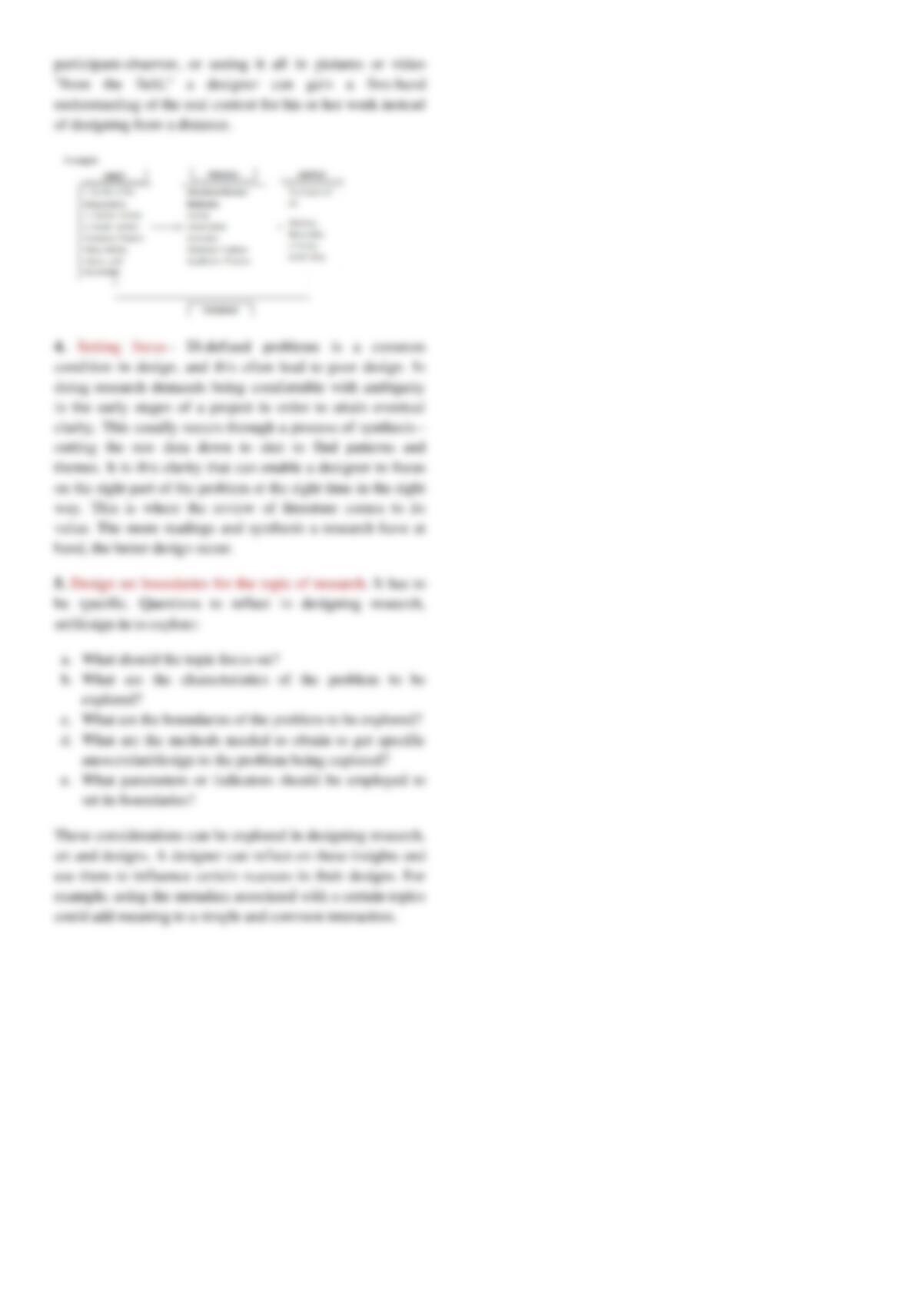
The kind of research is dependent on the researcher’s aim in
conducting the study and the extent to which the findings
will be used. Quantitative research designs are generally
classified into experimental and non-experimental as the
following matrix below.

Characteristics of Quantitative Research
• Emphasis on collecting and analyzing information
in the form of numbers
• Emphasis on collecting scores that measure distinct
attributes of individuals and organizations
• Emphasis on the procedures of comparing groups
or relating factors about individuals or groups in
experiments, co relational studies, and surveys
Research Design
This allows the researcher to control the situation. In
doing so, it allows the researcher to answer the question,
“What causes something to occur?” This kind of research
also allows the researcher to identify cause and affect
relationships between variables and to distinguish placebo
effects from treatment effects. Further, this research design
supports the ability to limit alternative explanations and
to infer direct causal relationships in the study; the
approach provides the highest degree level of evidence for
single studies.
Types of Experimental Design
1. PRE-EXPERIMENTAL DESIGN. A type of research
applies to an experimental design with the least internal
validity. One type of pre-experiment, the simple group, pre-
test-post-test design, measures the group two times, before
and after the intervention.
❖ Instead of comparing the pretest with the posttest within one
group, the posttest of the treated groups is compared with that
of an untreated group. Measuring the effect as the difference
between groups marks this as between-subjects design.
Assuming both groups experienced the same time-related
influences, the comparison group feature should protect this
design from the rival explanations that threaten the within-
subject design.
2. QUASI-EXPERIMENTAL DESIGN – the researcher
can collect more data, either by scheduling more
observations or finding more existing measures. Quasi-
experimental design involves selecting groups, upon which
a variable is tested, without any random pre-selection
processes. After this selection, the experiment proceeds in a
very similar way to any other experiment, with a variable
being compared between different groups, or over a
period of time.
There are twotypes of quasi-experimental design, these are:
• Non-Equivalent Control Group. This refers to the
chance failure of random assignment to equalize
the conditions by converting a true experiment into
this kind of design, for purpose of analysis.
• Interrupted Time Series Design. It employs
multiple measures before and after the
experimental intervention. It differs from the
single-group pre-experiment that has only one
pretest and one posttest. Users of this design
assume that the time threats such as history or
maturation appear as regular changes in the
measures prior to the intervention.
3. TRUE-EXPERIMENTAL DESIGN. It controls for both
time-related and group-related threats. Two features
mark true experiments: two or more differently treated
groups; and random assignment to these groups. These
features require that the researchers have control over
the experimental treatment and the power to place
subjects in groups. The true experimental design employs
both treated and control groups to deal with time-related
rival explanations.
A control group reflects changes other than those due to
the treatment that occurs during the time of the study. Such
changes include effects of outside events, maturation by the
subjects, changes in measures, and the impact of any pre-
tests.
The true experimental design offers the highest internal
validity of all the designs. Quasi-experimental design
differs from a true experimental design by the absence of a
random assignment of subjects to different conditions.
What quasi-experiments have in common with true
experiments is that some subjects receive an intervention
and provide data likely to reflect its impact.
Non-experimental Research Design
In this kind of design, the researcher observes the
phenomena as they occur naturally and no external
variables are introduced. Thevariables are not
deliberately manipulated nor is the setting controlled.
Researchers collect data without making changes or
introducing treatments. This may also be called a
DESCRIPTIVE RESEARCH DESIGN because it is only
one under non-experimental design.
DESCRIPTIVE RESEARCH DESIGN’s main purpose is to
observe, describe, and document aspects of a situation as
it naturally occurs and sometimes to serve as a starting
point for hypothesis generation or theory development.
The types of descriptive design are as follows:
• Survey – it is used to gather information from
groups of people by selecting and studying
samples chosen from a population. This is useful
when the objective of the study is to see the
general picture of the population under
investigation in terms of their social and economic
characteristics, opinions, and their knowledge
about the behavior towards a certain phenomenon.
• Correlational – It is conducted by researchers
whose aim would be to find out the direction,

associations, and/or relationship between
different variables or groups of respondents
under study.
• Ex-post facto / Causal Comparative – this kind of
research derives a conclusion from observations
and manifestations that already occurred in the
past and now compared to some dependent
variables. It discusses why and how a
phenomenon occurs.
• Comparative – it involves comparing and
contrasting two or more samples of study
subjects on one or more variables, often at a
single point of time. Specifically, this design is
used to compare two distinct groups on the basis
of selected attributes such as knowledge level,
perceptions, and attitudes, physical or
psychological symptoms.
Quantitative research is an objective, systematic empirical
investigation of observable phenomena through the use
of computational techniques. It highlights the numerical
analysisof data hoping that the numbers yield unbiased
results that can be generalized to some larger population
and explain a particular observation. Simply, quantitative
research is concerned with numbers and their
relationship with events.
Your goal in conducting a quantitative research study is to
determine the relationship between one thing (an
independent variable) and another (a dependent or
outcome variable) within a population. Quantitative
research designs are either descriptive (subjects usually
measured once) or experimental (subjects measured before
and after treatment). A descriptive study establishes only
associations between variables; an experimental study
establishes causality.
Its main characteristics are:
1. The data is usually gathered using structured research
instruments.
2. The results are based on larger sample sizes that are
representative of the population.
3. The research study can usually be replicated or repeated, given
its high reliability.
4. The researcher has a clearly defined research question to
which objective answers are sought.
5. All aspects of the study are carefully designed before data is
collected.
6. Data are in the form of numbers and statistics, often arranged
in tables, charts, figures, or other non-textual forms.
7. Project can be used to generalize concepts more widely,
predict future results, or investigate causal relationships.
8. The researcher uses tools, such as questionnaires or computer
software, to collect numerical data.
❖ Quantitative research makes you focus your mind on specific
things by means of statistics that involve the collection and study
of numerical data. Thus, to give the basic meaning of quantitative
research is to say that research is a way of making any
phenomenon or any sensory experience clearer or more meaningful
by gathering and examining facts and information about such
person, thing, place, or event appealing to your senses. You use
mathematical operations of addition, subtraction, division, and
multiplication to study and express relationships between quantities
or magnitudes shown by numbers or symbols. Involving
measurements and amounts, quantitative research seeks to find
answers to questions starting with how many, how much, how
long, to what extent, and the like. Answers to these questions
come in numerals, percentages, and fractions, among others.
(Suter 2012; Russell 2013)
Characteristics of Quantitative Research
❖ Since quantitative research uses numbers and figures to denote a
particular thing, this kind of research requires you to focus your
full attention on the object of your study. Doing this, you tend to
exclude your own thoughts and feelings about the subject or object.
This is why quantitative research is described as objective research
in contrast to qualitative research that is subjective. Characterized
by objectiveness, in which only the real or factual, not the
emotional or cognitive existence of the object matters greatly to the
artist, quantitative research is analogous to scientific or
experimental thinking. In this case, you just do not identify
problems but theorize, hypothesize, analyze, infer, and create as
well. Quantitative research usually happens in hard sciences
like physics, chemistry, biology, and medicine; qualitative
research, in soft sciences such as humanities, social sciences,
education, and psychology, among others.
Other characteristics of Quantitative Research are as follows:
1. OBJECTIVE. Quantitative research seeks
accurate measurement and analysis of target
concepts. It is not based on mere intuition and
guesses. Data are gathered before proposing a
conclusion or solution to a problem.
2. CLEARLY DEFINED RESEARCH
QUESTIONS. The researchers know in advance
what they are looking for. The research questions
are well-defined for which objective answers are
sought. All aspects of the study are carefully
designed before data are gathered.
3. STRUCTURED RESEARCH
INSTRUMENTS. Standardized instruments guide
data collection, thus, ensuring the accuracy,
reliability, and validity of data. Data are normally
gathered using structured research tools such as
questionnaires to collect measurable
characteristics of the population like age, socio-
economic status, number of children, among
others.
4. NUMERICAL DATA. Figures, tables, or graphs
showcase summarized data collection in order to
show trends, relationships, or differences among
variables. In sum, the charts and tables allow you
to see the evidence collected.
5. LARGE SAMPLE SIZES. To arrive at a more
reliable data analysis, a normal population
distribution curve is preferred. This requires a
large sample size, depending on how the
characteristics of the population vary. Random
sampling is recommended in determining the
sample size to avoid the researcher’s bias in
interpreting the results.
6. REPLICATION. Quantitative methods can be
repeated to verify findings in another setting thus
strengthen and reinforce the validity of findings
eliminating the possibility of spurious conclusions.
7. FUTURE OUTCOMES. By using complex
mathematical calculations and with the aid of
computers, if-then scenarios may be formulated
thus predicting future results. Quantitative research
puts emphasis on proof, rather than discovery.
Strengths and Weaknesse s
The strengths of quantitative research include the following:
1. It is objective. The most reliable and valid way of
concluding results, giving way to a new hypothesis,
or to disproving it.
2. The use of statistical techniques facilitates
sophisticated analyses and allows you to
comprehend a huge amount of vital characteristics
of data.
3. It is real and unbiased. .
4. The numerical data can be analyzed in a quick and
easy way.
5. Quantitative studies are replicable. Standardized
approaches allow the study to be replicated in
different areas or over time with the formulation of
comparable findings.
6. Quantitative experiments are useful for testing the
results gained by a series of qualitative
experiments, leading to a final answer, and
narrowing down of possible directions to follow.
The weaknesses of quantitative research are as follows:
1. Quantitative research requires a large number of
respondents. It is assumed that the larger the
sample is, the more statistically accurate the
findings are.
2. It is costly.
3. The information is contextual factors to help
interpret the results or to explain variations are
usually ignored. It does not consider the distinct
capacity of the respondents to share and elaborate
on further information, unlike qualitative research.
4. Much information is difficult to gather using
structured research instruments, specifically on
sensitive issues like pre-marital sex, domestic
violence, among others.
5. If not done seriously and correctly, data from
questionnaires may be incomplete and inaccurate.
Researchers must be on the look-out on
respondents who are just guessing in answering the
instrument.
The Nature and Use of Variables in Research
The term ‘variable’ has been mentioned several times so that
it is necessary to define it here. In research, a variable refers
to a “characteristic that has two or more mutually
exclusive values or properties” (Sevilla and Other, 1988).
The root word of the word variable is “vary” or simply “can
change”. These variables are among the fundamental
concepts of research, alongside measurement, validity,
reliability, cause and effect; and theory. Bernard (1994)
defines a variable as something that can take more than one
value, and values can be words or numbers.
A variable specifically refers to characteristics or attributes
of an individual or an organization that can be measured or
observed, and that varies among the people or organizations
being studied (Creswell, 2002).
Kinds of Variables
1. INDEPENDENT VARIABLES – Those that probably
cause, influence, or affect outcomes. They are invariably
called treatment, manipulated, antecedent, or predictor
variables. This is the cause variable or the one responsible
for the conditions that act on something else to bring about
changes.
EXAMPLE: A study is on the relationship between study
habits and academic performance of UTNHS senior high
school students. STUDY HABITS is the independent
variable because it influenced the outcome or the
performance of the students.
2. DEPENDENT VARIABLES – those that depend on the
independent variables; they are the outcomes or results of
the influence of the independent variable. That is why it is
also called the outcome variable.
EXAMPLE: A study is on the relationship between study
habits and academic performance of UTNHS senior high
school students. ACADEMIC PERFORMANCE is the
dependent variable because it is depending on the study
habits of the students; if the students change their study
habit the academic performance also changes.
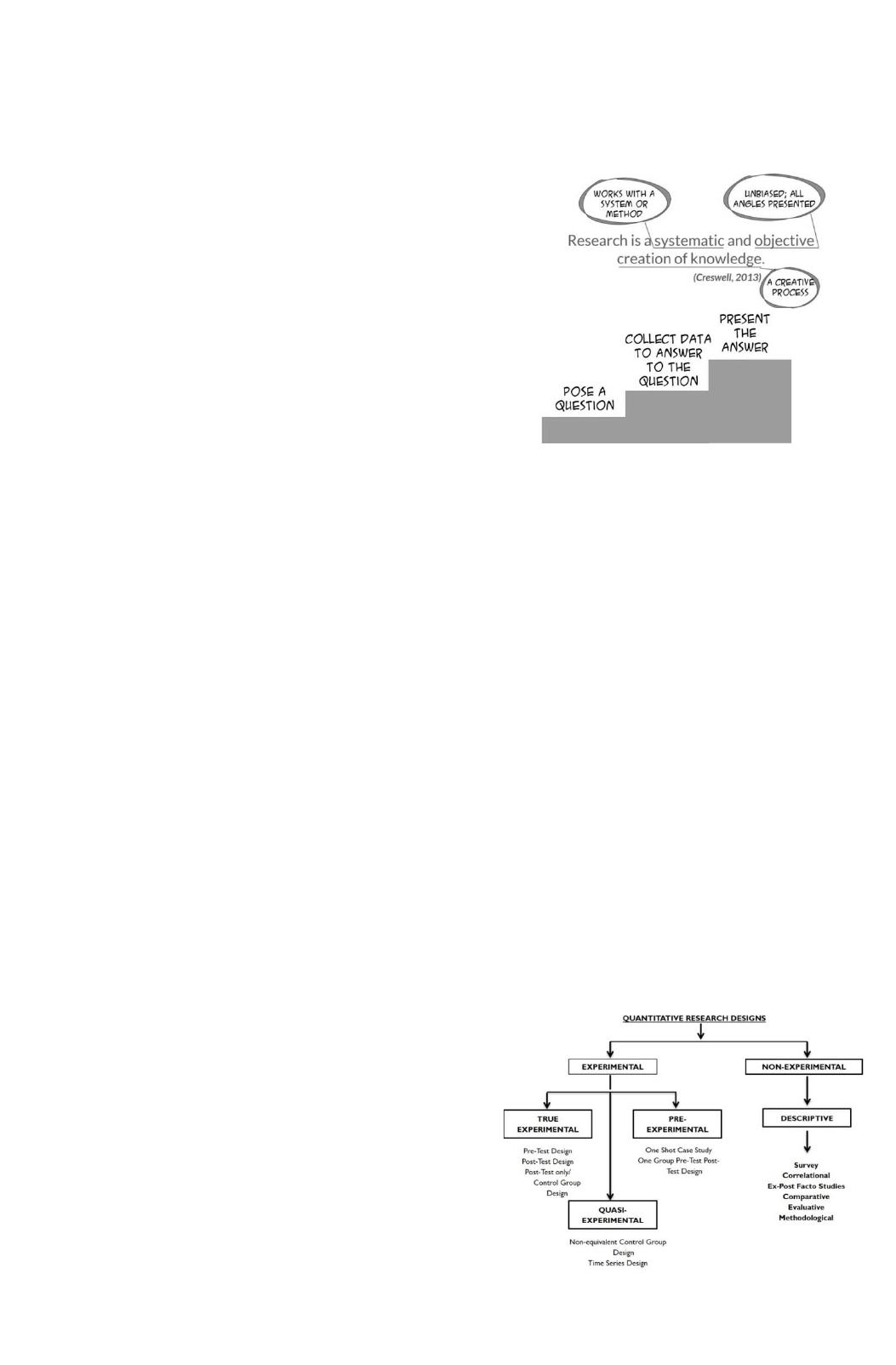
3. INTERVENING OR MEDLING VARIABLES –
Variables that “stand between” the independent and
dependent variables, and they show the effects of the
independent variable on the dependent variable.
EXAMPLE: Consider the given below. Even if farm
production is good, if the attitude towards payment is
negative, loan repayment would be low, whereas, if the
attitude towards repayment is positive or favorable, loan
repayment would be high.
4. CONTROL VARIABLES – Special types of
independent variables that are measured in the study
because they potentially influence the dependent variable.
Researchers use statistical procedures (e.g. analysis of
covariance) to control these variables. They may be
demographic or personal variables that need to be
“controlled” so that the true influence of the independent
variable on the dependent variable can be determined.
5. CONFOUNDING VARIABLES – Variables that are
not actually measured or observed in a study. They exist
but their influence cannot be directly detected in a study.
Researchers comment on the influence of confounding
variables after the study has been completed, because these
variables may have operated to explain the relationship
between the independent variables and dependent variable,
but they were not or could not be easily assessed.
Module 2 – IDENTIFYING THE INQUIRY AND
STATING THE PROBLEM
Lesson 1: Research Topic Area Identification
Identify a good topic area for research
Research begins with an inquiry (a question, a problem, or
an issue) which leads further to a discovery (an answer, a
solution, or a clarification). In answering at discovery, the
person must be guided by the standards in the discipline
(theories, concepts, principles, models) so that the research
will be valid, scientifically done, and acceptable in the field.
Here are the following good topic areas for research:
1. Research’s observations, interests, and experiences
➢ Beginning researchers can make use of their own
experiences, in whatever environment they may be, as a
fertile source of topics for research. Realistically, you
have to select something that you are interested in since
you are going to commit yourself to a significant
investment of time and energy. Thus if you are not
personally interested, it will be difficult to sustain the
effort needed to complete the research with any measure
of quality or validity. Research topics may come from
problems arising from daily life situations.
2. Deductions from theories
The close connection between theory and research cannot be
research problems. Because of these conflicting results from
previous studies, the results were not that conclusive. Thus,
this can be a good source of a research problem. These
studies may be replicated to see if changes in research
design or situations or even involving other variables in the
study will surface some changes in the results.
Identify the research focus
➢ There is a need to clarify or narrow down the identified
topic area. A topic area such as “Students can’t read.” is
not clear because many aspects of reading, including
discrete reading skills and strategies, may contribute to
reading difficulties. Alternatively, “Students cannot find
the main idea in reading passages,” is much clearer and
potentially much easier to measure and address, since
one can define the main idea and determine student
performance related to this behavior in a number of
ways.
➢ Your chosen research focus must have your interest
sustained and your imagination stimulated yet it must be
relevant enough for it to merit the investigation.
Consider knowledge and experience in the identified
topic area. Required data can be made available to the
researcher and the entire research agenda manageable in
size. Expected results must have the potential to
contribute to the existing literature in terms of
theories, practices, and policies.
➢ Clarifying the focus of the problem may be done by
identifying the areas (specific problems) affected by it.