Journal of Economics and Development Vol. 20, No.1, April 201832
Journal of Economics and Development, Vol.20, No.1, April 2018, pp. 32-47 ISSN 1859 0020 | DOI: 10.33301/JED-P-2018-20-01-02
Impact of Globalization on Economic
Growth in Vietnam: An Empirical Analysis
Tran Tho Dat
National Economics University, Vietnam
Email: tranthodat@neu.edu.vn
Nguyen Thi Cam Van
National Economics University, Vietnam
Email: ncvantkt@neu.edu.vn
Abstract
This study aims at investigating the impact of globalization on economic growth in the case
of Vietnam. Empirical analysis is done by using time series data for the period from 1995 to
2014. The paper tested the stationary cointegration of time series data and utilized the error
correction modeling technique to determine the short run relationships among economic growth,
globalization, foreign direct investment, balance of trade and exchange rate variables. Then,
the long run relationship between economic growth and the variables representing economic
integration were estimated by ordinary least square. The results show that globalization, measured
by the KOF index, promotes economic growth and Vietnam has gained from integrating into
the global economy. The overall index of globalization had positively and significantly impacted
the economic growth in Vietnam. The results also indicated that economic globalization had a
significantly positive effect on economic growth in the period examined. The study further revealed
that foreign direct investment and the exchange rate affect economic growth positively whereas
balance of trade affects economic growth negatively.
Keywords: Globalization; economic growth; trade balance; foreign direct investment;
cointegration.
JEL code: F63, O47, C32.
Received: 13 October 2017 | Revised: 15 December 2017 | Accepted: 1 Febuary 2018

Journal of Economics and Development Vol. 20, No.1, April 201833
1. Introduction
Globalization reflects an ongoing process of
greater interdependence among countries and
their citizens (Fischer, 2003). There are four
main driving forces behind increased interde-
pendence: trade and investment liberalization,
technological innovation and the reduction of
communication costs, entrepreneurship, and
global social networks. Globalization is de-
scribed as the growing economic interdepen-
dencies of countries worldwide through the
increasing volume and variety of cross-border
transactions in goods and services and of inter-
national capital flows, as well as through the
rapid and widespread diffusion of technology
and information. As a multidimensional con-
cept, globalization expresses the extension pro-
cess of economic, political and social activities
across national borders.
Today, there are two main views on glo-
balization, one given by anti-globalists and
the other by supporters of globalization. The
anti-globalists view globalization as a con-
trolling and influencing force used by overseas
corporations to dominate international trade
(Konyeaso, 2016). Western organizations have
throughout the years increased their commit-
ments in developing countries due to this be-
ing more profitable for them. One reason is
due to the large quantity of resources found in
these parts of the world. Many highly global-
ized developing countries have not been able
to profit from globalization and are still facing
the same problems they have been facing for
many decades. According to the globalists, glo-
balization is viewed as a beneficial process. It
is presumed the only true way to beat poverty
(Konyeaso, 2016). They argue that one of the
main characteristics of globalization is greater
trade in goods and services both between na-
tions and within regions. Many of the industri-
alizing countries are winning a rising share of
world trade and their economies are growing
faster than in richer developed nations, espe-
cially after the global financial crisis. Anoth–
er important characteristic of globalization is
the increasing transfers of capital, including
the expansion of foreign direct investment, by
trans-national companies and the rising influ–
ence of sovereign wealth funds. Foreign direct
investment will help developing nations to in-
dustrialize, create jobs, bring business opportu-
nities, and acquire manufacturing skills (Kon-
yeaso, 2016).
Globalization could be either a success or
a failure depending on its management (Sti-
glitz, 2002). There is success when it is well
managed, for instance in the case of East Asian
countries. Their success is based on exports,
closing technological, capital and knowledge
gaps. However, there is failure when global-
ization is managed by international economic
institutions. Stiglitz argued that the problem is
not with globalization but with how it is man-
aged by international institutions who set the
rules of the game.
Following the globalization trend, Vietnam
has made considerable efforts for economic in–
tegration with the world since the late 1980s.
Vietnam joined ASEAN, APEC, and ASEM
in 1995, 1998, and 2001. The country contin-
ues to move toward greater international eco-
nomic integration, through more opening up
of trade with China, expanding bilateral links
with the US, accessing the WTO in 2007, and
signing the TPP in 2015. In addition to a more

Journal of Economics and Development Vol. 20, No.1, April 201834
open trade policy, Vietnam has improved the
investment environment to attract foreign di-
rect investment. In Vietnam, trade and foreign
investment are the two strongest linkages to
the global economy. In more than 20 years,
Vietnam has made a number of convincing
economic achievements. The average annu-
al economic growth rate was 6.5 percent over
the period 1995 – 2016. In 1995, Vietnam’s
GDP per capita of US$ 288 placed it among
the poorest countries in the world. In 2008, a
GDP per capita of US$ 1164 led to Vietnam’s
attainment of lower middle-income status by
the World Bank classification. In the year 2016,
GDP per capita reached US$ 2185. Economic
growth in Vietnam has been accompanied by
trade liberalization reforms that have led to an
explosion in international trade. Exports as a
share of GDP grew from 32.81 percent in 1995
to 93.62 percent in 2016, while imports grew
from 41.91 percent to 91.06 percent over that
same period. The key to the remarkable gains
of the Vietnamese economy is the liberalization
of domestic markets, foreign investment attrac-
tion, a trade openness policy and other macro-
economic policies.
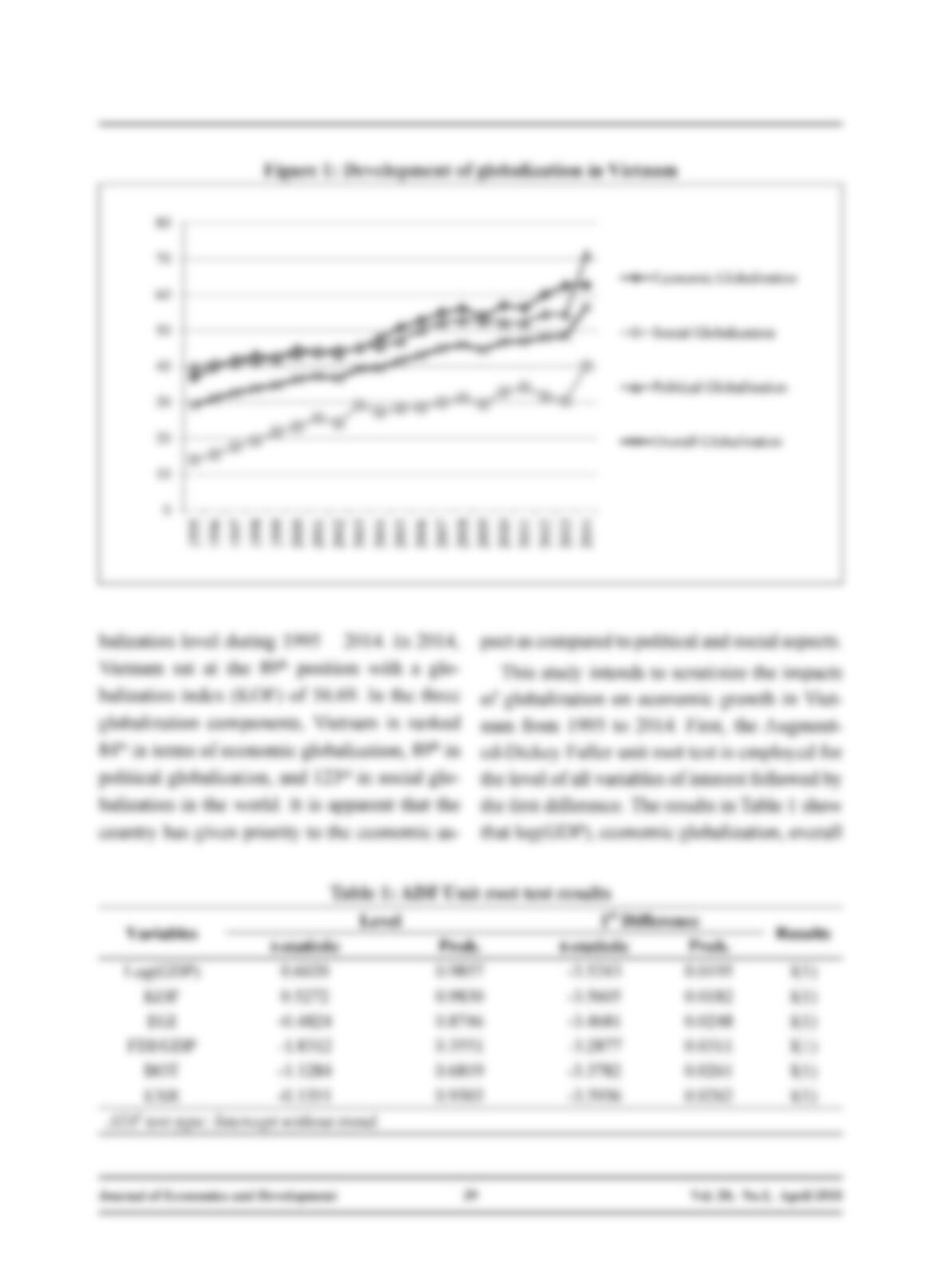
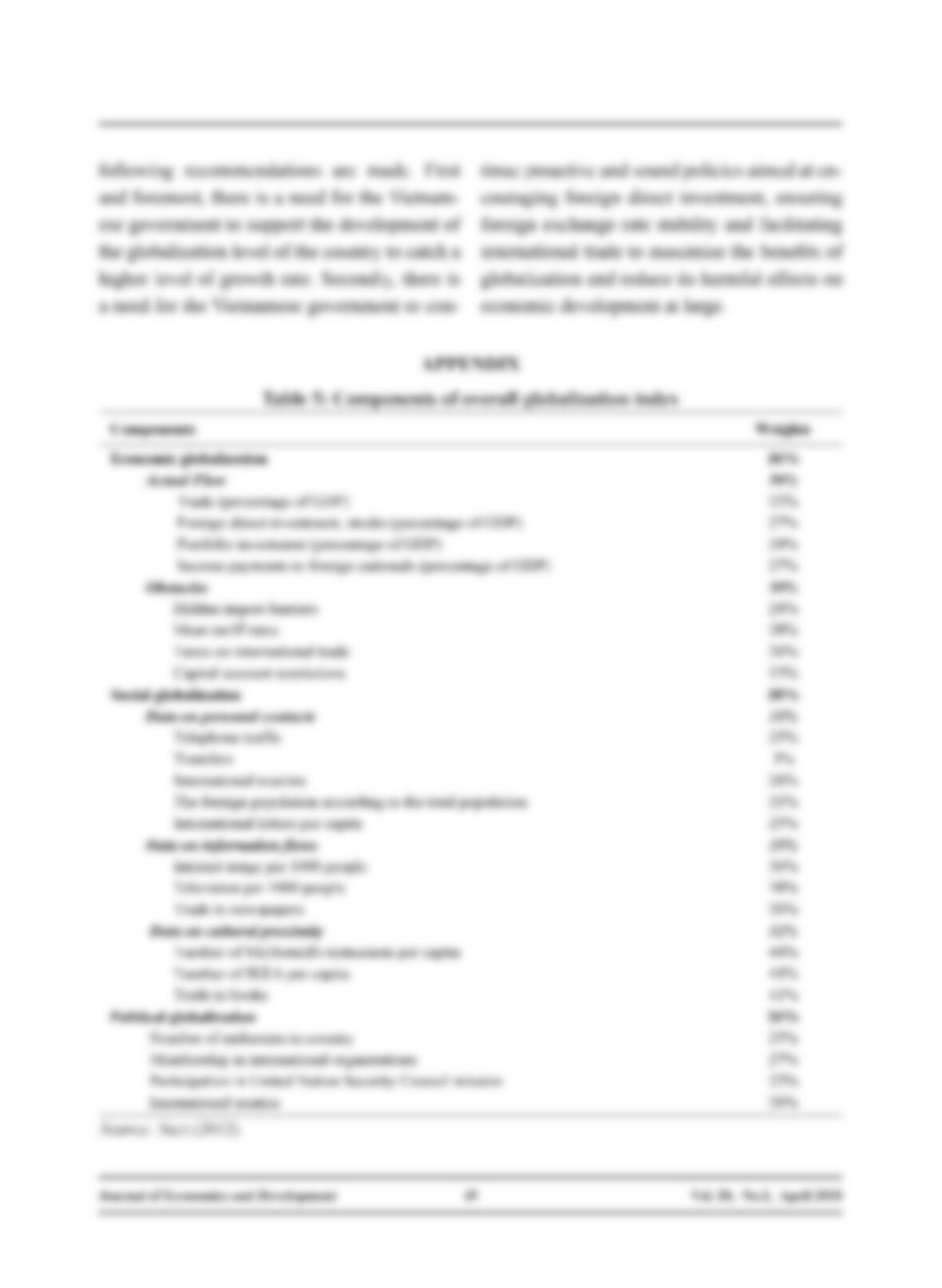
Vietnam has experienced an increasing lev-
el of the overall globalization index (KOF),
from 29.29 in 1995 to 56.69 in 2014. Due to
the increasing trend of globalization, finding
the effect of globalization on economic growth
is most important. However, the relationship
between globalization and economic growth in
Vietnam has not been deeply evaluated by pre-
vious researchers (for example John Thoburn
(2004), Jenkins (2006), and Pham Lan Huong
(2013) etc.) and there is apparently a need to
fill this research gap. Therefore, the aim of this
study is to investigate the impact of globaliza-
tion on economic growth in Vietnam for the pe-
riod from 1995 to 2014.
This paper is organised as follows: after a
short literature review of relevant studies on the
impact of globalization on economic growth,
the methodology of the study is presented. The
next section exposes the main findings, and the
final section concludes the paper with several
policy recommendations.
2. Literature review
The relationship between globalization and
growth is a heated and highly debated topic in
the growth and development literature. Econo-
mists have long been interested in determining
how globalization affects economic growth.
Theoretical growth studies report a contradic-
tory discussion on the relationship between
globalization and growth. Some of the stud-
ies found a positive effect of globalization on
growth, others argued that globalization has
a harmful effect on growth. Despite the con–
flicting theoretical views, many studies have
empirically examined the impact of globaliza-
tion on economic growth in developed coun-
tries as well as in developing ones. Many of
them appeared after 2006 when Dreher intro-
duced a new comprehensive index of global-
ization – KOF (an acronym for the German
word “Konjunkturforschungsstelle”). The
overall globalization index (KOF) covers the
economic, social and political dimensions of
globalization. Economic globalization is char–
acterized as long-distance flows of goods, cap–
ital and services, information and perceptions
that accompany market exchanges. Political
globalization is characterized by a diffusion
of government policies. Social globalization is

Journal of Economics and Development Vol. 20, No.1, April 201835
expressed as the spread of ideas, information,
images and people (Fidelis, 2012).
There have been numerous studies on the
effects of globalization on economic growth.
Dreher (2006) examined the impact of global-
ization on the growth of 123 countries between
1970 and 2000. Ordinary Least Squares (OLS)
regression and Generalized Method of Moment
(GMM) techniques have been used for the anal-
ysis. The overall result showed that globaliza-
tion promotes economic growth. The economic
and social dimensions have a positive impact
on growth whereas the political dimension has
no effect on growth.
Zhuang and Koo (2007) used a panel data-
set covering 56 countries in the period from
1991 to 2004 to investigate the effects of glo–
balization on economic growth. The variables
include GDP growth rate, labor, capital, foreign
direct investment, portfolio capital flow, trade,
consumer price indices, per capita GDP, hu-
man capital, indicators of technology, and real
exchange rates. By using the generalized least
squares estimation, results strongly suggest
that economic globalization has a significant–
ly positive effect on economic growth for all
countries.
Rao and Vadlamannati (2009) examined the
impact of globalization on the growth rate of
21 poor African countries during 1970 – 2005.
The variables used in the study include log(out-
put per worker), log(capital per worker), index
of globalization, index of institutional reforms,
the rate of inflation and the ratio of current gov–
ernment expenditure to GDP. They employed a
systems GMM method of estimation and found
a small but significant positive association be–
tween globalization and economic growth in 21
low-income African countries.
Kakar (2011) determined the long run effect
of globalization on economic growth in Paki-
stan from the year 1980 to 2009 by employing
the time series data, co-integration and error
correction technique. The variables include
GDP growth rate, foreign direct investment
inflow, population growth rate, real effective
exchange rate, government expenditure on
education and health as a percentage of GDP
and trade as a percentage of GDP. The results
show that globalization can be a useful tool for
economic growth for a developing country like
Pakistan.
Plegrinova et al. (2012) studied the rela-
tionship between globalization and important
macroeconomic indicators in twelve developed
countries on the European and North American
continents from 1995 to 2009. They considered
the effect of rising FDI, balance of payments
and GDP per capita on the KOF globalization
index. By using nonparametric regression mod-
el (panel data regression), the results indicate
that there is a statistically significant relation–
ship between the KOF index of globalization
and foreign direct investments as well as GDP
per capita. They could not accept the hypothe-
sis of a statistically significant relationship be–
tween the KOF index of globalization and the
balance of payments of selected countries.
Umaru (2013) analyzed the effects of glo–
balization on Nigeria’s economic performance
between the years 1962 and 2009 by using
the Annual Average Growth Rate technique.
He found that globalization affects the petrol,
manufacturing industry and solid mineral sec-
tors in negative ways, but it effects the agricul–
ture, transportation and communication sectors
in positive ways. Konyeaso (2016) also stud-
ied the impact of globalization on the Nigerian
economy between 1986 and 2013. By using the
multiple regression technique, the results show
that there is a positive relation between glo-
balization and economic growth. The Nigerian
economy is gaining from globalization main-
ly due to foreign direct investment and trade
openness.
Chelly and Deluna (2014) examined the re-
lationship among economic growth, financial
and trade globalization in the Philippines from
1980 to 2011. The variables considered in the
study include real GDP growth rate, financial
openness (the sum of FDI inflow and external
debts divided by GDP) and trade openness (the
trade to GDP ratio). The study used the Vector
Autoregressive VAR(1) model and the Grang-
er Causality test. It was found that the current
value of GDP is positively affected by the pre–
vious value of itself and trade openness. The
dex of globalization (KOF) had a positive and
significant impact on economic growth in the
region. Economic and political globalization
positively impacted the economic growth but
social globalization did not affect growth. In–
flation, infrastructure, quality of education,
technological preparedness, and government
spending also had positive impacts on econom-
ic growth.
Olimpia Neagu (2017) studied the impact of
globalization on economic growth in Romania
for a time span of 24 years between 1990 and
2013. In order to highlight the impact of glo-
balization, expressed by the KOF globalization
index and its components, on the economic
growth rate, the author estimated an econo-
metrical model and found a statistically strong
and positive link between the GDP per capita
dynamics and the overall globalization index
as well as between the GDP growth rate and
economic and political globalization. Howev-