Incident Reports
Table of Contents
(ctrl+click on text to go directly to section)
Function/Purpose ………………………………………………………………………………………………………… 1
When to Report …………………………………………………………………………………………………………… 1
OSHA Recordkeeping Requirements ……………………………………………………………………………… 1
Who Should Report ……………………………………………………………………………………………………… 2
Employee Responsibility ………………………………………………………………………………………………. 2
Supervisor Responsibility ……………………………………………………………………………………………… 2
Tips for Reporting Incidents ………………………………………………………………………………………….. 3
Instructions for Completion of Form ……………………………………………………………………………….. 3
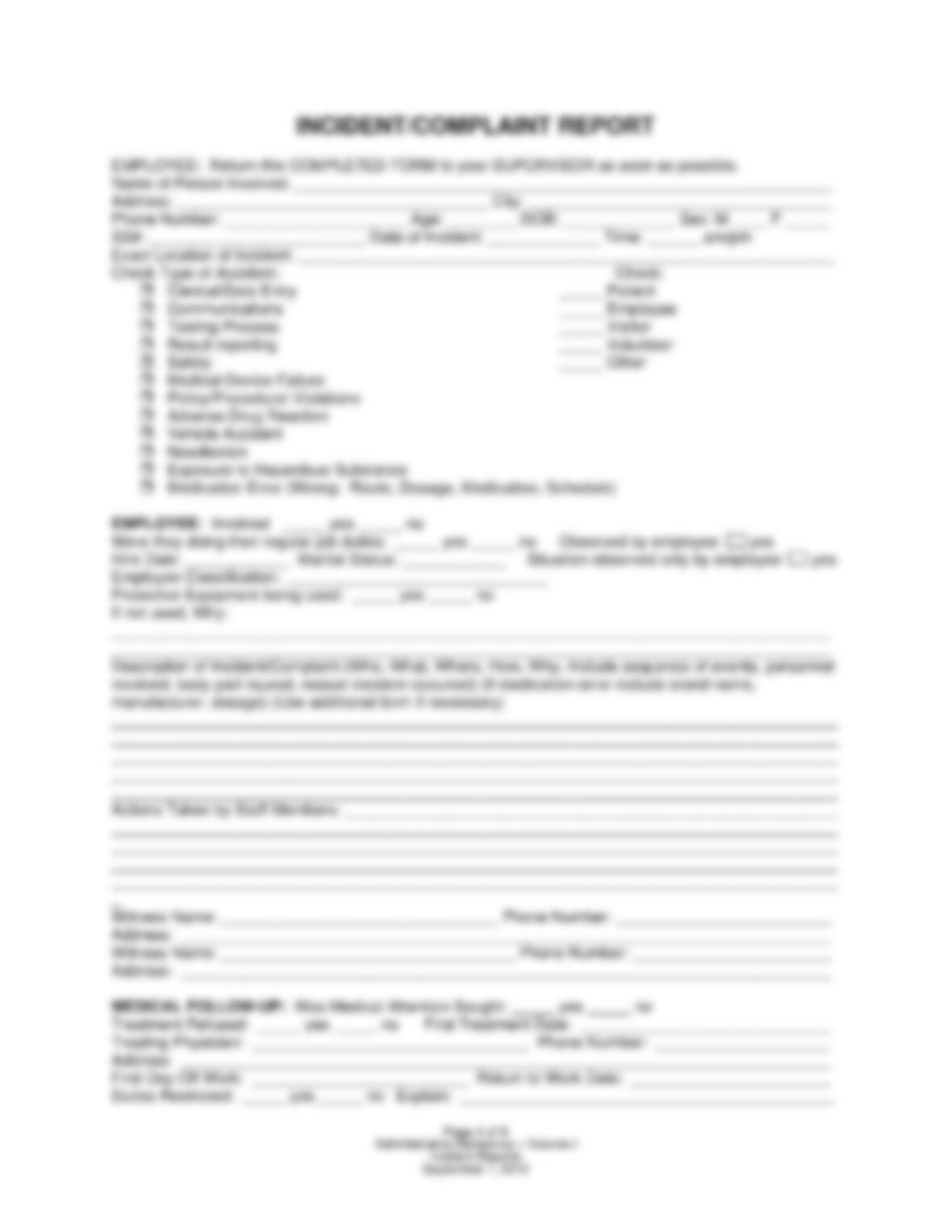
Incident/Complaint Report …………………………………………………………………………………………….. 4
Laboratory Incident Report ……………………………………………………………………………………………. 6
Post-Exposure Incident Source Individual Consent Form …………………………………………………… 8
Post-Exposure Incident Exposed Employee Consent Form ……………………………………………….. 9
Page 1 of 9
Administrative Reference – Volume I
Incident Reports
September 1, 2012
INCIDENT REPORTS
Function/Purpose
An incident report is not part of the patient’s chart, but it may be used later in litigation. A report
has two functions:
1. It informs the administration of the incident so management can prevent similar incidents
in the future.
2. It alerts administration and the facility’s insurance company to a potential claim and the
need for investigation.
Regulations issued under OSHA require all employers with more than ten employees at any
time during the previous calendar year to maintain records of recordable occupational injuries
and illnesses.
When to Report
Incidents that must be reported and documented include:
1. Exposure Incidents: skin, eye, mucous membrane or parental contact with blood or
other potentially infectious materials that may result from the performance of an
employee’s duties.
2. Accident, Injury: patient, visitor, employee slips or falls, or other incident, which results
or may result in injury.
3. Event, Behaviors, or Actions: incidents that are unusual, contrary to agency policy or
procedure or which may result in injury.
4. Vaccine Adverse Event Reporting System: reaction to vaccine administered at agency
(use VAERS form, instructions and sample in Immunization section).
5. Medication reaction: reaction to any drug administered at or provided by health
department. Complete Adverse Drug Reaction Form. For more information,
call 1-800–332–1088.
6. Property damage or missing articles.
7. Administration of wrong medication or vaccine.
8. Improper administration of medication or vaccine.
OSHA Recordkeeping Requirements
OSHA 300 Log-recordable and nonrecordable injuries are distinguished by the treatment
provided; i.e., if the injury required medical treatment, it is recordable; if only first aid was
required, it is not required, it is not recordable. However, medical treatment is only one of
several criteria for determining recordability. Regardless of treatment, if the injury involved loss
of consciousness, restriction of work or motion, transfer to another job or termination of
employment, the injury is recordable. An explanation, with examples, is included on the
backside of the OSHA 300 Form.
Who Should Report
Only people who witness the incident should fill out and sign the incident report. Each
witness should file a separate report. Once the report is filed, the nursing supervisor,
department heads, administration, the facility’s attorney, and the insurance company may
review it.
Because incident reports will be read by many people and may even turn up in court, you
must follow strict guidelines when completing them. If an incident report form does not
leave enough space to fully describe an incident, attach an additional page of comments.
Document the incident as it occurred in the patient’s medical record, “Incident Report
Completed” should never appear in the patient’s record. The incident report should never
be referred to in any way in the medical record.
Employee Responsibility
All employees are responsible for preparing an incident report as soon as possible and
reporting immediately to their supervisor or in the supervisors absence report to the
administration any incident or injury including near misses. Recommendations and