FOREIGN TRADE UNIVERSITY
VJCC INSTITUTE
———***——–
GROUP 1
REPORT ON
INTERNATIONAL BRANDING PROJECT
BITI’S EXPANSION IN CAMBODIA
Student Name- ID:
Pham Minh Ngoc – 1715520076
Nguyen Ngoc Son – 1715520056
Nguyen Thi Ngoc Tram – 1715520069
Nguyen Phuong Thao Anh – 1715520007
Pham Le Thao Chi – 1715520012
Nguyen Ngoc Huyen – 1715520028
Ho Thi Yen Chi – 1715520010
Class: K56 JIB
Instructor: MSc. Doan Anh Tuan
MSc. Tran Hong Hanh
Hanoi
, November 11st, 2020

Tables of content
1
Contents
Page
Abstract
2
I. Introduction
3
1. About the brand Biti’s
3
2. About the market Cambodia
3
II. Market potential
4
1. Some potential markets evaluation overview
4
2. Cambodia market evaluation
5
III. Penetration strategy
8
1. 3C analysis
8
2. Focus products
9
3. Customer-based brand equity
9
4. Standardization and customization strategy
11
IV. Conclusion
13
1. Highlight
13
2. Limitations and reasons
13
References
14

ABSTRACT
Biti’s, one of the Vietnamese high-quality brands, has introduced its products
in Cambodia since the 2000s through a local distributor and won local customers’
trust. On September 7, Bitis launched its first official store in Phnom Penh, Cambodia,
marking its official presence on the market. However, in the current time, Bitis’ image
is not of high awareness of Cambodia people due to their preference of Thailand and
Chinese products. For this reason, in this report, our group has caught up with some
recommendation for the Bitis brand to penetrate this potential market in a more
successful way. The report is divided into four relative parts: Introduction, Market
potential, Market penetration and Conclusion. In the first place, we will give out the
overall understanding of the brand Bitis and the market Cambodia. To conduct the
second part, we will analyse how the potential Cambodia market is by comparing
among those markets such as China, Thailand, Indonesia and the USA. From that, we
will analyze some economic indicators of the Cambodia market. The third part is our
strategic solutions for Cambodia to implement including 3C models, customization
and standardization, building brand equity strategy. Last is our conclusion for the
whole report, we will synthesize the main and important ideas.
2

I. INTRODUCTION
1. About the brand Biti’s
Going along with childhood for many generations (8x, 9x) from sandals to
school, Biti’s have been a well-known footwear brand on the market and gain value in
the consumer’s mind. They step by step became the No.1 footwear brand in Vietnam
and was known as “ The people’s Brand ”, “ The Childhood Brand ”. Starting with 20
staff in 1982.
Only after 33 years, Biti’s have set up more 4000 retailer stores in Vietnam.
They can produce 25 millions pairs of shoes per year, and now their footwear
appeared in 40 countries, even USA, Australia. But for only focusing on the
product’s quality, skipping the renewable steps, not launching the new design in a
long time, and not concentrating on marketing, there was a period when Biti’s sunk
down. Until 2016, with the new mission of keeping the old value but bringing the new
atmosphere in modern design and colourful paint. They officially reveal the brand
new series called HUNTER – high essential sports shoes, suitable for the design and
style for Vietnamese consumers. Then spend 5M$ to re-create the technology and
marketing the new product. That marked a big point in Biti’s history in general, in
marketing from traditional methods to digital marketing
2. About the market Cambodia
Cambodia is a country in Southeast Asia that borders the Gulf of Thailand and
has neighbouring countries including Laos, Thailand, and Vietnam. Cambodia has a
mixed economic system, self-defined as a planned economy with markets, in which
the economy includes a variety of private freedom, combined with centralized
economic planning and government regulation. Cambodia is also a member of the
Association of Southeast Asian Nations (ASEAN).
Recently, Cambodia is hoping to attract more investors to its fast-growing
footwear industry with the establishment of the Cambodia Footwear Association
(CFA). An International Labour Organisation (ILO) report released in July showed
that Cambodia was among the world’s top 10 footwear producers, exporting more
than $1 billion worth of footwear products last year – up 19 per cent from 2017.
Cambodia’s garment and footwear exports were valued at $10 billion last year – up 24
per cent from $8 billion in 2017 according to the National Bank of Cambodia, with
growth in the footwear sector now outstripping the garment industry. The creation of
the CFA is expected to help create new opportunities for investment and production in
Cambodia and invite further research in the sector. And it is also a wonderful chance
for Bitis when focusing on Cambodian market.
3
II. MARKET POTENTIAL
1. Some potential markets evaluation overview
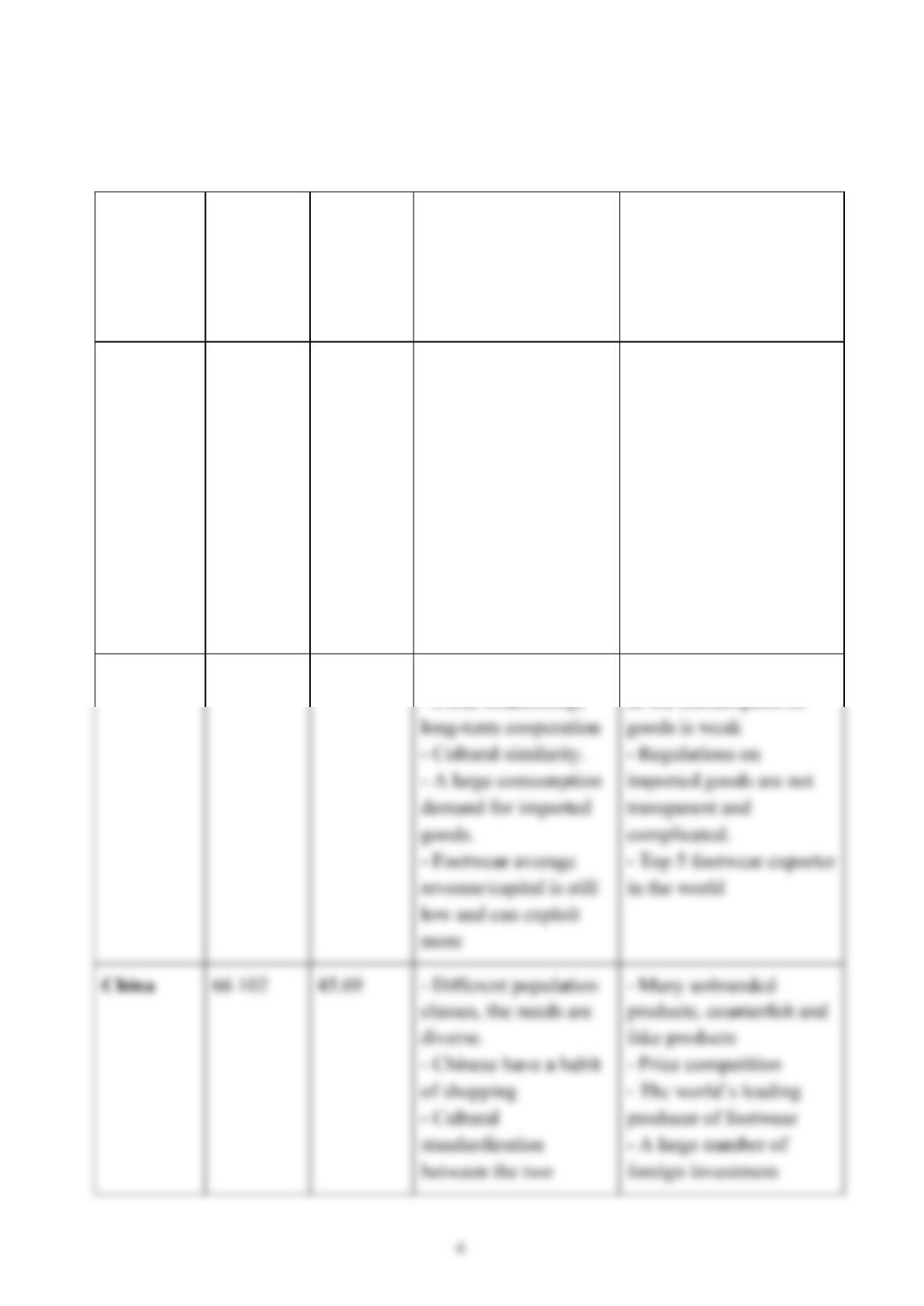
Country
Footwear
revenue
(2020)
(million$)
Footwear
average
revenue/
capital
(2020) ($)
Pros
Cons
Thailand
1 160
16.62
– The similarity in taste
and term of market
segments of consumers
– Vietnam’s largest
trading partner in
ASEAN
– Import tax incentives
– Footwear average
revenue/capital is still
low, and can exploit
more
– The market is very
competitive, there have
been many international
businesses entering
Thailand
– The low-priced segment
in Thailand is still full of
fake and poor quality
products.
Indonesia
3 916
14.48
– Import tax incentives
– The income is not high,
so the consumption of
goods is weak
– Regulations on
imported goods are not
transparent and
complicated.
– Top 5 footwear exporter
in the world