1
PRINCIPLES OF MARKETING
GROUP REPORT
2
Table of content
1. Abstract ………………………………………………………………………………………………………….. 6
2. Introduction …………………………..……………………………………………………………………….. 6
3. External Environment ………………………………………………………………………………………. 6
4. SWOT ……………………………………………………………………………………………………………. 7
5. STDP analysis ………………………………………………………………………………………………… 8
5.1. Segmentation ……………………………………………………………………………………………. 8
5.2. Targeting ………………………………………………………………………………………………….. 9
5.2.1. Analysis of customer insights …………………………………………………………………… 9
5.2.2. Reason this segment targeted by the company ……………………………………………. 9
5.2.3. Targeted Strategy ……………………………………………………………………………………. 9
5.3. Differentiation …………………………………………………………………………………………. 10
5.3.1. Competitive advantage ………………………………………………………………………….. 10
5.3.2. Marketing channels ……………………………………………………………………………….. 10
5.4. Positioning …………………………..…………………………………………………………………. 11
5.4.1. Positioning map ……………………………………………………………………………………. 11
5.4.2. Positioning statement …………………………………………………………………………….. 11
6. Marketing Mix ………………………………………………………………………………………………. 11
6.1. Product …………………………………………………………………………………………………… 11
6.2. Price ………………………………………………………………………………………………………. 12
6.3. Place ………………………………………………………………………………………………………. 12
6.4. Promotion……………………………………………………………………………………………….. 13
7. Conclusion ……………………………………………………………………………………………………. 13
8. Reference ……………………………………………………………………………………………………… 14
9. Appendix …………………………..…………………………………………………………………………. 16
Red Bull marketing analysis
3
1. Abstract
In recent years, the trend of energy drink consumption among young people has been developing for many
reasons, and Red Bull is the typical example of this new wave. This project’s primary aim is to get
complete information on Red Bull and what their goals are to gain customer loyalty and maintain their
market leadership. This is the premise to concentrate on STPD and SWOT analysis, providing 4Ps
marketing strategy to differentiate Red Bull from its rivals, especially in the Vietnam field.
2. Introduction
2.1 Company description
Red Bull is an Austrian company, which was created on April 1, 1987. by Dietrich Mateschitz.The first
time, it was called Krating Daeng because it was initially based on a Thai drink. Then, Mateschitz
collaborated to reformulate the drink to Western palettes. Today, Red Bull became a famous energy drink
worldwide. In 1987, it began launching a completely new product category in the international market.
From the first product sold until now, Red Bull has now been present in 167 countries and officially
entered Vietnam in 1999.
2.2 Product description
Red Bull Vietnam, headquartered in Di An, Binh Duong, operates an enterprise with 100% foreign-owned
capital, with the product sold at a reasonable price. Red Bull products are a significant beverage category
in Vietnam, and it has higher sales than mineral water and cola carbonate. These energy drink ingredients
meet health safety standards entirely and have passed strict censorship on the Vietnamese market. It has
been certified by the Department of Food Hygiene and Safety under the Ministry of Health(2012).
3. External environment
Microenvironment
Customer
Red Bull is one the most popular energy drinks in the Vietnam market because of its customer behavior.
According to the research, Red Bull’s targeted customers are mainly from the age of 18 to 35, and it is
very well known that the energy drink market is generally young people under and of the working class.
Competitors
Red Bull is a popular choice with many athletes because it has sponsored various football matches. In
Vietnam, the company’s most notable competitors are Coca-cola, Tan Hiep Phat, and Sting. Coca-cola,
The brand was born under the Coca-Cola company in 1886 in the USA. Coca-cola takes every customer as
a target, and its world’s segmentation is mainly based on “age, family size, and income.” The perfect
segmentation was the main factor for Coca-Cola’s success. Tan Hiep Phat, which was established in 1994,
Tan Hiep Phat Beverage Group (THP) is Vietnam’s largest FMCG (FMCG). THP mainly develops,
manufactures, and sells beverage products to 63 provinces in Vietnam and 16 countries worldwide.
Products include herbal teas, green tea, squash tea, exercise drinks, energy drinks, soy milk, and purified
water.
Red Bull marketing analysis
4
4. SWOT Analysis
Strengths
Weakness
⚫ Strong brand
– A powerful slogan, “Give You Wings,” and
unique, color-based branding
⚫ Effective supply chain
-The company has developed a highly
efficient supply chain that includes
dependable manufacturers and devoted
distributors.
⚫ Intensive market
-Red Bull’s marketing campaign is highly
aggressive, using social media and athletics
⚫ Lack of variety
–
Red Bull is almost entirely dependent on
sugar-rich energy drinks and sugar-free
energy drinks
⚫ Patent enforcement difficulty
–
As the company did not develop the
ingredients, Red Bull’s recipe is difficult to
protect.
–
Any business can produce a closely
similar product to Red Bull.
Opportunities
Threat
⚫ Product
–
develop new flavors and formats to
maintain market share.
⚫ Health option
–
Adding health-conscious options like
protein drinks, vitamin drinks, and electrolyte
drinks.
–
Reworking their existing products to use
fewer toxic ingredients and rebranding
themselves appropriately
⚫ Increase in Imitations
–
Consumers enjoy energy drinks that taste
and pack very much like Red Bull, thinking
they are legally consuming Red Bull.
⚫ Growing Health-Consciousness
-Red Bull comprises unhealthy ingredients,
such as caffeine, artificial flavor, color,
taurine, etc.,
⚫ High marketing cost
–
Because of the matured and developed
market today, promotion is more
complicated than ever.
Red Bull marketing analysis
5. STDP
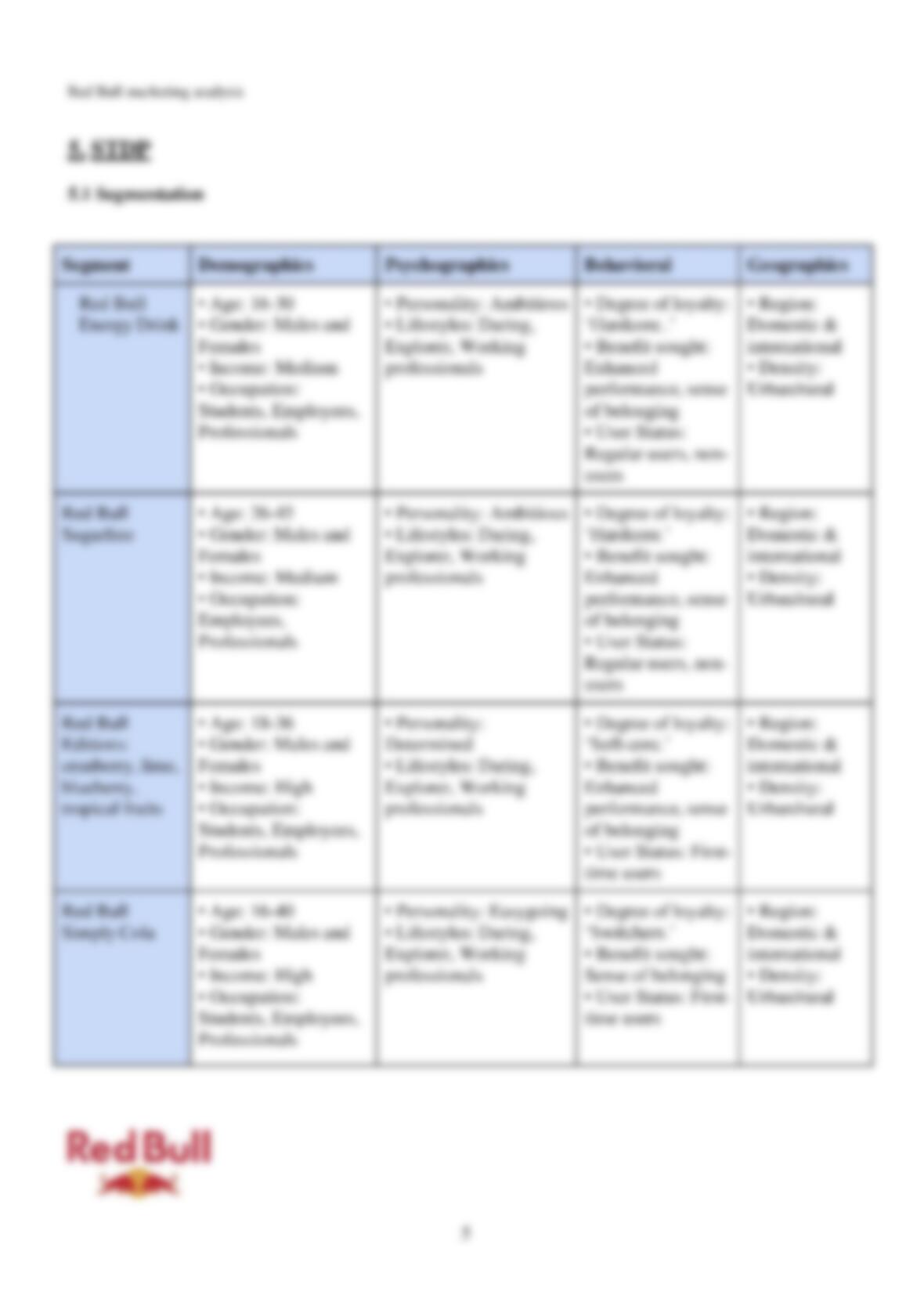
5.1 Segmentation
Segment
Demographics
Psychographics
Behavioral
Geographics
Red Bull
Energy Drink
• Age: 16-30
• Gender: Males and
Females
• Income: Medium
• Occupation:
Students, Employees,
Professionals
• Personality: Ambitious
• Lifestyles: Daring,
Explorer, Working
professionals
• Degree of loyalty:
‘Hardcore..’
• Benefit sought:
Enhanced
performance, sense
of belonging
• User Status:
Regular users, non-
users
• Region:
Domestic &
international
• Density:
Urban/rural
Red Bull
Sugarfree
• Age: 26-45
• Gender: Males and
Females
• Income: Medium
• Occupation:
Employees,
• Personality: Ambitious
• Lifestyles: Daring,
Explorer, Working
professionals
• Degree of loyalty:
‘Hardcore.’
• Benefit sought:
Enhanced
performance, sense
of belonging
• Region:
Domestic &
international
• Density:
Urban/rural
blueberry,
tropical fruits
• Income: High
Students, Employees,
Explorer, Working
professionals
Enhanced
performance, sense
of belonging
• Density:
Urban/rural