Differential Calculus and Coordinate Geometry Spring 2018-19
P a g e 1 | 22
Chapter 1
Coordinate Geometry of Two Dimensions
1.1 Introduction
Analytic- geometry was introduced by Rene Descartes (1596 – 1650) in his La Geometric
published in 1637. Accordingly, after the name of its founder, analytic or co-ordinate geometry
is often referred to as Cartesian geometry. It is essentially a method of studying geometry by
mean of algebra. Its main purpose was to show how a systematic use of coordinates (real
numbers) could vastly simplify geometric arguments. In it he gave a simple technique of great
flexibility for the solution of a variety of problems.
1.2 Coordinate system
1.2.1 Rectangular Coordinate System
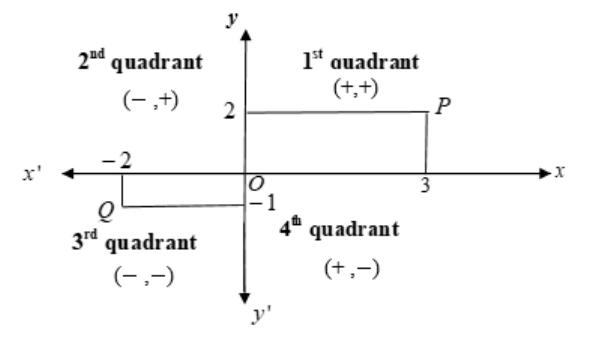
Consider a plane with two lines intersecting each other at right angles at O as shown in
following figure. The horizontal line is called the x-axis and the vertical line the y-axis. The
point of intersection of the axes is the origin. Two axes divide the plane into four quarters. Each
quarter is called a quadrant. The quadrants are numbered from 1 to 4 as shown, in an anti-
clockwise direction.
Measurements of distances on the axes are taken from O. On the x-axis measurements to the
right of O are positive whilst those to the left are negative. On the y-axis measurements above
O are positive, and those below O negative. The position or coordinates of a point is defined
by the ordered pair x–coordinate and it’s y-coordinate. The coordinates of P defined by the
ordered pair
)2,3(
and Q by the ordered pair
)1,2( −−
.
1.2.2 Distance between two points
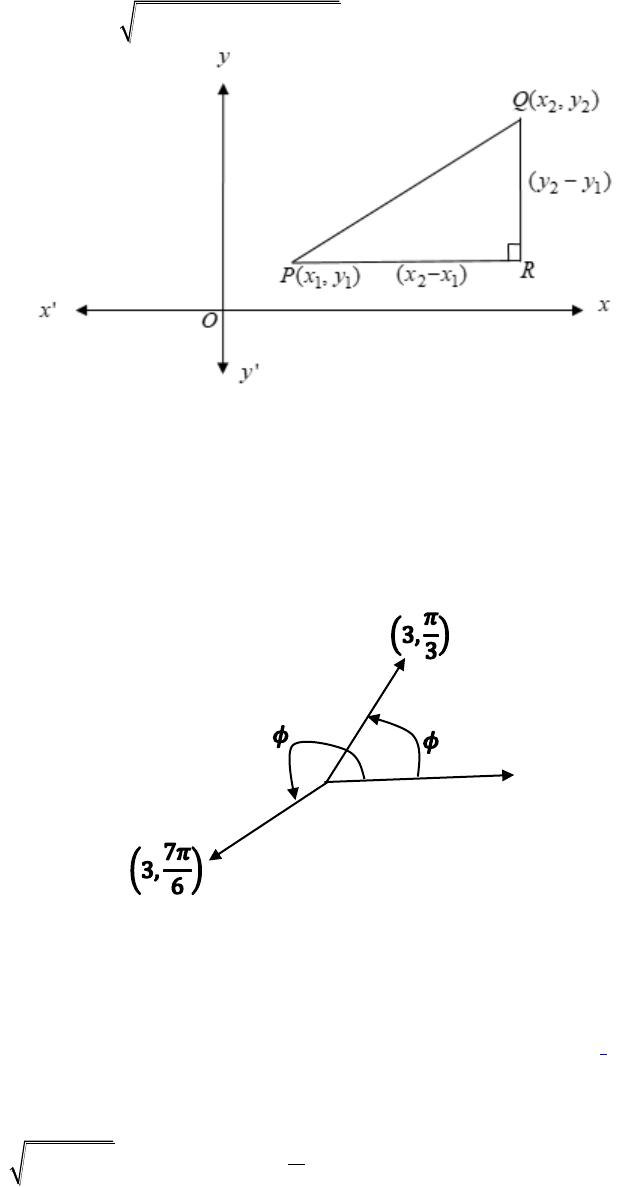
In the right-angled triangle PQR (Fig 1.2.2),
222 RQPRPQ +=
(Pythagoras’ theorem).
Hence
( ) ( )
22
22 1 2 1
PQ x x y y= − + −
.
Thus the distance between any two points
),( 11 yx
and
),( 22 yx
is given by
Differential Calculus and Coordinate Geometry Spring 2018-19
P a g e 2 | 22
( ) ( )
22
2 1 2 1
Distance x x y y= − + −
.
1.2.3 Polar Coordinate System
In mathematics, the polar coordinate system is a two-dimensional coordinate system in which
each point on a plane is determined by a distance from a reference point and an angle from a
reference direction. The reference point (analogous to the origin of a Cartesian system) is called
the pole, and the ray from the pole in the reference direction is the polar axis. The distance
from the pole is called the radial coordinate or radius, and the angle is the angular coordinate,
polar angle, or azimuth.
1.2.4 Relation between polar and Cartesian coordinate system
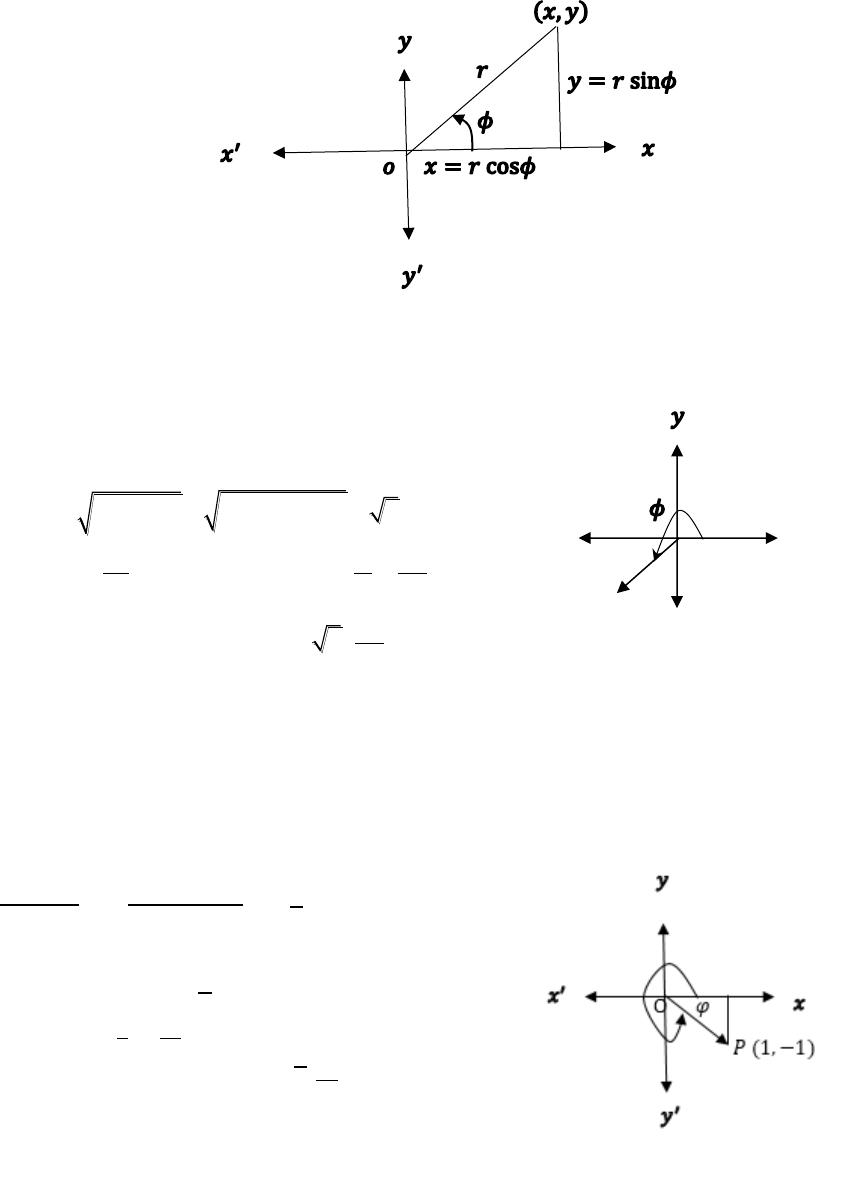
The polar coordinates r and ϕ can be converted to the Cartesian coordinates x and y by using
the trigonometric functions sine and cosine:
cos and sinx r y r
==
The Cartesian coordinates x and y can be converted to polar coordinates r and ϕ using the
relations
( )
22
and arctan y
r x y x
= + =
.
Differential Calculus and Coordinate Geometry Spring 2018-19
P a g e 3 | 22
Example 1: Find the polar coordinate of (-1, -1).
Solution:
( )
( ) ( )
22
22 1 1 2r x y= + = − + − =
( )
15
and arc tan arctan 1
1 4 4
−
= = + = + =
−
So, the polar coordinate of (-1, -1) is
5
2, 4
.
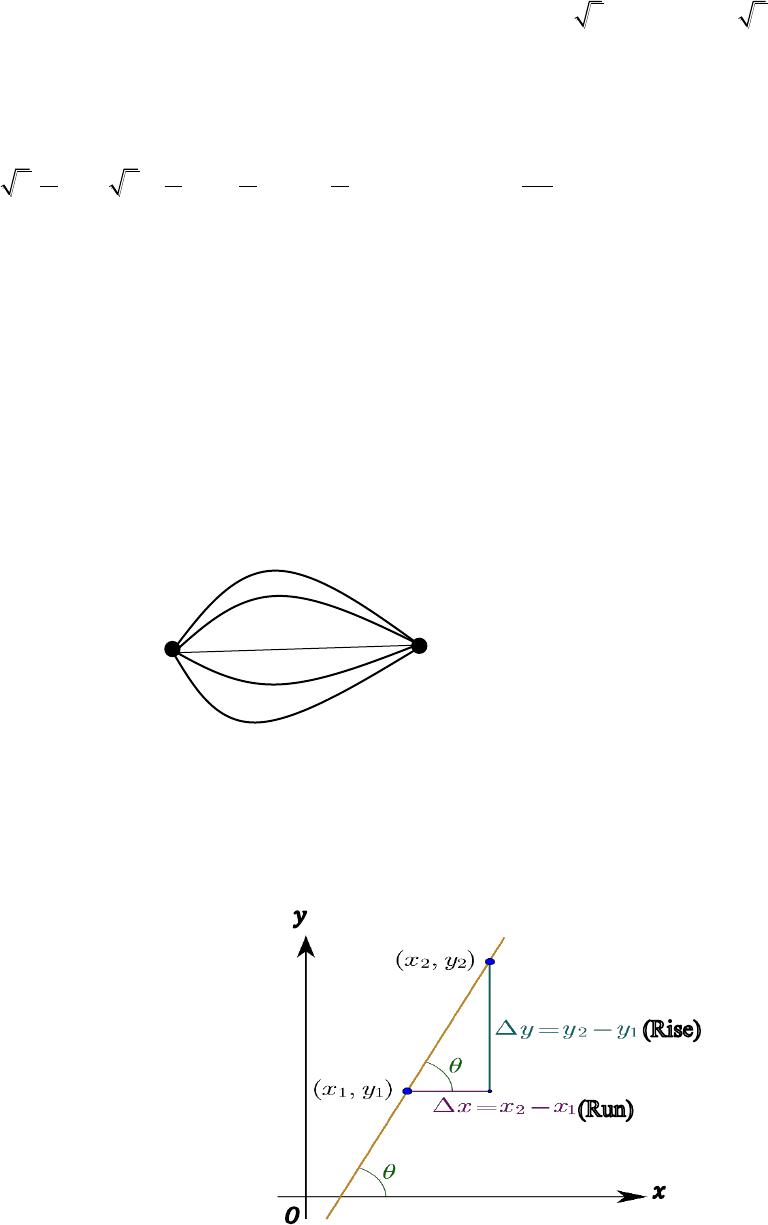
Example 2: Find the Polar coordinate of (1,−1).
Solution:
𝑟=√𝑥2+𝑦2=√12+(−1)2=√2
∠𝑥𝑜𝑝=2𝜋−𝜑
⟹∠𝑥𝑜𝑝=2𝜋−arctan(1
1)
⟹∠𝑥𝑜𝑝=2𝜋−𝜋
4=7𝜋
4.
So, polar coordinate of (1,−1) is (√2,7𝜋
4).
x
O
)1,1( −−
‘x
‘y
Differential Calculus and Coordinate Geometry Spring 2018-19
P a g e 4 | 22
Exercise set 1.1
1. Find the corresponding polar co-ordinates of the following points. Also locate them in
( )
,r
plane.
(1,1),(1,−1),
( ) ( ) ( ) ( ) ( ) ( )
( ) ( )
2,0 , 0,3 , 0, 3 , 1,0 , 2,2 , 1,1 , 3, 1 and 3, 3 3− − − − − −
.
2. Find the rectangular coordinates of the following points whose polar coordinates are
given bellow. Also locate them in
( )
,xy
plane.
( )
7
2, , 3 2, , 2, , 1, , 3, and 2,
4 4 2 2 6
− − −
.
1.3 Straight Line
The shortest distance between two points is a straight line.
1.3.1 Inclination of slope of a straight line:
Differential Calculus and Coordinate Geometry Spring 2018-19
P a g e 5 | 22
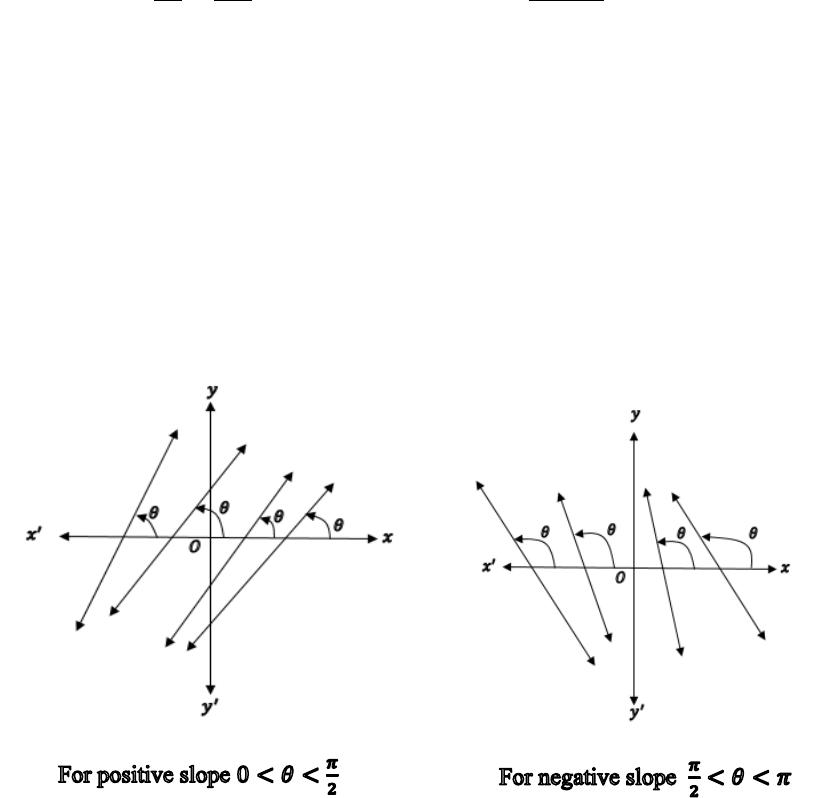
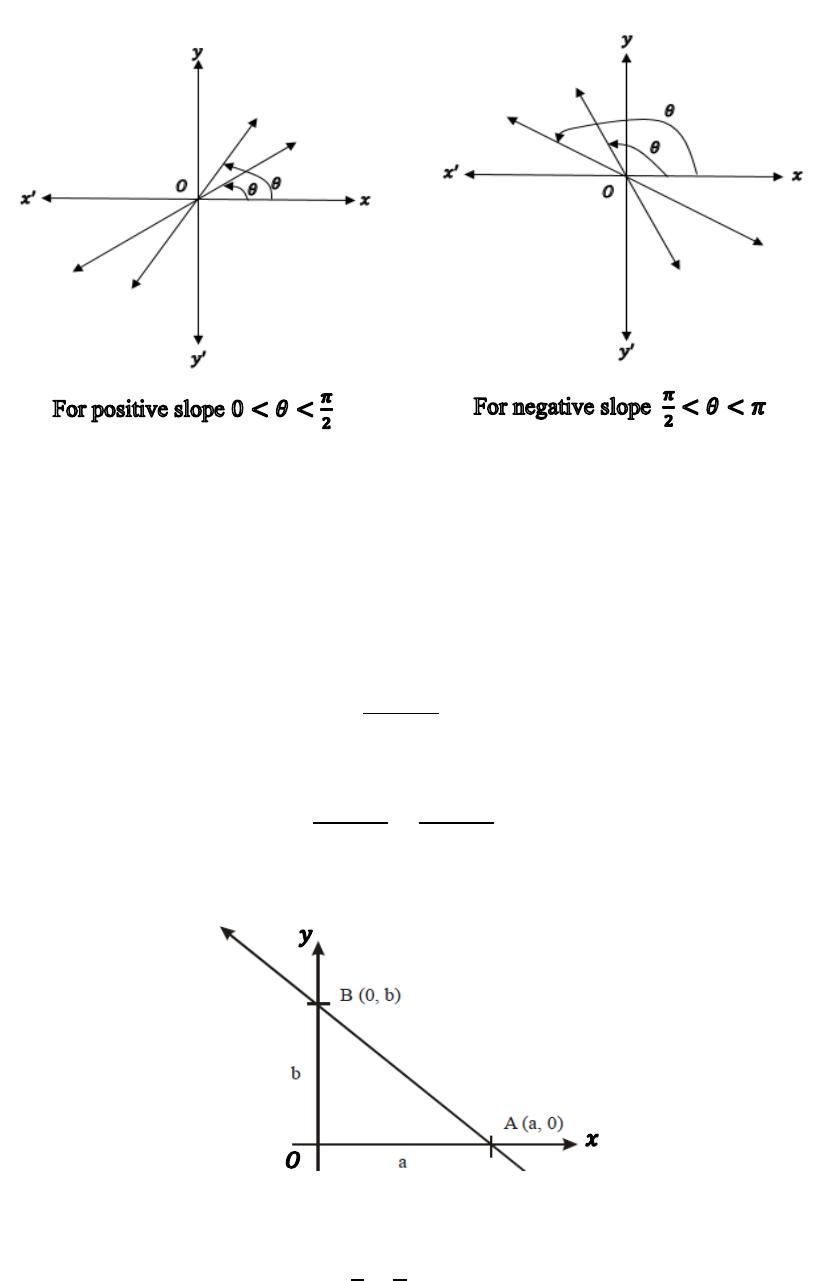
The angle θ (0 < θ < π), measured counter clockwise from the positive 𝑥 – axis to the line
is called the inclination of the line or the angle of inclination of the line.
The tangent of this angle i.e. tanθ, is called the slope or gradient of the line. It is generally
denoted by m. Thus m =tanθ, 0<θ<π. The slope of the line is positive or negative according
as the angle of inclination is acute or obtuse.
Alternative Definition:
The ratio of vertical and horizontal distances between any two points on a line is called the
slope of a straight line.
Δ𝑦
Δ𝑥=rise
run (Read as rise over run)=𝑦2−𝑦1
𝑥2−𝑥1
1.3.2 Different forms of straight line:
A. Slope Intercept form: 𝑦=𝑚𝑥+𝑐;
Where 𝑚=tan𝜃 (slope) and 𝑐 is the 𝑦−intercept.
Graph of 𝑦=𝑚𝑥+𝑐 is given below:
If 𝑐=0 and 𝑚≠0 the line passes through origin and its equation is 𝑦=𝑚𝑥. The
graph of this equation is:
Differential Calculus and Coordinate Geometry Spring 2018-19
P a g e 6 | 22
B. Point-slope form:
Suppose a line passing through a point (𝑥1,𝑦1) and its slope is 𝑚, then the equation of
the line is 𝑦−𝑦1=𝑚 (𝑥−𝑥1)
C. Two point form:
Suppose a line passing through two points (𝑥1,𝑦1) and (𝑥2,𝑦2), then slope of the line
is 𝑦2−𝑦1
𝑥2−𝑥1.
Now, using point- slope form of linear equation, two point form of straight line stands
for 𝑥−𝑥1
𝑥1−𝑥2=𝑦−𝑦1
𝑦1−𝑦2
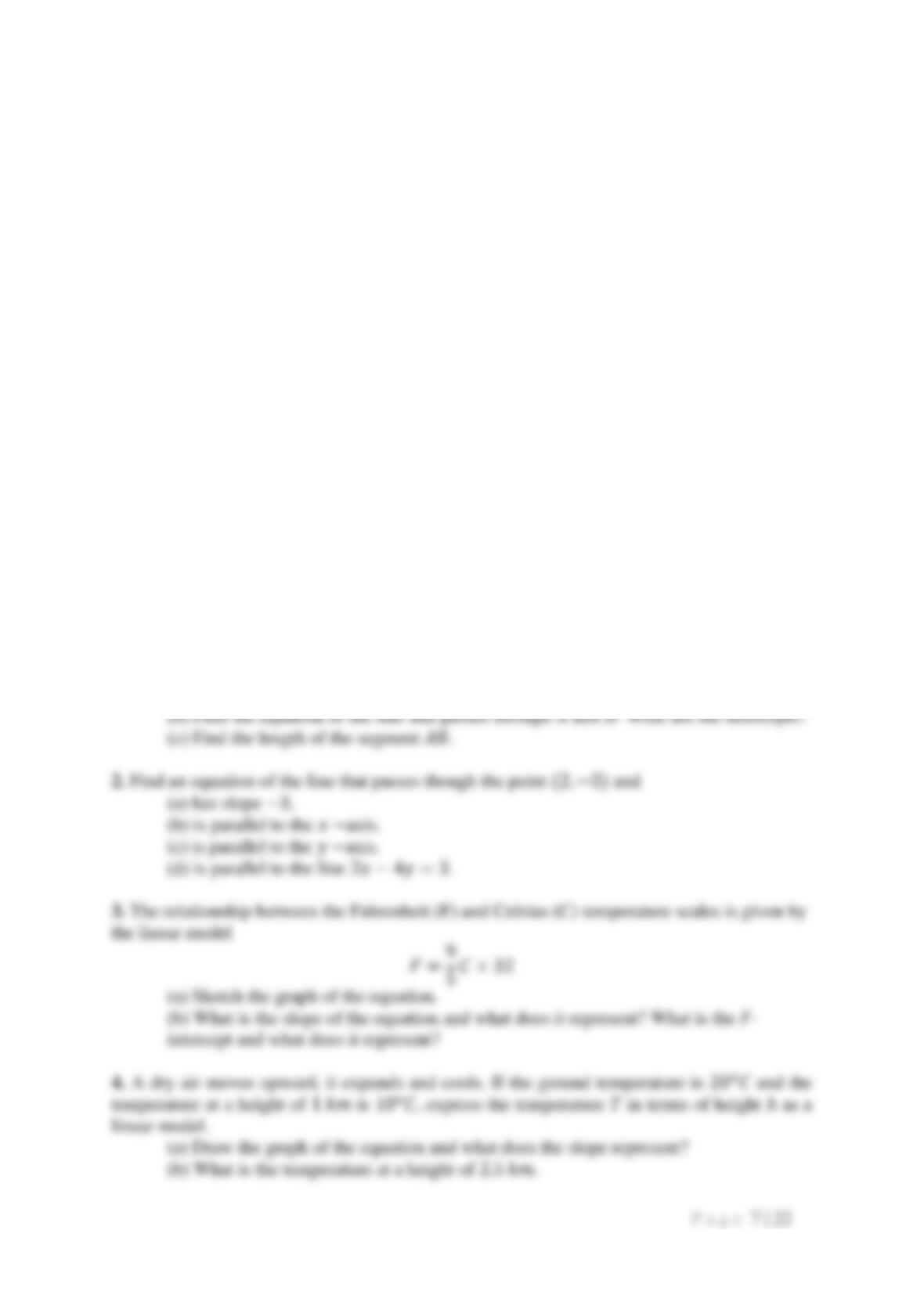
D. Intercept form:
Suppose 𝑎 and 𝑏 are 𝑥 and 𝑦−intercept of a straight line of point 𝐴(𝑎,0) and 𝐵(0,𝑏),
then the linear equation will be 𝑥
𝑎+𝑦
𝑏=1.
Differential Calculus and Coordinate Geometry Spring 2018-19
1.3.3 Straight line parallel to an axis:
The equation of the line parallel to 𝑥-axis is
𝑦=𝑏
• If 𝑏>0, then the line lies above the 𝑥-axis
• If 𝑏<0, then the line lies below the 𝑥-axis
• If 𝑏=0, then the line is the 𝑥-axis itself.
The equation of the line parallel to 𝑦-axis is
𝑥=𝑐
• If 𝑐>0, then the line lies to the right of 𝑦-axis.
• If 𝑐<0, then the line lies to the left of 𝑦-axis.
• If 𝑐=0, then the line is the 𝑦-axis itself.
1.3.4 Condition to be two straight lines are parallel and perpendicular:
𝑦1=𝑚1𝑥+𝑐1
𝑦2=𝑚2𝑥+𝑐2
• Given two lines are parallel when 𝑚1=𝑚2.
• If 𝑚1.𝑚2=−1 then two lines will be perpendicular.
Exercise set 1.2
1. Let 𝐴(−7,4) and 𝐵(5,−12) be points in the plane.